
Digital PR metrics are the measures you use to judge whether earned media coverage did its job: the outputs a campaign produced (placements, links, reach), what audiences did with them (visits, branded searches), and the business outcomes they contributed to (enquiries, sales, visibility in search and AI answers). Link counts are one output, not the whole result.
Key takeaways
- In Muck Rack’s 2025 survey of 832 PR professionals, 86% count stories placed and 79% track reach, but only 42% measure website impact and 17% revenue impact.
- 61% of PR pros follow no formal measurement framework; only 7% use the Barcelona Principles and 4% AMEC’s Integrated Evaluation Framework (Muck Rack, 2025).
- Barcelona Principles 4.0 (June 2025) says invalid measures such as advertising value equivalents (AVEs) “should not be used”.
- In BuzzStream’s 2026 survey, 85.1% of digital PR pros measure success by the number of quality links, while tracking of organic traffic and ranking gains fell from 78% to 63.5%.
- Google’s Search Console Links report shows only a sample of links, caps tables at 1,000 rows and doesn’t say whether a link is nofollow, so it can’t be your only link tracker.
Why do link counts alone undersell digital PR?
Digital PR is usually bought for links, so links are usually what gets reported. That makes sense as a starting point. A placement on a relevant, well-read site is a real asset, and the number of quality links is still the most common success measure among digital PR specialists: 85.1% of respondents in BuzzStream’s State of Digital PR 2026 use it, ahead of total mentions (72.3%) and total links (70.9%).
The problem is what a link count leaves out. It doesn’t tell you whether anyone read the coverage, whether it reached the audience you care about, whether more people searched for your brand afterwards, or whether any of it turned into enquiries. It also invites the wrong behaviour. Google’s spam policies define link spam as creating links “primarily for the purpose of manipulating search rankings” and list “links with optimized anchor text in articles, guest posts, or press releases distributed on other sites” as an example. A target that rewards raw link volume pushes teams towards exactly that.
The wider PR industry has the opposite habit. It counts coverage and reach, then struggles to connect them to business results. Neither approach on its own tells a client or a finance director what the campaign was worth. (If you’re still deciding between the two disciplines, our guide to link building vs digital PR explains how they differ.)
What do PR teams actually measure today?
The best current data comes from Muck Rack’s State of PR Measurement 2025, which surveyed 912 PR professionals from September 1 to 29, 2025 (832 responses after quality checks). Muck Rack sells media monitoring software, so treat it as a large vendor survey rather than a neutral census. Its headline is that measurement is near-universal but shallow: 81% say they measure their PR work, and the average respondent tracks about five metrics.
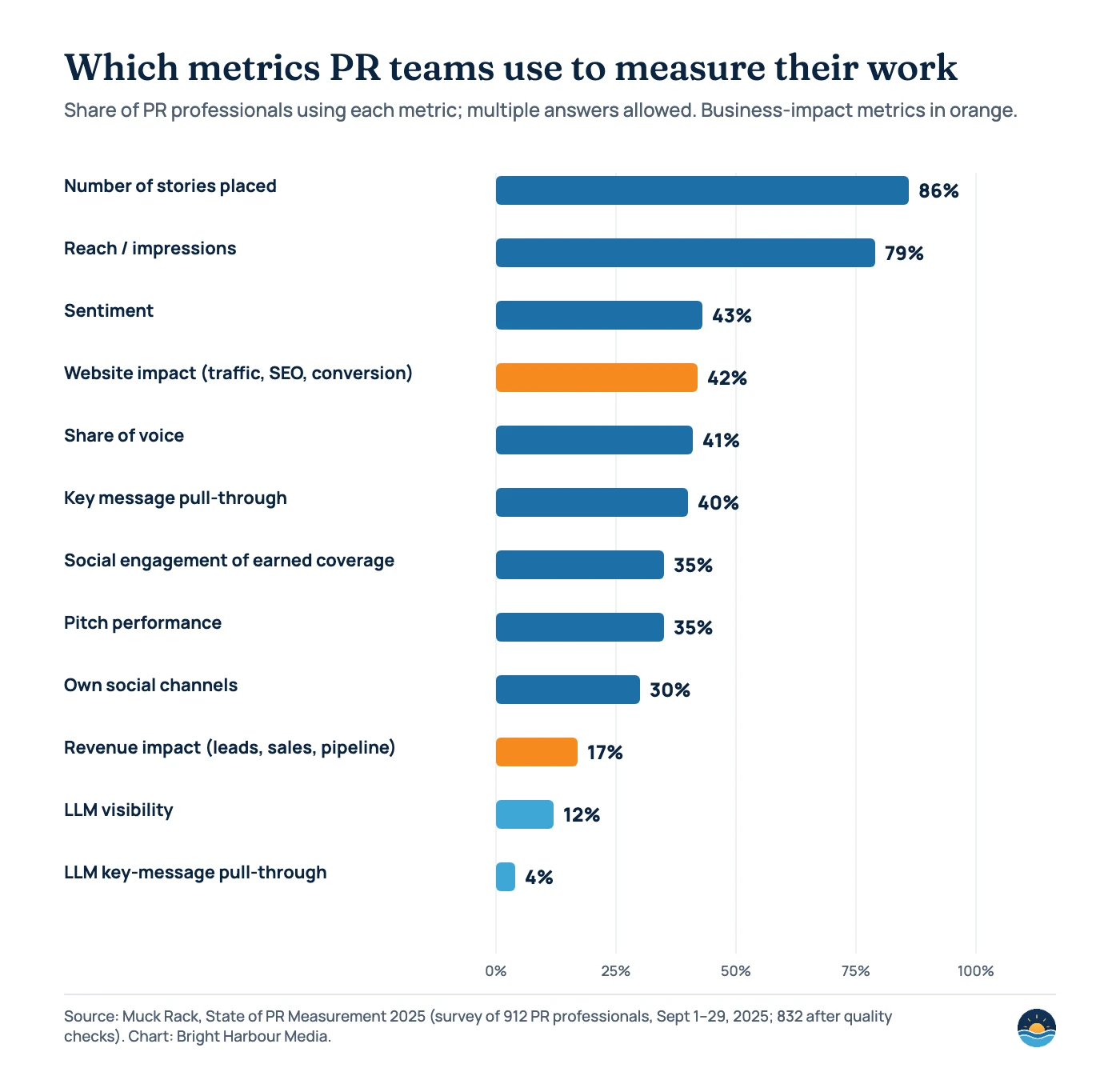
Two numbers stand out for anyone running digital PR for SEO. Only 42% measure website impact (traffic, SEO or conversions), and only 17% measure revenue impact. Muck Rack’s chart puts LLM visibility at 12%, although its own commentary says 16%, so the honest reading is “somewhere in the low to mid teens”. The same survey found that 75% say their measurement is at least somewhat tied to business goals, but only 20% say it is very closely tied.
Frameworks are rare too. 61% of respondents follow no industry framework, 29% use a proprietary or internal one, 7% use the Barcelona Principles and 4% use AMEC’s Integrated Evaluation Framework. In the link building world the picture is similar: in Citation Labs’ 2025 survey of 300+ SEOs, run with BuzzStream, “only 40%” said their link building reports effectively show value.
| Survey | Who and when | Key measurement finding |
|---|---|---|
| Muck Rack, State of PR Measurement 2025 | 912 PR pros, Sept 1–29, 2025 (832 analysed) | 86% count stories placed; 42% measure website impact; 17% revenue impact; 61% use no framework |
| Muck Rack, State of PR 2026 | 1,115 PR pros, May 14–June 12, 2026 (971 usable) | 69% say producing measurable results is the best way to raise PR’s perceived value; 39% don’t yet measure GEO |
| BuzzStream, State of Digital PR 2026 | “150+” digital PR pros; no fieldwork dates given (page updated Feb 19, 2026) | 85.1% measure quality links; 72.3% mentions; 70.9% total links; traffic/rankings gains 63.5% (78% in 2025); AI citations 55.4% |
| Citation Labs 2025 Link Building Survey | 300+ SEOs (published Jan 28, 2025) | Only 40% say their reports effectively show value; 29% call their link building successful |
What do the Barcelona Principles say about PR measurement?
The Barcelona Principles are the PR industry’s closest thing to a measurement standard. They are published by AMEC, the International Association for the Measurement and Evaluation of Communication, and were first agreed in 2010. Version 3.0 arrived in July 2020; Barcelona Principles 4.0 was published in June 2025 and is now the current version. Three of its seven principles matter most for digital PR:
- Objectives first. Principle 1: “Setting clear, measurable objectives is a critical prerequisite for effective communication planning, measurement and evaluation.” Version 4.0 asks for SMARTER objectives rather than SMART ones.
- No AVEs. Principle 5: “Invalid measures such as advertising value equivalents (AVEs) should not be used.” The 4.0 document lists EMV (earned media value) and similar “equivalency” figures as variations of the same flawed metric.
- Outputs, outcomes and impact. Principle 6: measurement and evaluation “should report outputs, outcomes, and impact related to the organization and stakeholder audiences.”
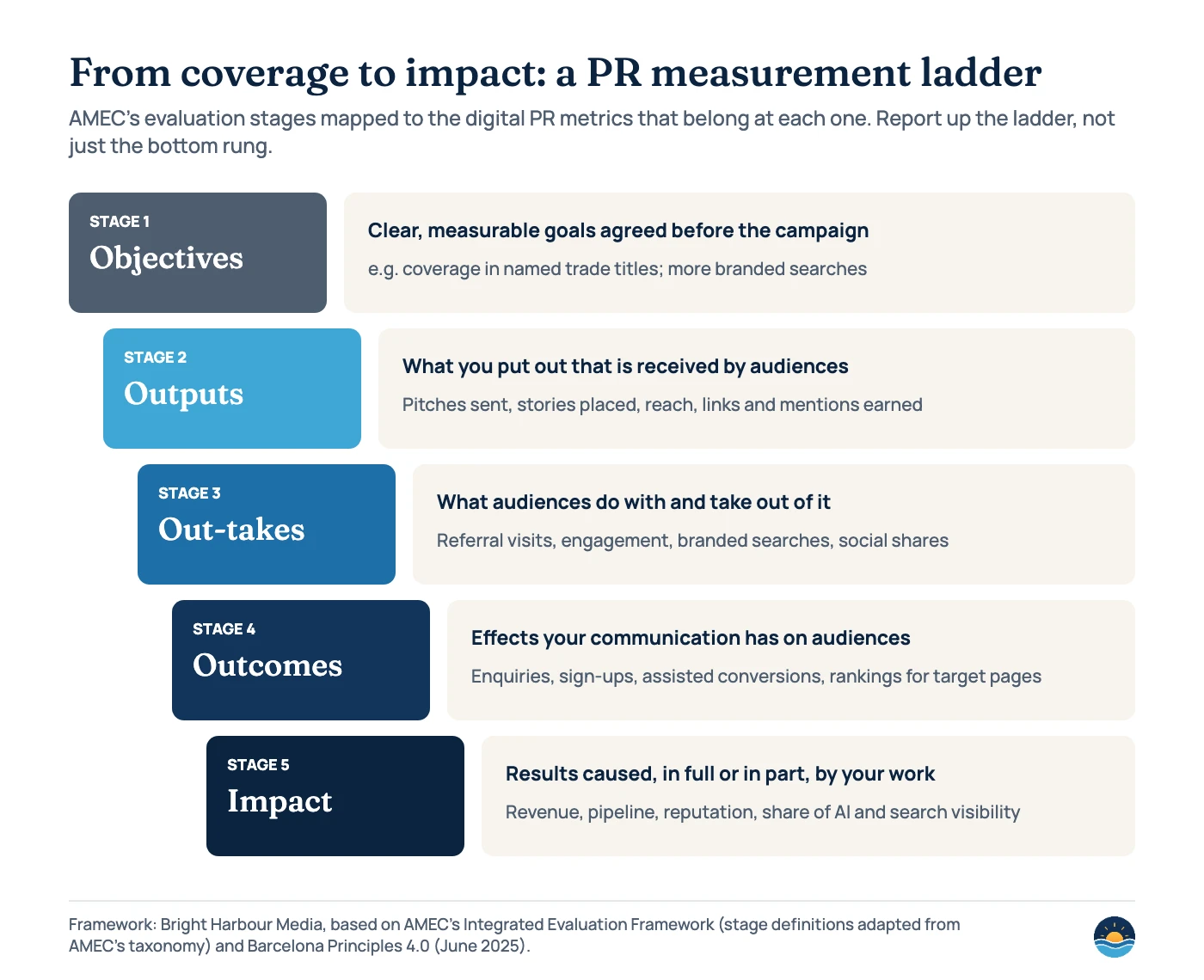
AMEC’s Integrated Evaluation Framework turns that into a sequence: objectives, inputs, activities, outputs, out-takes, outcomes and impact. AMEC’s taxonomy defines outputs as “what you put out that is received by target audiences”, out-takes as “what audiences do with and take out of your communication”, outcomes as the “effects that your communication has on audiences”, and impact as “the results that are caused, in full or in part, by your communication”. Its guidance is that evaluation should report outcomes at a minimum and, where possible, impact.
A measurement ladder for digital PR
Most digital PR reports stop at outputs. The ladder below maps AMEC’s stages to metrics an SEO-led digital PR campaign can realistically collect. The aim isn’t to measure everything; it’s to make sure every report has at least one number above the outputs rung.
| Stage | Digital PR metric | Where the data comes from | Watch out for |
|---|---|---|---|
| Outputs | Placements, linking domains, brand mentions, estimated reach | Coverage tracking sheet, backlink tool, Search Console Links report, media monitoring | Search Console shows a sample, up to 1,000 rows per table, and doesn’t flag nofollow links |
| Outputs (quality) | Relevance of each site and page to your audience; editorial vs syndicated copy; link attribute | Manual review of each placement | Third-party authority scores are estimates from tool vendors, not Google metrics |
| Out-takes | Referral sessions from coverage; engagement on landing pages | GA4 Traffic acquisition report (Session source / medium) | Many readers search for the brand instead of clicking, so referrals understate reach |
| Out-takes | Branded search demand | Search Console branded queries filter; Google Trends | Trends is a sample scaled 0–100, not search volume; seasonality can swamp a campaign |
| Outcomes | Key events (enquiries, sign-ups) from PR referrals; rankings and organic clicks for the pages you built links to | GA4 key events; Search Console Performance report by page | Ranking changes have many causes; compare against pages that got no links |
| Impact | Pipeline or revenue influenced; share of voice in search and AI answers | CRM, sales notes, AI visibility tracking | Attribution is partial; report contribution, not sole credit |
How to measure each rung with free Google tools
Outputs: links and coverage
Keep your own coverage log. It is the only complete record you will have. Search Console’s Links report helps, but Google says it “isn’t a comprehensive list of every link on your site” and “shows a sample of internal and external links”. Tables are limited to 1,000 rows, links “may have since been removed”, and the report “doesn’t specify if a link is marked as nofollow”. Check each placement yourself and record the URL, publication, date, whether the link is followed, and the anchor text.
Treat link attributes as a quality signal, not a pass/fail test. Google’s spam policies say paid links are fine “as long as they are qualified with a rel=”nofollow” or rel=”sponsored”” attribute, and since 2019 Google has treated sponsored, ugc and nofollow as “hints about which links to consider or exclude within Search”. A nofollowed mention in a national newspaper can still send readers and searches your way. Our guide to nofollow, sponsored and UGC links covers this in more detail.
Out-takes: referrals and brand searches
In GA4, open Reports › Acquisition › Traffic acquisition and use the Session source / medium dimension to see visits from each publication. GA4 defines the Referral channel as visits “via non-ad links on other sites/apps (e.g., blogs, news sites)”. If you share links in syndication feeds or newsletters you control, tag them with UTM parameters; Google recommends always using utm_source, utm_medium and utm_campaign.
Many readers never click. They search for your brand later. Search Console’s branded queries filter, which Google introduced on November 20, 2025, splits Performance data into branded and non-branded queries using “an internal, AI-assisted system”. It is available only for top-level properties with enough query volume, and Google notes it “has no effect on how Google Search ranking works”. For a wider view, Google Trends shows relative interest in your brand name, scaled from 0 to 100 against all searches in that place and period.
Outcomes: rankings, organic clicks and enquiries
For the SEO side, track the specific pages that earned links, not the whole site. Compare their organic clicks and average position over 8–12 weeks with a set of similar pages that received no new links. For business outcomes, set up GA4 key events for enquiries or sign-ups and look at them by session source. Our article on measuring SEO ROI with GA4 and Search Console walks through the attribution settings and their limits.
Impact: revenue and visibility in AI answers
Revenue is where PR measurement is weakest, and that’s partly unavoidable: coverage influences buyers who later arrive through other channels. Ask sales to log “where did you hear about us?” and keep a simple influenced-pipeline list. AI visibility is the newest layer. In Muck Rack’s State of PR 2026, 39% of PR pros said they don’t yet measure generative engine optimisation at all; among the methods used, 25% monitor brand mentions in AI responses and 21% track search visibility or rankings. Off-site mentions matter here. In Ahrefs’ May 2025 study of 75,000 brands, branded web mentions had the strongest correlation with appearing in AI Overviews (0.664), ahead of branded anchors (0.527) and referring domains (0.295). It is a correlation, not proof of cause. See brand mentions vs backlinks for more.
Which metrics to report, and which to retire
Report these
- Placements on relevant sites, with followed/nofollow noted
- Referral sessions and key events from coverage
- Branded search trend before and after
- Organic clicks and rankings for linked pages vs a control set
- Mentions in AI answers for your priority topics
Retire or caveat these
- Advertising value equivalents (AVE) or “earned media value”
- Total links with no relevance filter
- Combined “potential reach” of every outlet
- Third-party authority scores presented as Google metrics
- Anchor-text targets for exact-match keywords
A seven-step digital PR measurement process
- Agree objectives before pitching. Write down two or three measurable goals, such as coverage in named trade titles, branded search growth or enquiries from referral traffic, and a review date.
- Record a baseline. Export 3 months of branded and non-branded Search Console data, referral traffic and key events, plus a Google Trends line for your brand.
- Choose target pages. Decide which pages the campaign should strengthen and pick a comparable control group that won’t be promoted.
- Log every placement. URL, outlet, date, followed or not, anchor text, syndicated copies. Don’t rely on the Links report alone.
- Measure out-takes at 2 and 6 weeks. Referral sessions by source/medium, engagement on the landing page and branded query clicks.
- Measure outcomes at 8–12 weeks. Organic clicks and positions for target pages vs control pages; key events and enquiries.
- Report up the ladder. One page: objectives, outputs, out-takes, outcomes and what you’ll change next time. No AVEs.
If you are planning the campaign itself, our guides to original research for digital PR and pitching journalists cover the earning side.
Frequently asked questions
What is the most important digital PR metric?
There isn’t one. The number of quality links on relevant sites is the most common measure (85.1% of digital PR pros in BuzzStream’s 2026 survey), but a useful report pairs it with at least one out-take or outcome, such as referral visits, branded search growth or enquiries.
Should I report advertising value equivalents (AVEs)?
No. Barcelona Principles 4.0 (June 2025) says invalid measures such as AVEs “should not be used” and that communication should be evaluated by its outcomes and impact. Variants such as earned media value are covered by the same advice.
Do nofollow links from news sites count?
They count as coverage and can send readers and branded searches. Google has treated nofollow, sponsored and ugc as hints since 2019, so how much ranking value they pass isn’t published. Record them separately from followed links rather than ignoring them.
How long should I wait before judging a digital PR campaign?
Track referrals and branded searches in the first few weeks, and give ranking and organic-traffic effects around 8–12 weeks before drawing conclusions. In BuzzStream’s 2026 survey, 85.2% of respondents said measurable results arrive within six months.
Sources
- State of PR Measurement 2025 — Muck Rack, survey Sept 1–29, 2025 — metrics used, frameworks, link to business goals
- State of PR 2026 — Muck Rack, survey May 14–June 12, 2026 — measurable results, GEO measurement
- Barcelona Principles 4.0 — AMEC, June 2025 — the seven principles and AVE guidance
- Barcelona Principles 3.0 — AMEC, July 2020 — previous version
- Integrated Evaluation Framework — AMEC (no date shown) — evaluation stages and taxonomy definitions
- State of Digital PR 2026 — BuzzStream, last updated Feb 19, 2026 — success metrics and time to results
- 2025 Link Building Survey Results — Citation Labs, Jan 28, 2025 — reporting value
- Spam policies for Google web search — Google Search Central, last updated Aug 28, 2026 — link spam definition and examples
- Evolving “nofollow” – new ways to identify the nature of links — Google Search Central Blog, Sept 10, 2019 — link attributes as hints
- Links report — Search Console Help (no date shown) — sampling, row limits, nofollow
- Introducing the branded queries filter in Search Console — Google Search Central Blog, Nov 20, 2025
- [GA4] Default channel group — Analytics Help (no date shown) — Referral channel definition
- [GA4] Traffic acquisition report — Analytics Help (no date shown) — Session source / medium
- [GA4] URL builders: Collect campaign data with custom URLs — Analytics Help (no date shown) — UTM parameters
- FAQ about Google Trends data — Google Trends Help (no date shown) — 0–100 scaling
- An Analysis of AI Overview Brand Visibility Factors (75K Brands Studied) — Ahrefs, May 26, 2025 — correlation figures
Cite this article: Bright Harbour Media. “Digital PR Metrics: How to Measure Results Beyond Links.” Bright Harbour Media Insights, November 2026. https://brightharbourmedia.com/digital-pr-metrics/
You are welcome to reference the charts and frameworks in this article with a link back to this page.
Want digital PR that you can actually measure? Our link building and digital PR service sets objectives, baselines and reporting up front. Get in touch to talk about your next campaign.