
Link building is the practice of earning links from other websites to yours through targeted outreach, useful resources and relationships. Digital PR earns links and brand mentions by giving journalists and publishers newsworthy stories, data or expert commentary. Both build authority; they differ in targets, timelines and the kind of coverage they produce.
Key takeaways
- Links remain a strong signal of authority, but only when they are editorially earned and relevant.
- Google’s spam policies treat buying or selling links that pass ranking credit, excessive link exchanges, automated link building and low-quality directory links as link spam.
- Paid or sponsored placements are acceptable when qualified with
rel="sponsored"orrel="nofollow". - Editorial outreach is better for targeted, topically relevant links to specific pages; digital PR is better for high-authority coverage and brand awareness.
- The strongest programs blend both and judge every link on relevance, editorial placement and real audience.
Link building vs. digital PR at a glance
| Editorial link building | Digital PR | |
|---|---|---|
| Primary goal | Relevant links to specific pages you want to rank | Coverage, brand awareness and authoritative links |
| Typical targets | Niche publications, industry blogs, resource pages | News sites, journalists, national and trade media |
| Main assets | Guides, tools, expert articles, existing content | Original data, studies, expert commentary, stories |
| Link placement | Usually contextual, inside relevant content | Often in news articles; sometimes brand mentions without links |
| Timeline | Steady, predictable cadence | Campaign-based; results can arrive in bursts |
| Best for | Building topical authority around commercial pages | Earning top-tier links and brand visibility |
| Main risk | Drifting toward low-quality or paid placements | Coverage that is irrelevant or unlinked |
What Google considers link spam
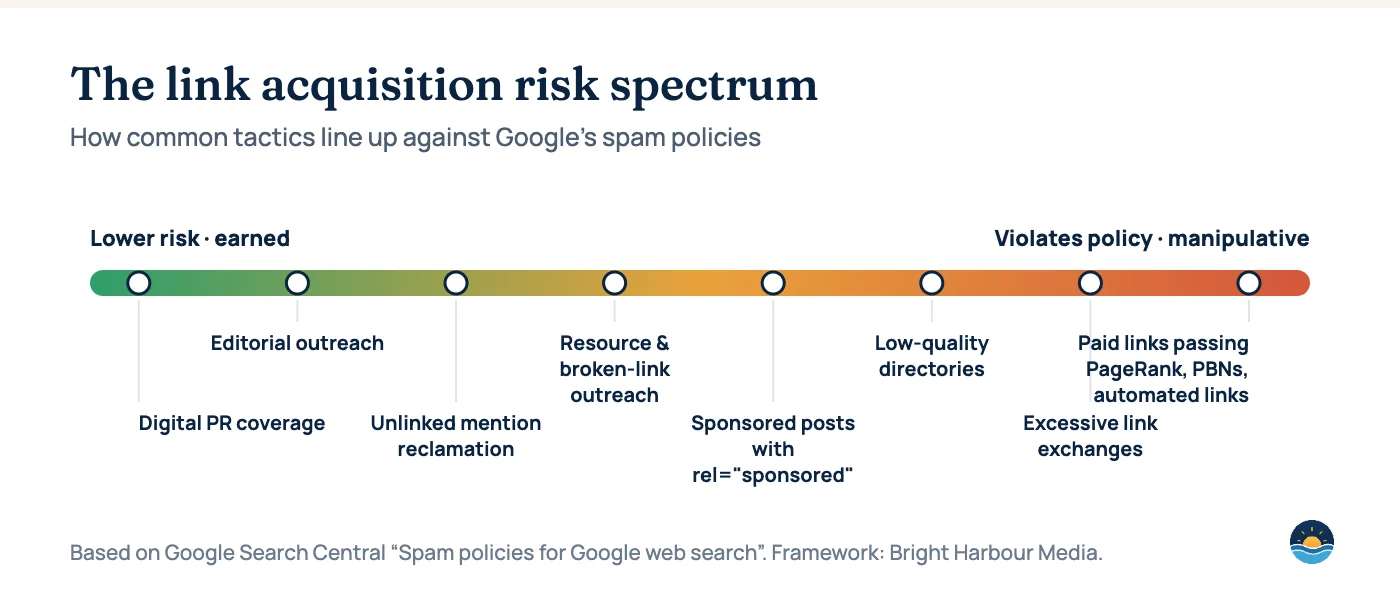
Google’s spam policies are the clearest guide to where the line sits. They describe link spam as links intended to manipulate rankings, and list examples including:
- Buying or selling links for ranking purposes, including exchanging money, goods or services for links, or for posts that contain links.
- Excessive link exchanges, or partner pages created purely for cross-linking.
- Using automated programs or services to create links.
- Requiring a link as part of a terms of service or contract without allowing the owner to qualify the outbound link.
- Advertorials or native advertising where payment is received for articles that include links passing ranking credit.
- Low-quality directory or bookmark site links, keyword-rich links hidden in widgets, and optimized links in forum comments or signatures.
Importantly, Google does not prohibit paid placements outright. Its policies state that it is not a violation to have paid links as long as they are qualified with a rel="nofollow" or rel="sponsored" attribute.
The link quality scorecard
Metrics such as domain authority are useful shortcuts, but they do not tell you whether a link is genuinely valuable. Score every prospect against these signals instead:
| Signal | What good looks like | Red flag |
|---|---|---|
| Relevance | The site and page cover topics closely related to yours | Unrelated topics, “write for us” pages covering everything |
| Editorial placement | The link sits naturally inside useful content | Footer, sidebar or author-bio links on mass-produced posts |
| Real audience | The site has genuine readers and organic traffic | Traffic that is tiny, erratic or from unrelated countries |
| Outbound link patterns | Links out sparingly and to reputable sources | Many posts with commercial anchors to unrelated sites |
| Anchor text | Natural: brand, URL or descriptive phrases | Exact-match commercial anchors on most links |
| Indexation | The page is indexed and crawlable | Pages blocked, noindexed or not in Google |
When to use each approach
Choose editorial link building when…
- You need authority for specific service or product pages
- Your niche has many relevant industry publications
- You want a steady, predictable flow of links
- You have strong guides or tools to promote
Choose digital PR when…
- You have, or can create, original data or a strong story
- You want top-tier media coverage and brand awareness
- Competitors rely on a few very authoritative links
- You can support campaigns with expert commentary
Building a blended authority program
- Benchmark: Compare your referring domains with competitors for each priority page and topic.
- Prioritize pages: Choose the commercial pages and content hubs where more authority would make the biggest difference.
- Build linkable assets: Create data studies, tools or definitive guides that deserve citations.
- Run both motions: Steady editorial outreach for relevance; periodic digital PR campaigns for reach.
- Reclaim what you have earned: Turn unlinked brand mentions and broken links into live links.
- Report transparently: Track every live URL, its anchor text and the ranking movement of target pages.
Frequently asked questions
Are paid guest posts against Google’s guidelines?
Paying for posts that contain links passing ranking credit is listed as link spam in Google’s spam policies. Paid or sponsored placements are acceptable when the links are qualified with rel=”sponsored” or rel=”nofollow”.
Does digital PR always produce links?
No. Some coverage results in brand mentions without links. Following up politely and offering a useful source page can often turn mentions into links.
How many links do I need to rank?
There is no fixed number. It depends on competitors, the page’s relevance and the quality of links. Benchmark against the pages currently ranking for your target query.
Should I disavow bad links?
Most sites do not need to. Consider it mainly if you have a manual action for unnatural links or a clear history of manipulative link building.
Sources
- Spam policies for Google web search — Google Search Central — link spam examples and qualifying paid links
Cite this article: Bright Harbour Media. “Link Building vs. Digital PR: How to Build Authority Without Breaking Google’s Rules.” Bright Harbour Media Insights, October 2026. https://brightharbourmedia.com/link-building-vs-digital-pr/
You are welcome to reference the charts and frameworks in this article with a link back to this page.
Looking for guideline-safe authority building? Explore our link building and digital PR services or request an audit of your current link profile.