

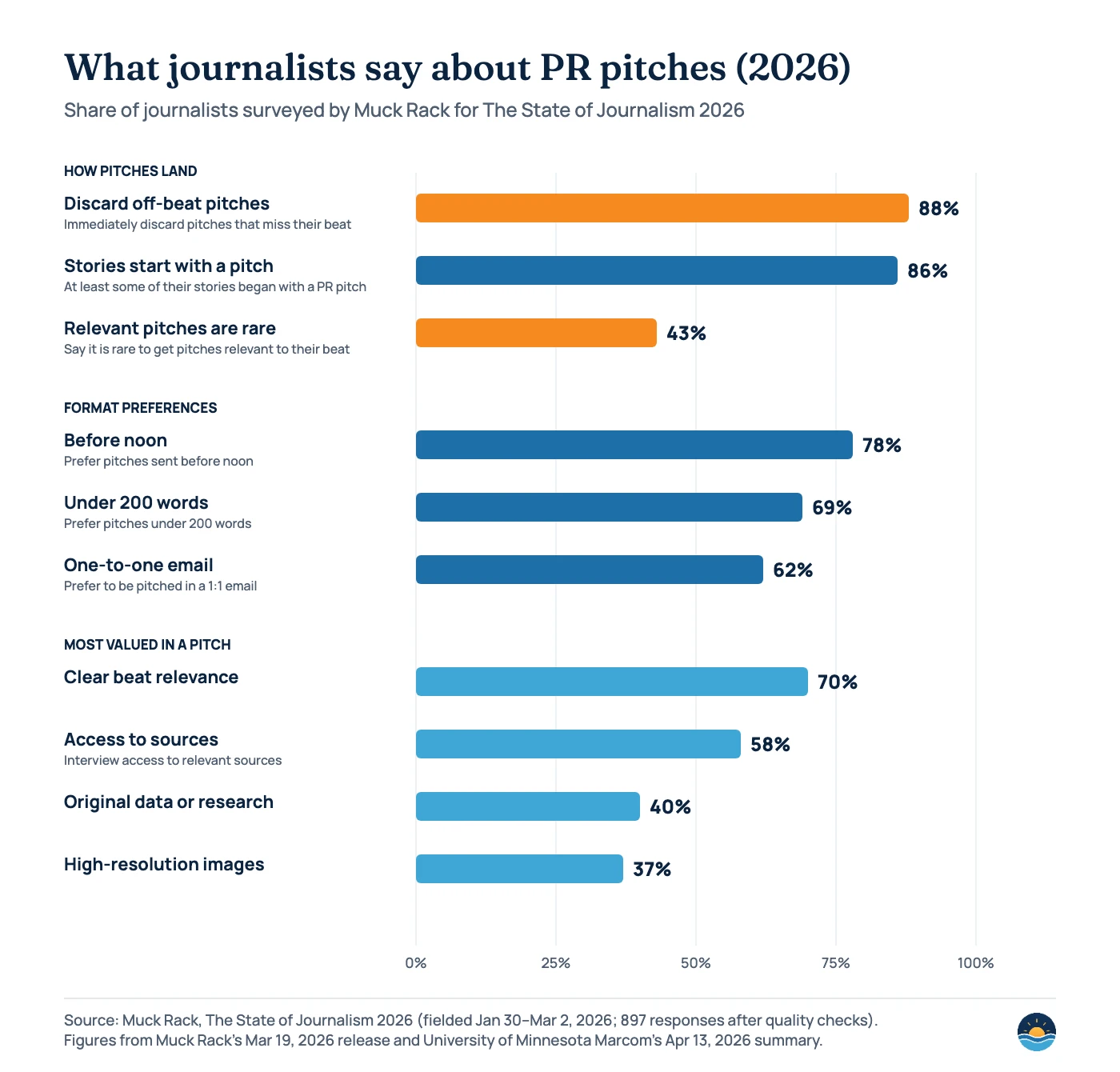
Pitching journalists means sending a reporter a short, one-to-one email that offers a story, data or expert source that fits what they already cover. Surveys of journalists in 2025 and 2026 agree that relevance decides almost everything: in Muck Rack’s 2026 survey, 88% of journalists said they immediately discard pitches that miss their beat.
Key takeaways
- Pitching still works: 86% of journalists say at least some of their stories began with a PR pitch (Muck Rack, State of Journalism 2026).
- Relevance is the filter: 88% immediately discard off-beat pitches, and Cision’s 2025 survey of more than 3,000 journalists found 86% would reject a pitch that doesn’t match their beat or audience.
- Short, early and personal: 69% prefer pitches under 200 words, 78% prefer them before noon and 62% prefer a one-to-one email.
- What journalists value: clear beat relevance (70%), interview access to sources (58%), original data or research (40%) and high-resolution images (37%).
- Links must be earned: Google’s spam policies (updated Aug 28, 2026) list “sending someone a product in exchange for them writing about it and including a link” as link spam.
Digital PR lives or dies on the pitch. You can have strong data and a sharp angle, but if the email lands with the wrong reporter, or reads like a mass mail-out, it is deleted in seconds. This guide uses the two largest recent journalist surveys we could verify to show what reporters say they want, then turns that into a pitching process that also keeps your link building inside Google’s rules. If you are still deciding between traditional outreach and PR-led campaigns, start with our comparison of link building vs digital PR.
Does pitching journalists still work in 2026?
Yes, but for fewer, better pitches. Muck Rack’s State of Journalism 2026 was fielded from January 30 to March 2, 2026. Of 1,044 journalists who responded, 897 responses were kept after data quality checks; most respondents were in the United States, with others in the United Kingdom, Canada and India. In that survey, 86% of journalists said at least some of their stories started with a PR pitch.
The same survey shows how crowded the inbox is. About half of journalists said they seldom or never respond to pitches, and 43% said it was rare to receive pitches relevant to their beat. In other words, PR people are a real source of stories, but most of what reporters receive is not useful to them.
Cision’s 16th annual State of the Media report, published May 7, 2025, points the same way with a larger, global sample. It surveyed more than 3,000 journalists across 19 markets: 86% said they would immediately reject a pitch that doesn’t match their beat or audience, 72% named press releases as the most useful resource PR teams can offer, and 85% said the best way to build a relationship is to introduce yourself by email, even when you have no story to pitch.
| Survey | Sample | Published | Key pitching findings |
|---|---|---|---|
| Muck Rack, State of Journalism 2026 | 897 journalists (after quality checks), mainly US, plus UK, Canada and India | Mar 19, 2026 | 86% say some stories start with a pitch; 88% discard off-beat pitches; 43% rarely get relevant pitches |
| Cision, 2025 State of the Media | More than 3,000 journalists in 19 markets | May 7, 2025 | 86% reject pitches that miss their beat or audience; 72% value press releases most; 85% prefer an email introduction |
Both are self-reported surveys, so treat them as what journalists say they prefer rather than a measurement of what gets covered. Still, when two different panels land on 86–88% for the same behaviour, it is safe to build your process around it.
What makes a journalist use a pitch?
Relevance comes first. Clear relevance to the journalist’s beat was the most valued element in Muck Rack’s 2026 survey (70%), followed by interview access to relevant sources (58%), original data or research (40%) and high-resolution images (37%). And 78% said a pitch feels relevant when it directly affects the community their audience belongs to.
That last figure matters for small and mid-sized businesses. A national reporter rarely needs your company, but a trade title or regional outlet often does, especially when you bring local numbers, a named expert and images they can use without extra work.
What to send
- A story that clearly fits the reporter’s recent coverage
- A named expert who is available this week
- Original data with a clear method and a page to cite
- High-resolution images the outlet can use
- A short, personal email to one person
What gets deleted
- Pitches that miss the beat (88% discard them)
- Mass mail-outs with a generic greeting
- Long emails that bury the news
- Claims without data or a source
- Requests for a link in exchange for something
How long should a pitch be, and when should you send it?
Muck Rack’s 2026 data gives clear answers on format. Most journalists want a short email, sent to them personally, early in the day. The table below turns each finding into a practical rule.
| Pitch element | What the 2026 data says | What to do |
|---|---|---|
| Length | 69% prefer pitches under 200 words | Lead with the news in one sentence; put detail in a linked page, not the email |
| Channel | 62% prefer a one-to-one email | Write to one named person; no visible mailing lists or BCC blasts |
| Time of day | 78% prefer pitches before noon | Send in the reporter’s morning, in their time zone |
| Day of week | About half don’t mind the day; 18% prefer Monday | Timing around news cycles matters more than the weekday |
| Relevance | 70% value clear beat relevance most | Reference their recent coverage and say why this fits their audience |
| Assets | 58% value access to sources; 40% original data; 37% high-res images | Offer an expert, a data page and images in the first email |
The surveys we read did not publish a figure on follow-ups. Our working rule is one follow-up, a few days later, that adds something new, such as a fresh data point, a local angle or an available interview slot, and then stop. Cision’s finding that 85% of journalists welcome an email introduction even without a story is a reminder that the relationship lasts longer than any single pitch.
How do you turn coverage into a link without breaking Google’s rules?
Coverage is the goal; a link is a welcome result. Google’s spam policies (last updated Aug 28, 2026) define link spam as “creating links to or from a site primarily for the purpose of manipulating search rankings.” The examples that matter most for PR teams are:
- Exchanging money for links, or posts that contain links
- Exchanging goods or services for links, including sending someone a product in exchange for them writing about it and including a link
- Advertorials or native advertising where payment is received for articles that include links that pass ranking credit
- Links with optimised anchor text in articles, guest posts or press releases distributed on other sites
Google also says buying links for advertising or sponsorship is fine as long as those links carry rel="nofollow" or rel="sponsored". Our guide to nofollow, sponsored and UGC links explains when each value applies. In practice, a clean digital PR programme pitches stories, not links: never make coverage conditional on a link, never request keyword-rich anchor text, and keep paid placements clearly labelled.
It is reasonable to ask for credit. If an outlet uses your data without linking, a polite note that points to the original source page helps readers check the numbers. The same approach works for links that later break, which we cover in broken link building.

A 7-step process for pitching journalists
- Build a story asset first. Original data, a useful tool or a named expert with a clear point of view. Publish it on a page that can be cited, with the method explained.
- Build a short, beat-matched list. Read each reporter’s last few articles. If you can’t say in one sentence why the story fits their audience, leave them off.
- Write the pitch in under 200 words. One-line hook, two or three supporting facts, what you can offer (expert, data, images) and a link to the source page.
- Send one-to-one, before noon. Personalise the first line, use the reporter’s time zone and avoid bulk sends.
- Follow up once with something new. A new data cut, a local angle or interview times. Then move on.
- Make coverage easy. Answer quickly, supply high-resolution images and make your expert available.
- Check coverage and credit. Record every mention, ask politely for a source link where your data was used, and never offer payment or products in exchange for a link.
Track results by story, not by email volume: coverage won, referring domains earned and whether the linked page gained visibility. Our SEO reporting and KPIs guide shows how to fit those numbers into monthly reporting.
Frequently asked questions
How many journalists still use PR pitches?
In Muck Rack’s State of Journalism 2026, 86% of journalists said at least some of their stories began with a PR pitch. But about half said they seldom or never respond to pitches, so only relevant, well-targeted pitches tend to get used.
How long should a pitch email be?
Short. 69% of journalists in Muck Rack’s 2026 survey said they prefer pitches under 200 words. Put the news in the first sentence and link to a page with the full data rather than pasting it into the email.
What is the best time to pitch a journalist?
Morning. 78% of journalists in the 2026 survey prefer pitches before noon. About half don’t mind which day of the week a pitch arrives, so relevance and news timing matter more than the weekday.
Is it against Google’s rules to ask journalists for a link?
Asking for credit to an original source is normal. What Google’s spam policies prohibit is paying for links, exchanging goods or services for links, or sending a product in exchange for a linked write-up. Paid or sponsored placements should carry rel=”sponsored” or rel=”nofollow”.
Sources
- The State of Journalism 2026 — Muck Rack, 2026 — report overview (nearly 1,100 journalists responded)
- Muck Rack’s 2026 State of Journalism Report Finds 82% of Journalists Use AI — Muck Rack via GlobeNewswire, Mar 19, 2026 — methodology, 86%, 88%, 78% relevance, valued elements
- Pitching journalists with Muck Rack’s The State of Journalism 2026 — University of Minnesota University Marketing and Communications, Apr 13, 2026 — length, timing, channel and valued-element percentages
- Examining Muck Rack’s “State of Journalism in 2026” Report — Matter, 2026 — response rate and relevance findings
- Cision’s 2025 State of the Media Report Reveals a Tipping Point for Trust, Technology, and PR-Journalist Partnerships — Cision, May 7, 2025 — 3,000+ journalists, 19 markets, 86%, 72% and 85% findings
- Spam policies for Google web search — Google Search Central, last updated Aug 28, 2026 — link spam examples and nofollow/sponsored guidance
Cite this article: Bright Harbour Media. “How to Pitch Journalists: What the 2026 Survey Data Says.” Bright Harbour Media Insights, October 2026. https://brightharbourmedia.com/how-to-pitch-journalists/
You are welcome to reference the charts and frameworks in this article with a link back to this page.
Want journalists to cover your expertise and cite your site? Our link building and digital PR service builds story assets, beat-matched media lists and pitches that earn coverage the clean way. Get in touch to talk through a campaign.