

Programmatic SEO means publishing many pages from one template and a structured dataset, so each page matches a search in a family of similar searches, such as “[service] in [city]” or “[product] vs [product]”. Google does not ban it. What Google’s spam policies target is scaled content abuse: many pages generated “for the primary purpose of manipulating search rankings and not helping users”, no matter how they are made.
Key takeaways
- Google introduced the scaled content abuse policy on 5 March 2024, alongside expired domain abuse and site reputation abuse.
- The policy applies whether content is produced “through automation, human efforts, or some combination” of the two.
- When the March 2024 changes finished rolling out on 19 April 2024, Google reported 45% less low-quality, unoriginal content in results, against the 40% it expected.
- Google’s spam policies (last updated 28 August 2026) list five examples of scaled content abuse, from AI-generated pages with no added value to keyword pages that make “little or no sense to a reader”.
- Google’s generative AI guidance (updated 1 October 2026) says to fact-check all AI-generated content, including titles, meta descriptions, structured data and alt text.
What is programmatic SEO?
A programmatic page is assembled rather than written one by one. You build a template, connect it to a dataset (locations, products, integrations, prices, timetables, specifications) and generate a page for each row. Done well, this is how travel sites publish route pages, how software companies publish integration pages and how directories publish listings.
Google has never objected to automation as such. In February 2023, Google’s Search Quality team wrote that automation “has long been used to generate helpful content, such as sports scores, weather forecasts, and transcripts.” The problem is pages whose main reason to exist is to catch search traffic, with nothing on them a reader could not get from the template plus a swapped keyword.
Programmatic pages that help people
- Each page shows data that is different and useful for that query (stock, prices, opening times, specifications, reviews)
- There is real demand for each variation, confirmed by keyword research
- Pages fit a browseable structure users can navigate
- Facts are checked and kept current
- Thin variations are merged or kept out of the index
Patterns Google calls abuse
- Thousands of near-identical pages with only a city or keyword swapped
- AI-written pages “without adding value for users”
- Scraped or synonym-spun content from other sites
- Pages that funnel visitors to one destination page
- Spreading pages across multiple sites to hide the scale
What does Google’s scaled content abuse policy say?
Google’s spam policies define scaled content abuse as creating “large amounts of unoriginal content that provides little to no value to users, no matter how it’s created.” The policy lists five examples. The middle column shows how each tends to appear in a programmatic project.
| Google’s example | How it shows up in programmatic SEO | Safer alternative |
|---|---|---|
| Using generative AI or similar tools to generate many pages without adding value for users | AI paragraphs padding out every location or comparison page | Use AI for structure and drafting, then add real data and human review |
| Scraping feeds, search results or other content to generate many pages, including synonymising or translating | Pages built from competitors’ listings or a scraped feed | Use your own or properly licensed data and add analysis |
| Stitching or combining content from different pages without adding value | “Best X in Y” pages assembled from other sites’ snippets | Add first-hand testing, original photos or your own comparisons |
| Creating multiple sites to hide the scaled nature of the content | Spinning up microsites per city or per product line | Keep one strong site with a clear hierarchy |
| Creating many pages that make little or no sense to a reader but contain search keywords | Keyword-permutation pages (“plumber cheap near me in…”) | Only build pages for real, distinct needs |
The policy also tells site owners hosting such content to exclude it from Search. In other words, if you already have thin generated pages, a noindex or removal is a legitimate fix while you decide what to improve.
How has Google’s position developed?
The scaled content abuse policy replaced Google’s older policy on automatically generated content. Google explained at launch that the new wording focuses on the purpose, so that “producing content at scale is abusive if done for the purpose of manipulating search rankings and that this applies whether automation or humans are involved.” The timeline below shows the key public milestones.
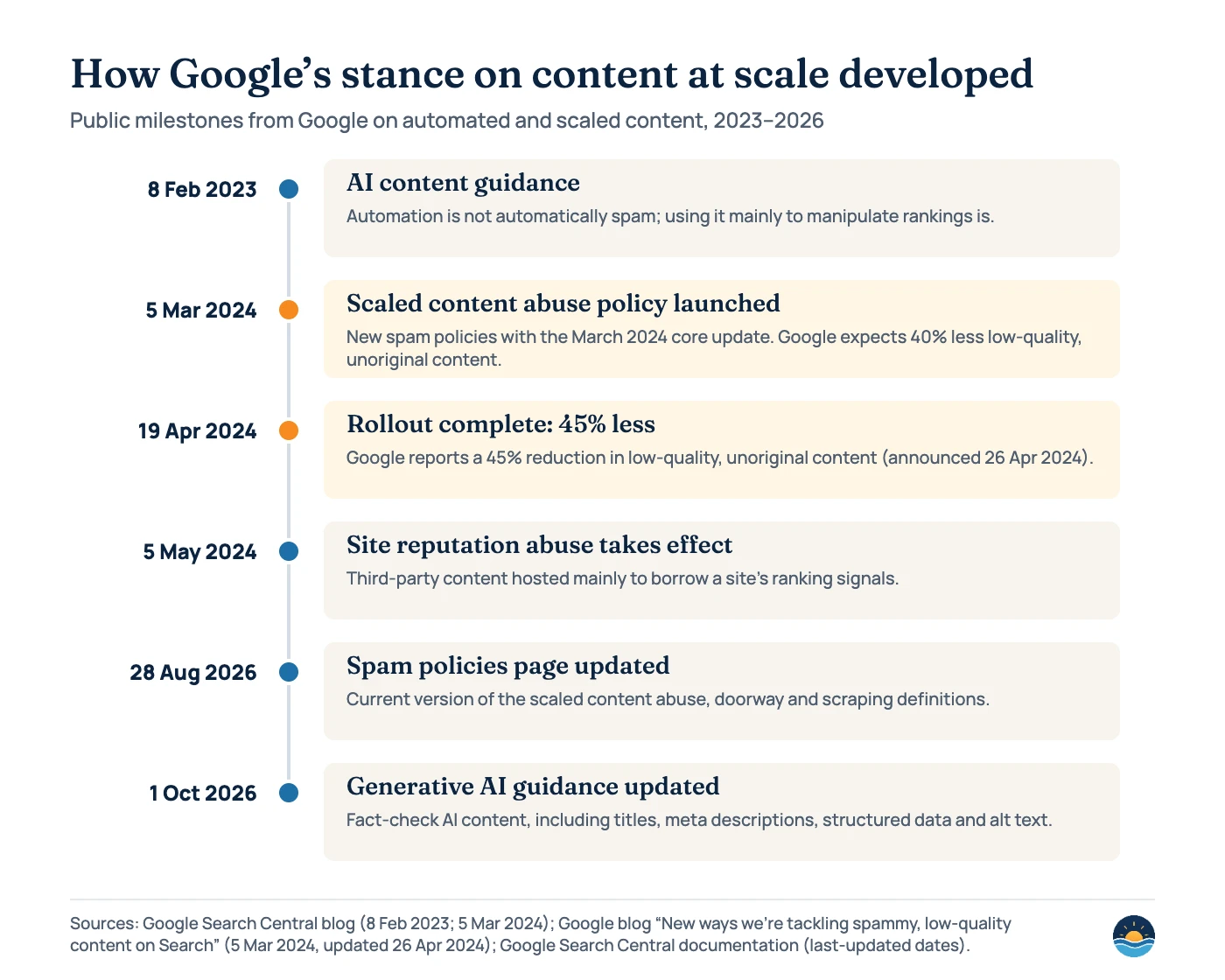
The numbers worth knowing are Google’s own. On 5 March 2024 Google said it expected the core update and earlier efforts to reduce low-quality, unoriginal content in results by 40%. On 26 April 2024 it updated the post: the rollout had finished on 19 April and the reduction was 45%. These are Google’s figures from its own evaluations, not independent measurements.
Which other spam policies affect template pages?
Scaled content abuse is not the only policy that programmatic projects run into. Location and comparison templates often overlap with doorway abuse, and data-driven pages built from other sites overlap with scraping. We covered the location side in detail in our multi-location SEO guide.
| Policy | Google’s definition (summarised) | Typical programmatic risk |
|---|---|---|
| Scaled content abuse | Many pages generated mainly to manipulate rankings rather than help users | Large sets of templated pages with little unique value |
| Doorway abuse | Sites or pages created to rank for specific, similar queries that lead users to less useful intermediate pages | City or region pages that all funnel to one page; pages “closer to search results than a clearly defined, browseable hierarchy” |
| Scraping | Taking content from other sites, often automatically, and hosting it to manipulate rankings | Pages built from copied feeds, listings or media without added value |
| Site reputation | Third-party content published on a host site mainly because of the host’s ranking signals | Partner-built programmatic sections (coupons, reviews) hosted without close oversight |
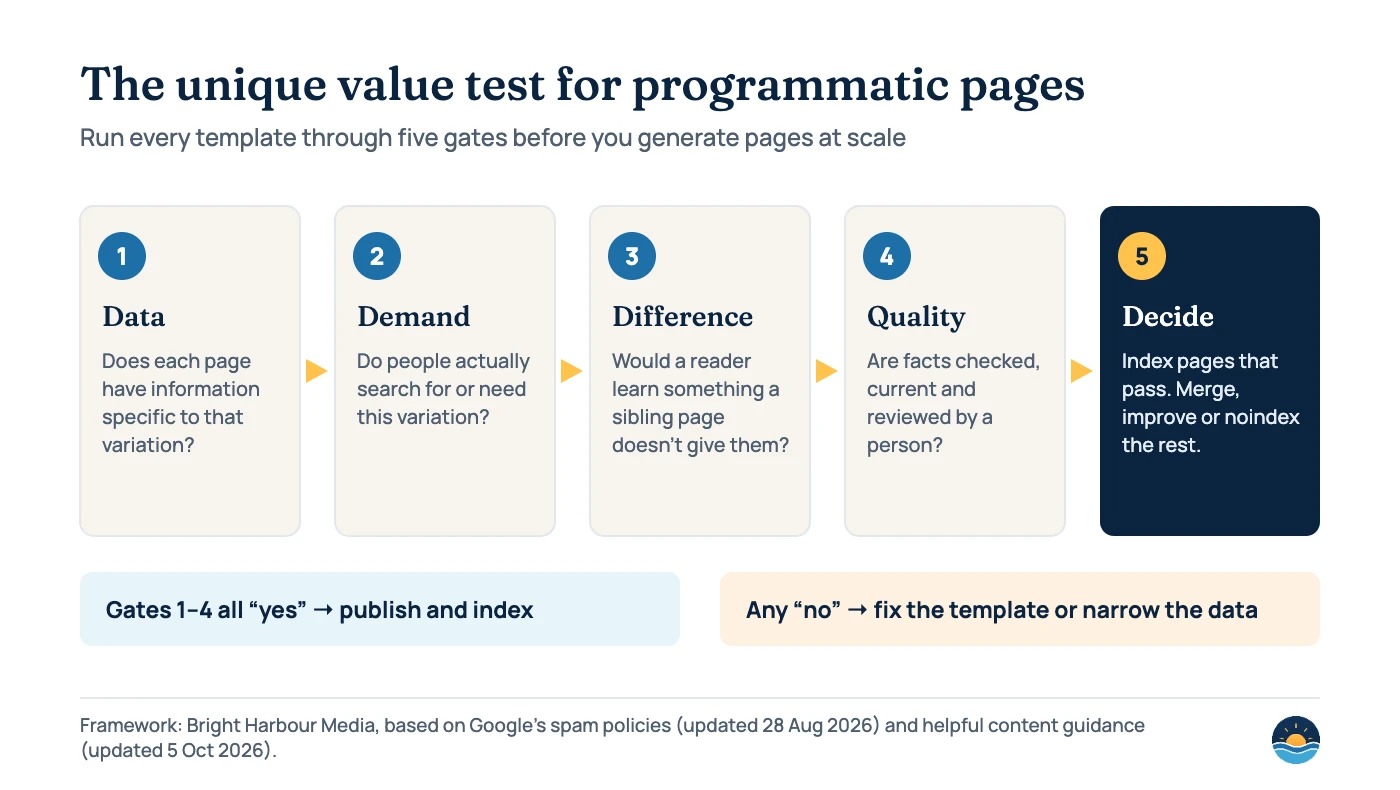
The unique value test: a framework for every template
Before you generate a single page, run the template through five questions. If any answer is “no”, fix the template or narrow the dataset before launch. This is our working framework, built on the self-assessment questions in Google’s helpful content guide (updated 5 October 2026).
Google’s helpful content guide lists warning signs that map closely onto programmatic projects. Two stand out: “Are you producing lots of content on many different topics in hopes that some of it might perform well in search results?” and “Are you using extensive automation to produce content on many topics?” A yes to either is a reason to slow down, not necessarily to stop.
Demand is where many projects fail. A template that can produce 5,000 pages does not mean 5,000 needs exist. Use the steps in our keyword research process to check each variation, and drop the ones with no real search or business value.
Can you use AI to write programmatic pages?
Yes, with conditions. Google’s guidance on generative AI content (updated 1 October 2026) says AI “can be particularly useful when researching a topic, and to add structure to original content,” but that using it to “generate many pages without adding value for users may violate Google’s spam policy on scaled content abuse.”
The same page sets two practical rules. First, manually fact-check and review all AI-generated content before publishing, and that review “also applies to metadata like <title> elements, meta description elements, structured data” and image alt text. Second, for shopping, Merchant Center requires AI-generated images to carry IPTC DigitalSourceType metadata set to TrainedAlgorithmicMedia, and AI-generated product titles and descriptions to be labelled as such.
How to launch a programmatic section safely
- Define the user need. Write one sentence on who each page serves and what they can do on it that they cannot do elsewhere.
- Audit the dataset. Check coverage, accuracy and freshness. Remove rows where you have nothing specific to say.
- Validate demand. Keep only variations with real search demand or clear business value.
- Design for difference. Make the unique data the main content, not a widget under generic copy.
- Build a browseable hierarchy. Link pages from logical hub pages so users and Google can navigate them, rather than leaving them orphaned in a sitemap.
- Launch a pilot batch. Publish a small, representative set first and review it by hand, including titles, meta descriptions, structured data and alt text.
- Watch indexing and engagement. Use the Search Console Page indexing report and Performance report to see whether Google indexes and shows the pilot pages.
- Scale or prune. Expand only the templates that earn impressions and engagement. Improve, merge or noindex the rest, as described in our content refresh and pruning guide.
Frequently asked questions
Is programmatic SEO against Google’s guidelines?
No. Google’s spam policies target scaled content abuse, meaning many pages made mainly to manipulate rankings without helping users. Template-built pages that give each visitor useful, specific information are not a violation.
Does it matter whether pages were written by AI or by people?
Not for the policy. Google said in March 2024 that scaled content abuse applies whether content is produced through automation, human effort or a combination. What matters is the purpose and the value to users.
How many programmatic pages is too many?
Google does not set a number. The test is whether each page adds value for users. A small set of thin pages can be a problem, while a large set of genuinely useful pages can be fine.
What should I do with thin programmatic pages that are already live?
Improve the ones with real demand, merge near-duplicates, and keep the rest out of the index. Google’s spam policies say content of this kind should be excluded from Search.
Sources
- Spam policies for Google web search — Google Search Central, last updated 28 August 2026. Used for the scaled content abuse, doorway, scraping and site reputation definitions.
- What web creators should know about our March 2024 core update and new spam policies — Google Search Central blog, 5 March 2024. Used for the policy’s origin and the automation-or-humans wording.
- New ways we’re tackling spammy, low-quality content on Search — Google (Elizabeth Tucker), 5 March 2024, updated 26 April 2024. Used for the 40% expected and 45% reported reduction.
- Google Search’s guidance about AI-generated content — Google Search Central blog, 8 February 2023. Used for Google’s view of helpful automation.
- Google Search’s guidance on generative AI content on your website — Google Search Central, last updated 1 October 2026. Used for the AI review, metadata and Merchant Center requirements.
- Creating helpful, reliable, people-first content — Google Search Central, last updated 5 October 2026. Used for the self-assessment and search engine-first warning questions.
Cite this article: Bright Harbour Media. “Programmatic SEO Without Scaled Content Abuse.” Bright Harbour Media Insights, October 2026. https://brightharbourmedia.com/programmatic-seo/
You are welcome to reference the charts and frameworks in this article with a link back to this page.
Planning location, comparison or integration pages at scale? Our SEO strategy and consulting service can pressure-test the template and dataset before you publish. Get in touch to talk it through.