
Keyword research is the process of finding the words and phrases your potential customers type into search engines, judging how valuable and winnable each one is, and deciding which page on your site should answer it. A good keyword research process starts with your customers and your services — not with the search volume column in a tool.
Key takeaways
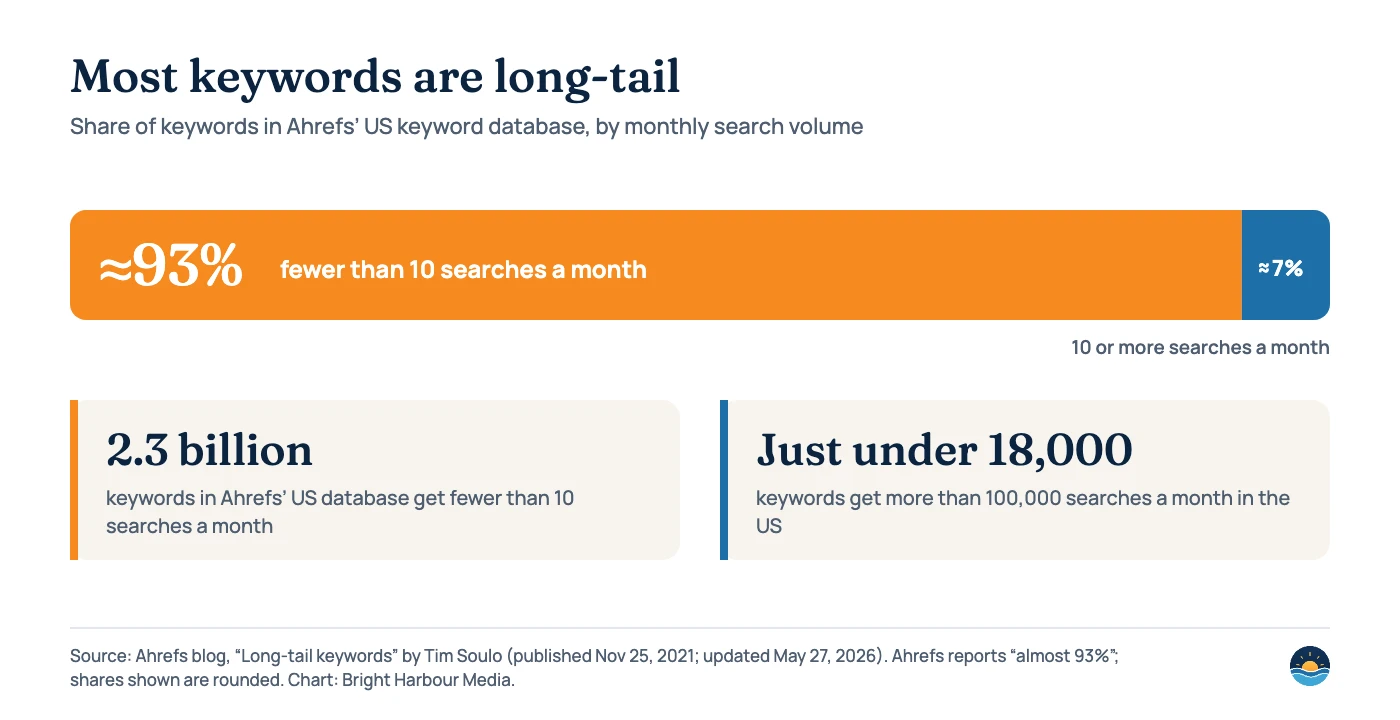
- In Ahrefs’ US keyword database, almost 93% of keywords — 2.3 billion — get fewer than 10 searches a month; just under 18,000 get more than 100,000.
- Google Keyword Planner’s “Avg. monthly searches” combine a keyword with its close variants, are averaged over 12 months by default, and are rounded.
- Google Trends shows relative interest on a 0–100 scale, not absolute search counts.
- Search Console’s Performance report tables show at most 1,000 rows and leave out some rare queries to protect privacy.
- Google calls content containing the same keywords as the query “the most basic signal” of relevance — but it first works out the intent behind the query.
Why keyword research still matters
Search engines have become much better at understanding language, but they still match pages to the words people use. Google’s own How Search Works explains that to return relevant results it first needs to establish “the intent behind your query”, and that “the most basic signal that information is relevant is when content contains the same keywords as your search query” — especially when those keywords appear in headings or body text.
Keyword research gives you both halves of that: the language customers actually use, and the intent behind it. It tells you which services to build pages for, what to call them, which questions to answer in articles, and which searches aren’t worth chasing. Intent is a big enough topic to deserve its own guide — see our article on search intent mapping.
Most keywords are long-tail
One finding shapes how a service business should approach keyword research: the vast majority of distinct keywords people search for are specific, low-volume phrases. In its study of long-tail keywords (updated May 27, 2026), Ahrefs reports that 2.3 billion keywords in its US database — almost 93% — get fewer than 10 searches a month. Just under 18,000 keywords get more than 100,000.
For a local accountant, builder or law firm, that is good news. The phrases that bring enquiries — a specific service plus a location, problem or situation — are usually long-tail. They have lower reported volume, but they are more specific about what the searcher needs, and they are often far easier to rank for than broad head terms.
Ahrefs also cautions that word count isn’t a reliable way to define long-tail keywords: what matters is how many people search for a phrase, not how many words it has.
Which keyword research tools should you use?
No single tool gives you the full picture, and every one of them has limits worth knowing before you trust its numbers.
| Tool | What it shows | Limits to know | Best used for |
|---|---|---|---|
| Google Search Console (Performance report) | Queries that already showed your site, with clicks, impressions, CTR and average position | Tables show up to 1,000 rows; rare and sensitive queries are omitted; data usually arrives in 2–3 days | Finding what you already rank for, and near-misses on page 2 |
| Google Keyword Planner | Average monthly searches, competition and top-of-page bid ranges | Volumes include close variants, are averaged over 12 months by default and are rounded; very low-volume keywords aren’t shown | Sizing demand and spotting commercial intent |
| Google Trends | Relative interest over time and by location | Scaled 0–100 from a sample of searches — not absolute numbers | Seasonality and comparing terms or regions |
| Third-party SEO tools | Estimated volumes, difficulty and competitor rankings from their own databases | Estimates vary between tools; treat them as relative, not exact | Competitor gaps and long-tail ideas at scale |
| The search results themselves | Which kinds of pages Google ranks today | Personalised and location-dependent; a snapshot in time | Checking intent and the format you’ll need |
A few details from Google’s documentation are easy to miss. Keyword Planner’s average monthly searches figure is “the average number of times people have searched for a keyword and its close variants”, so two near-identical phrases may show the same number. Its top-of-page bid figures are approximations of the 20th and 80th percentile of what advertisers have paid. And Google’s overview of Keyword Planner notes that keywords with very low search volumes, or that are considered sensitive, aren’t discoverable — which is exactly where many long-tail service searches sit.
Google Trends works differently again: each data point is divided by total searches for that place and time, then “scaled on a range of 0 to 100”. A score of 100 means peak relative interest, not a particular number of searches.
The keyword research process, step by step
This is the process we use for service businesses. It works for a new site and for an existing one — the existing site simply gets a head start from Search Console.
- Start with your services and customers. List every service you want more work for, the problems customers describe before they buy, and the areas you serve. Use the words customers use on calls and in emails, not internal jargon.
- Mine Search Console. In the Performance report, export queries and pages for the last 3–12 months. Look for queries with impressions but few clicks, and for pages ranking around positions 8–20.
- Expand the list. Run your seed terms through Keyword Planner and a third-party tool. Collect variations: service + location, service + problem, cost and price questions, comparisons and “near me” style searches.
- Check the search results by hand. For each important term, look at what ranks. Service pages, directories, guides or videos? That tells you the intent and the page type you need.
- Group keywords into topics. Put phrases that share the same intent and would be answered by the same page into one group. Each group becomes one page.
- Prioritise. Score each group on business value, intent fit, ranking feasibility and demand (see Table 2).
- Map groups to pages. Assign each group to an existing page or a new one. Avoid two pages chasing the same group.
- Brief, publish and measure. Write briefs that cover the main term, related questions and the intent you found. Track the group in Search Console after publishing.
How to prioritise keywords
Search volume is the least useful number on its own. A phrase with 30 searches a month from people ready to hire can be worth more than one with 3,000 searches from students. We weigh four factors, in line with how we prioritise SEO work generally.
| Factor | Question to ask | Weight | Where to look |
|---|---|---|---|
| Business value | If we ranked, would these searchers become customers for a service we want to sell? | 40% | Your services, margins and capacity |
| Intent fit | Do the current results show the type of page we can offer? | 25% | Manual review of the search results |
| Ranking feasibility | Can we realistically compete with the pages that rank now? | 20% | Search Console positions; competitor pages; third-party difficulty scores |
| Demand | Is there steady or growing interest? | 15% | Keyword Planner ranges; Google Trends |
Usually worth targeting
- Service + location phrases for areas you really serve
- Problem-led searches your service solves
- Cost, price and “how long does it take” questions
- Comparisons between options you offer
- Queries you already rank for on page 2
Usually worth skipping
- High-volume terms with mostly informational or job-seeker intent
- Services or areas you don’t actually provide
- Near-duplicate variants that belong on an existing page
- Terms where every result is a big directory or marketplace
- Topics unrelated to anything you sell
Mapping keywords to pages
The output of keyword research is a keyword map: a simple sheet listing each topic group, its main keyword, supporting phrases, intent, priority score and the URL that should rank. One group, one page. If two pages target the same group, merge them or make their focus clearly different.
The map also shows how pages should link together. Service pages become hubs, and the articles that answer related questions link up to them — the approach described in our internal linking strategy guide.
How do you measure keyword research?
Measure topic groups, not single keywords. In Search Console’s Performance report, filter by page or by a query pattern to see clicks, impressions, CTR and average position for each group. Remember the limits: Google says collected data “should be available in 2–3 days”, and some queries are omitted to protect privacy, so totals for a group will undercount. Our guide to SEO reporting and KPIs covers how to turn this into a monthly report.
Revisit the research every six to twelve months, or whenever you add a service or area. New questions appear, intent shifts and competitors change — and the queries Search Console shows you will grow as your site gains visibility.
Frequently asked questions
How many keywords should a page target?
One main topic, with as many closely related phrases as share the same intent. A single well-written service page can rank for dozens of variations. If two keywords need different answers, they need different pages.
Are keyword tool search volumes accurate?
Treat them as estimates. Google says Keyword Planner volumes include close variants, are averaged and are rounded, and very low-volume keywords aren’t shown at all. Third-party tools model their own estimates. Use volumes to compare options, not as forecasts.
Should I target keywords with zero reported search volume?
Often, yes, if they clearly describe a customer need. Ahrefs’ data shows that almost 93% of keywords get fewer than 10 searches a month, so many valuable service searches will look like zero in tools. Check Search Console for real impressions after publishing.
How often should I redo keyword research?
Do a full review every six to twelve months and a light check whenever you launch a new service, area or major page. Search Console is the quickest way to spot new queries between full reviews.
Sources
- Long-tail Keywords: What They Are and How to Get Search Traffic From Them — Ahrefs blog, Tim Soulo (published November 25, 2021; updated May 27, 2026) — US keyword volume distribution
- Understanding your Keyword Planner statistics and traffic estimates — Google Ads Help — average monthly searches, competition, top-of-page bid ranges
- Use Keyword Planner — Google Ads Help — keyword ideas, forecasts and low-volume limits
- FAQ about Google Trends data — Google Trends Help — normalisation and the 0–100 scale
- Performance report (Search results) — Google Search Console Help — metric definitions and dimensions
- About Search Console data — Google Search Console Help — anonymised queries, 1,000-row tables, data delays
- Ranking results — How Search Works — Google — query meaning and relevance
Cite this article: Bright Harbour Media. “Keyword Research: A Step-by-Step Process for Service Businesses.” Bright Harbour Media Insights, October 2026. https://brightharbourmedia.com/keyword-research-process/
You are welcome to reference the charts and frameworks in this article with a link back to this page.
Want a keyword plan built around the services you actually want to sell? Our SEO strategy and consulting service turns keyword research into a prioritised page and content roadmap. Get in touch to talk it through.