
Search intent is the goal behind a search query — what the person actually wants to know, compare, do or find. Search intent mapping is the process of assigning each target keyword to the page type that best satisfies that goal, so every page has one clear job and no two pages compete for the same query.
Key takeaways
- Most queries fall into five intent types: informational, commercial investigation, transactional, navigational and local.
- The search results page is the best evidence of intent — the formats Google already ranks show what searchers expect.
- Each intent maps to a page type, a primary call to action and a KPI; judging a guide by sales or a pricing page by time on page leads to bad decisions.
- One primary intent per URL prevents keyword cannibalization and makes content easier to rank and measure.
The five types of search intent
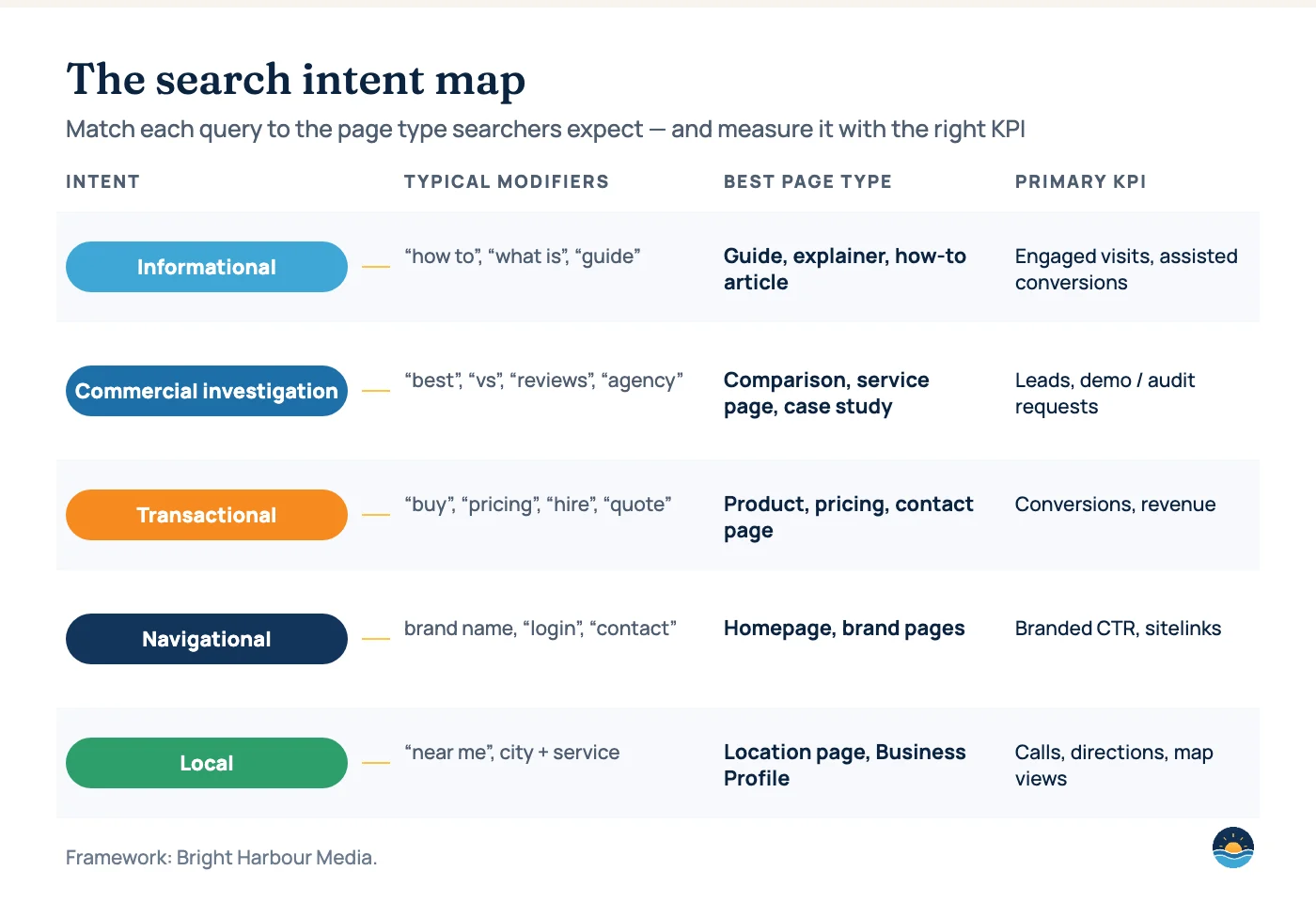
Different frameworks use slightly different labels, but in practice nearly every query a business cares about fits one of five types. The map below connects each type to the page that should rank and the metric that should judge it.
| Intent | Searcher wants to… | Typical modifiers | Best page type | Primary KPI |
|---|---|---|---|---|
| Informational | Learn or understand something | how to, what is, guide, examples | Guide, explainer, how-to article | Engaged visits, assisted conversions |
| Commercial investigation | Compare options before choosing | best, vs, reviews, alternatives, agency | Comparison page, service page, case study | Leads, demo or audit requests |
| Transactional | Take action now | buy, pricing, hire, quote, book | Product, pricing or contact page | Conversions, revenue |
| Navigational | Reach a specific brand or page | brand name, login, contact | Homepage, brand and account pages | Branded click-through rate |
| Local | Find a provider nearby | near me, city + service | Location page, Google Business Profile | Calls, direction requests, visits |
How to identify intent: read the results page
Modifiers are helpful clues, but the strongest evidence is the search results page itself. Google has already tested what satisfies searchers for that query. Before you assign a keyword, check these five things:
- Result types: Are the top results blog posts, product pages, category pages, local listings or videos?
- Dominant format: Lists, step-by-step guides, comparisons, tools or definitions?
- Angle: Are results aimed at beginners, buyers, a specific year or a specific audience?
- Freshness: Do recent dates dominate, suggesting the topic changes quickly?
- Search features: AI summaries, local packs, shopping results and “People also ask” all signal what searchers need.
If the results are mixed — for example, half guides and half service pages — the intent is split. Target the dominant format, or consider whether two separate pages are justified for two distinct needs.
The intent mapping process
- Collect keywords from research tools, Search Console queries, sales calls and customer questions.
- Cluster keywords that share the same results and the same intent; each cluster becomes one page.
- Label intent for each cluster using the results-page checks above.
- Assign a URL — an existing page if one fits, or a new page if there is a gap.
- Define the job of each page: its primary call to action and KPI.
- Link intentionally: informational pages link to commercial pages; commercial pages link to transactional ones.
Common intent mistakes
Mistakes we see most
- Sending commercial queries (“best SEO agency”) to blog posts
- Several pages targeting the same keyword cluster
- Writing a guide where searchers want a tool or template
- Forcing hard-sell CTAs onto informational content
How to fix them
- Build a dedicated service or comparison page for commercial queries
- Consolidate overlapping pages and redirect the weaker one
- Match the format the results page rewards
- Use soft CTAs on guides; save direct offers for commercial pages
Intent and helpful content
Google’s guidance on creating helpful, reliable, people-first content asks whether content serves an existing audience, demonstrates first-hand expertise, has a clear purpose and leaves readers satisfied rather than needing to search again. Intent mapping is how you make those principles operational: each page has one audience, one purpose and one clear next step.
Frequently asked questions
What are the main types of search intent?
The most practical model uses five types: informational, commercial investigation, transactional, navigational and local.
How do I find the intent of a keyword?
Search for it and study the results page. The types of pages and formats that rank show what Google has learned satisfies searchers.
Can one page target multiple intents?
A page can satisfy related needs, but it should have one primary intent. Pages that try to serve very different goals usually perform worse for all of them.
What is keyword cannibalization?
When several of your pages target the same query and intent, they compete with each other. Consolidating them into one stronger page usually helps.
Sources
- Creating helpful, reliable, people-first content — Google Search Central
Cite this article: Bright Harbour Media. “Search Intent Mapping: How to Match Every Keyword to the Right Page.” Bright Harbour Media Insights, October 2026. https://brightharbourmedia.com/search-intent-mapping/
You are welcome to reference the charts and frameworks in this article with a link back to this page.
Need a keyword-to-page map for your site? It is a core part of our content strategy service — or start with an SEO audit.