
Nofollow, sponsored and UGC are values of the HTML rel attribute that tell Google about your relationship with a page you link to. Use rel="sponsored" for paid or compensated links, rel="ugc" for links in comments and forum posts, and rel="nofollow" when neither fits and you don’t want to vouch for the page. Ordinary editorial links need no attribute at all.
Key takeaways
- Google introduced
sponsoredandugcon September 10, 2019, and since then all three values are treated as hints rather than strict commands. - For crawling and indexing,
nofollowbecame a hint on March 1, 2020 — so it was never a reliable way to keep a page out of Google. - Paid links that pass ranking credit are link spam under Google’s spam policies; marking them
sponsored(preferred) ornofollowkeeps them within the rules. - Across the web,
nofollowappears on 32.3% of mobile pages, whilesponsoredandugcappear on only 0.5% each (HTTP Archive Web Almanac 2025). - Google says there is “no wrong attribute” except for sponsored links: over-labelling is harmless, but an unlabelled ad or paid placement is a problem.
What are nofollow, sponsored and UGC links?
Every link on a page is a small statement. A normal link says “this page is worth a look”. Search engines have long used links as one way to understand which pages are useful and what they are about. The rel attribute lets you add context to that statement — for example, “someone paid for this link” or “a visitor posted this link, not us”.
Google’s documentation on qualifying outbound links is clear that most links need nothing: “For regular links that you expect Google to fetch and parse without any qualifications, you don’t need to add a rel attribute.” The three values only matter for the minority of links that are paid, user-generated or that you don’t want to be associated with.
| Value | Use it for | Example in HTML | How Google treats it |
|---|---|---|---|
sponsored | Advertisements, paid placements, sponsorships, affiliate links and other compensation agreements | <a rel="sponsored" href="…"> | A hint; generally not followed. Preferred value for paid links |
ugc | Links inside user-generated content such as comments and forum posts | <a rel="ugc" href="…"> | A hint; generally not followed. You may remove it for trusted, long-standing contributors |
nofollow | Any other link you don’t want Google to associate with your site, or crawl from your site | <a rel="nofollow" href="…"> | A hint for ranking and (since March 1, 2020) for crawling and indexing |
No rel value | Normal editorial links you are happy to stand behind | <a href="…"> | Fetched and parsed as a regular link |
You can combine values in one attribute, separated by a space or a comma — for example rel="ugc nofollow". Google’s 2019 announcement notes that adding nofollow alongside a newer value is a sensible way to stay backwards-compatible with services that don’t recognise sponsored or ugc.
How did Google’s treatment of nofollow change?
The nofollow value dates back to 2005, when it was introduced to help fight comment spam. For years, Google simply did not count a nofollowed link as a signal. That changed in 2019, and the history explains a lot of the confusion that still surrounds these attributes.
| Date | What changed | Why it matters today |
|---|---|---|
| 2005 | nofollow introduced to fight comment spam; later recommended for advertising and sponsored links | Many older sites and plugins still use nofollow for everything |
| May 25, 2017 | Google warned about large-scale guest post and “contributor” campaigns built mainly for links | Keyword-rich links in articles published elsewhere are a known risk |
| September 10, 2019 | sponsored and ugc announced; all three values become hints for ranking | Google may still look at a qualified link’s anchor text and patterns |
| March 1, 2020 | nofollow becomes a hint for crawling and indexing too | nofollow is not a way to stop a page being indexed — use noindex |
| July 26, 2021 | Google asks affiliate links to use sponsored and launches the “link spam update” | Unqualified affiliate, sponsored and guest post links can lead to manual or algorithmic actions |
Google explained the shift to hints like this: links “contain valuable information that can help us improve search, such as how the words within links describe content they point at.” In other words, by treating attributes as hints Google can still learn from a link without giving it the weight of a first-party endorsement. In the same post it added that it would “generally treat them as we did with nofollow before and not consider them for ranking purposes.” A qualified link is therefore not a secret ranking boost — but it is not invisible either.
How often are these attributes used?
The HTTP Archive’s Web Almanac 2025 SEO chapter measured how often each rel value appears on pages across millions of sites. The headline finding: the most common rel values today are about security, not search.
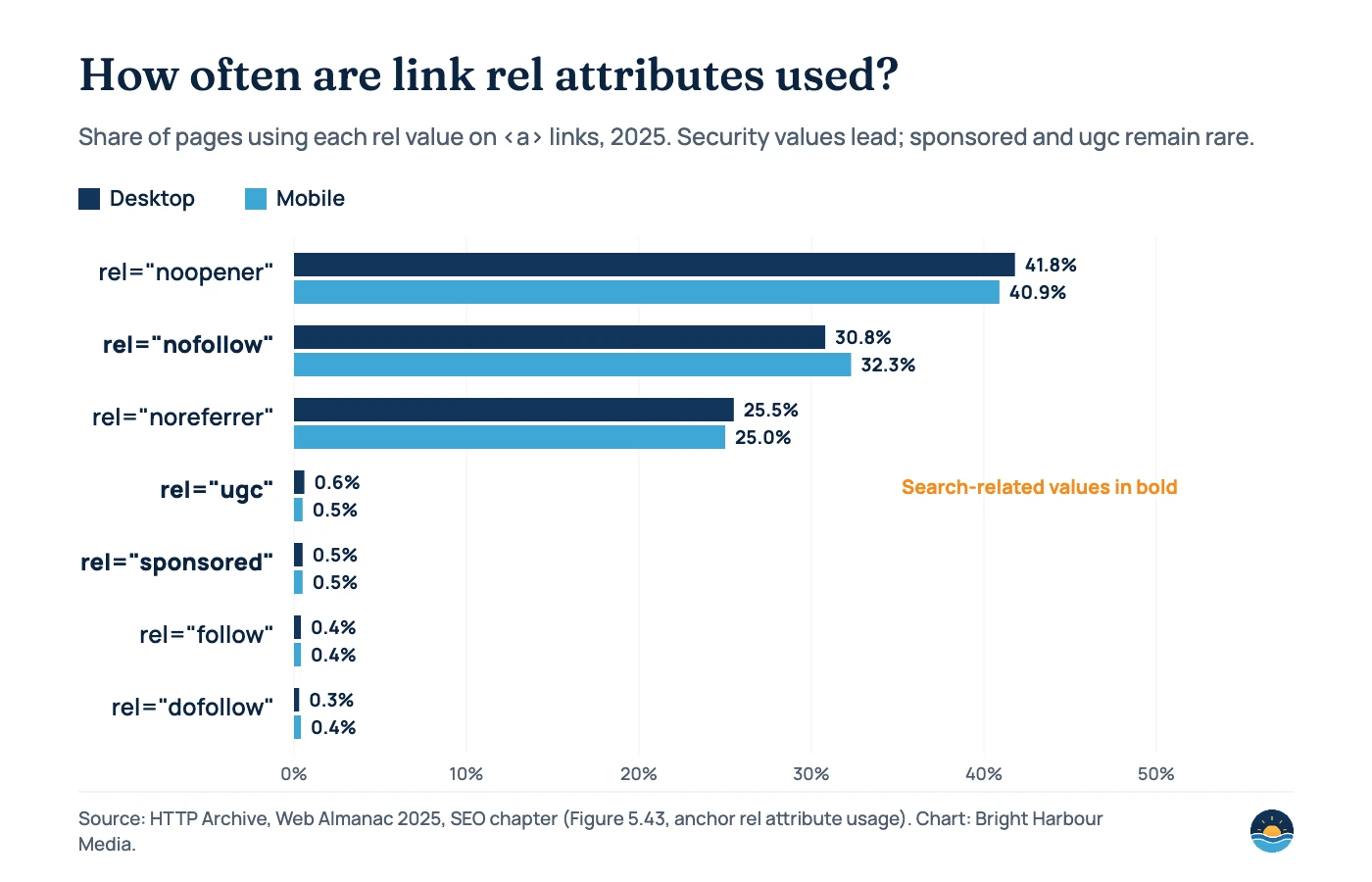
noopener (40.9% of mobile pages) and noreferrer (25%) stop a newly opened tab from controlling the original page and hide referral data. They have nothing to do with rankings. Among the search-related values, nofollow sits at 32.3% of mobile pages, “nearly identical to 2024 levels”, while sponsored and ugc “remain stuck at 0.5% each”. The made-up values follow and dofollow, which have no meaning to Google, still linger on fewer than 0.5% of pages.
The practical lesson is that most websites never moved beyond a simple “nofollow or normal link” split. That is allowed — Google says nofollow remains acceptable for paid links — but it leaves useful context on the table, and it often means the attribute is applied by a plugin without anyone checking whether it fits.
Which rel value should you use? A quick decision path
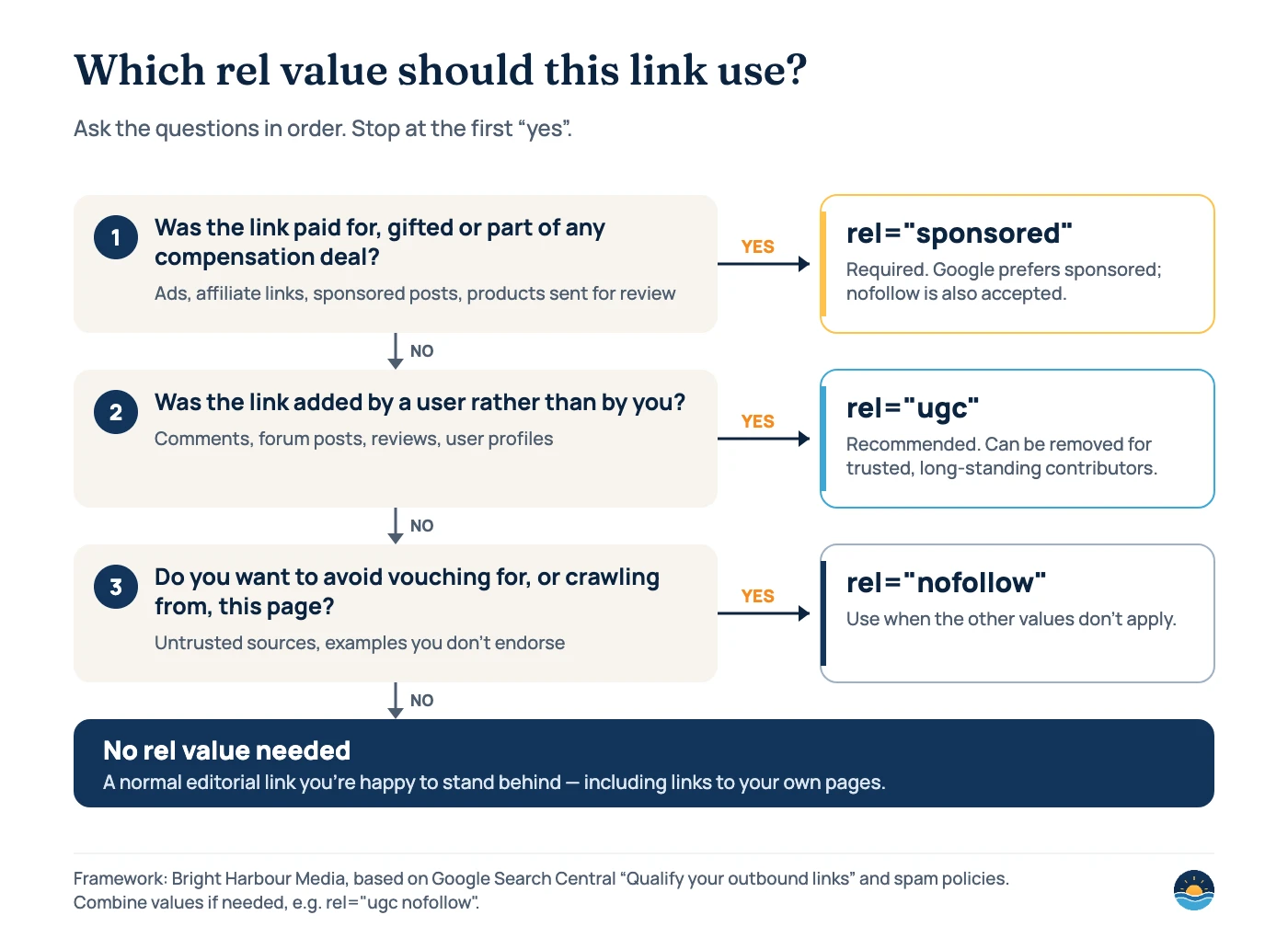
Most decisions come down to three questions, asked in order. If you answer “yes” to the first one, stop there: a paid link must be qualified no matter who wrote it.
| Link scenario | Recommended value | Reason |
|---|---|---|
| Affiliate link in a product review or buying guide | sponsored | Google asks affiliate links to use sponsored, whether created manually or dynamically |
| Banner ad or paid text link | sponsored | Text ads that don’t block ranking credit are listed as link spam |
| Sponsored post or advertorial you were paid to publish | sponsored on links in the paid content | Advertorials with links that pass ranking credit are link spam |
| Article you wrote for another site, with a link back to you | Ask the publisher to qualify keyword-rich links; keep anchors natural | Links with optimised anchor text in guest posts or press releases distributed on other sites are listed as link spam |
| Product sent to a blogger in exchange for a review with a link | sponsored | Exchanging goods for links counts as buying links |
| Blog comment or forum post on your site | ugc (optionally ugc nofollow) | Google recommends ugc for user-generated content |
| A source you cite but don’t trust, such as an example of misinformation | nofollow | You don’t want Google to associate your site with it |
| Editorial link to a useful source, or to your own pages | None | Normal links need no qualifier; use robots.txt to stop crawling of your own URLs |
Do nofollow links help SEO and digital PR?
This is the question clients ask most, usually after a press feature turns out to carry a nofollow link. The honest answer has two parts.
What Google has said
- All three values are hints that Google may use “along with other signals”
- In most cases, qualified links are not considered for ranking purposes
- Linked pages may still be crawled if Google finds them another way, such as sitemaps or other links
- Google says links are good to receive “as long as they’re well deserved”
What that means for your campaigns
- Don’t buy or count nofollow links as if they pass ranking credit
- Do value coverage for referral visits, brand searches and credibility
- Do judge outreach on audience fit, not on link attributes alone
- Don’t ask publishers to remove a
nofolloworsponsoredvalue from a paid placement
For a digital PR campaign, a feature on a respected site with a nofollowed link can still put your brand in front of the right readers and lead to further, editorially given links later. That is one reason we treat digital PR and link building as related but different jobs — see our comparison of link building vs digital PR. What you should never do is pay for a placement and then ask for the link to be left unqualified. That is exactly the pattern Google’s spam policies describe.
How to audit the links on your own site
Your outbound links are your responsibility. Google’s July 2021 post warned that when it finds sites “failing to qualify affiliate links appropriately”, it may issue manual actions and its systems “might also take algorithmic actions”. A short audit once or twice a year keeps you safe.
- Crawl your site and export every external link with its anchor text, source page and current
relvalue. - Flag every commercial relationship. Affiliate programmes, sponsorships, paid posts, partner pages and gifted products should all carry
sponsored. - Check user-generated areas. Comments, forums, reviews and user profiles should add
ugcautomatically. Most platforms support this in settings or with a small filter. - Review site-wide links. Footer credits, widgets and template links repeated across many sites are named in Google’s spam policies; qualify them or remove them.
- Remove meaningless values.
dofollowandfollowdo nothing. Delete them to keep your code clean. - Don’t use nofollow on internal links to control crawling. Google recommends robots.txt rules for your own URLs and
noindexto keep a page out of the index. Good internal linking should be plain links. - Document the rules for writers and developers so new content is qualified correctly from day one, and add the checks to your regular SEO audit checklist.
If you also run outreach, the same thinking applies in reverse. When you find a broken or outdated resource on another site and suggest yours as a replacement — the approach in our guide to broken link building — the publisher decides how to qualify the link. Your job is to earn it, not to dictate its attributes.
Frequently asked questions
Do I need to change my existing nofollow links to sponsored?
No. Google said in 2019 that there is “absolutely no need” to change existing nofollow links, and nofollow remains an acceptable way to flag paid links. It recommends switching to sponsored “if or when it is convenient”.
What happens if I use the wrong value?
Google says there is no wrong attribute except for sponsored links. Marking a non-paid link as sponsored or ugc at most means Google might not count it as credit for the other page. The problem is the opposite case: a clearly paid link with no sponsored or nofollow value.
Does nofollow stop Google from indexing a page?
No. Since March 1, 2020, nofollow is only a hint for crawling and indexing, and Google may find the page through sitemaps or other links. To keep a page out of Google, allow crawling and use a noindex rule.
Are noopener and noreferrer SEO attributes?
No. They are security and privacy values that control how a new tab behaves and whether referral data is passed. The Web Almanac 2025 notes that neither affects positioning in search results.
Sources
- Qualify your outbound links to Google — Google Search Central (updated December 10, 2025)
- Evolving “nofollow” – new ways to identify the nature of links — Google Search Central Blog, September 10, 2019
- A reminder on qualifying links and our link spam update — Google Search Central Blog, July 26, 2021
- A reminder about links in large-scale article campaigns — Google Search Central Blog, May 25, 2017
- Spam policies for Google web search — Google Search Central (updated August 28, 2026) — link spam examples
- Web Almanac 2025: SEO — HTTP Archive — anchor rel attribute usage
Cite this article: Bright Harbour Media. “Nofollow, Sponsored and UGC Links: When to Use Each.” Bright Harbour Media Insights, October 2026. https://brightharbourmedia.com/nofollow-sponsored-ugc-links/
You are welcome to reference the charts and frameworks in this article with a link back to this page.
Want links that are earned, qualified correctly and safe for the long term? Our link building and digital PR service plans campaigns around real stories and audiences — get in touch to talk it through.