
Broken link building is a link-earning method in which you find links on other websites that point to pages that no longer exist, then suggest a relevant, working resource — often your own — as a replacement. Done well, it helps the site owner fix a problem for their readers and earns you an editorial link.
Key takeaways
- Pew Research Center found that 38% of webpages that existed in 2013 were no longer accessible as of October 2023, and a quarter of all pages it sampled from 2013–2023 had disappeared.
- In the same study, 23% of news webpages and 21% of government webpages contained at least one broken link.
- Google’s spam policies prohibit buying links, excessive link exchanges and automated link creation — broken link building must stay editorial to stay compliant.
- Your own site loses links to dead pages too: a 301 redirect to a genuine replacement tells Google to show the new URL instead.
- The best opportunities combine a relevant dead page, several linking sites and a replacement resource that is genuinely as good or better.
Why broken links are such a reliable opportunity
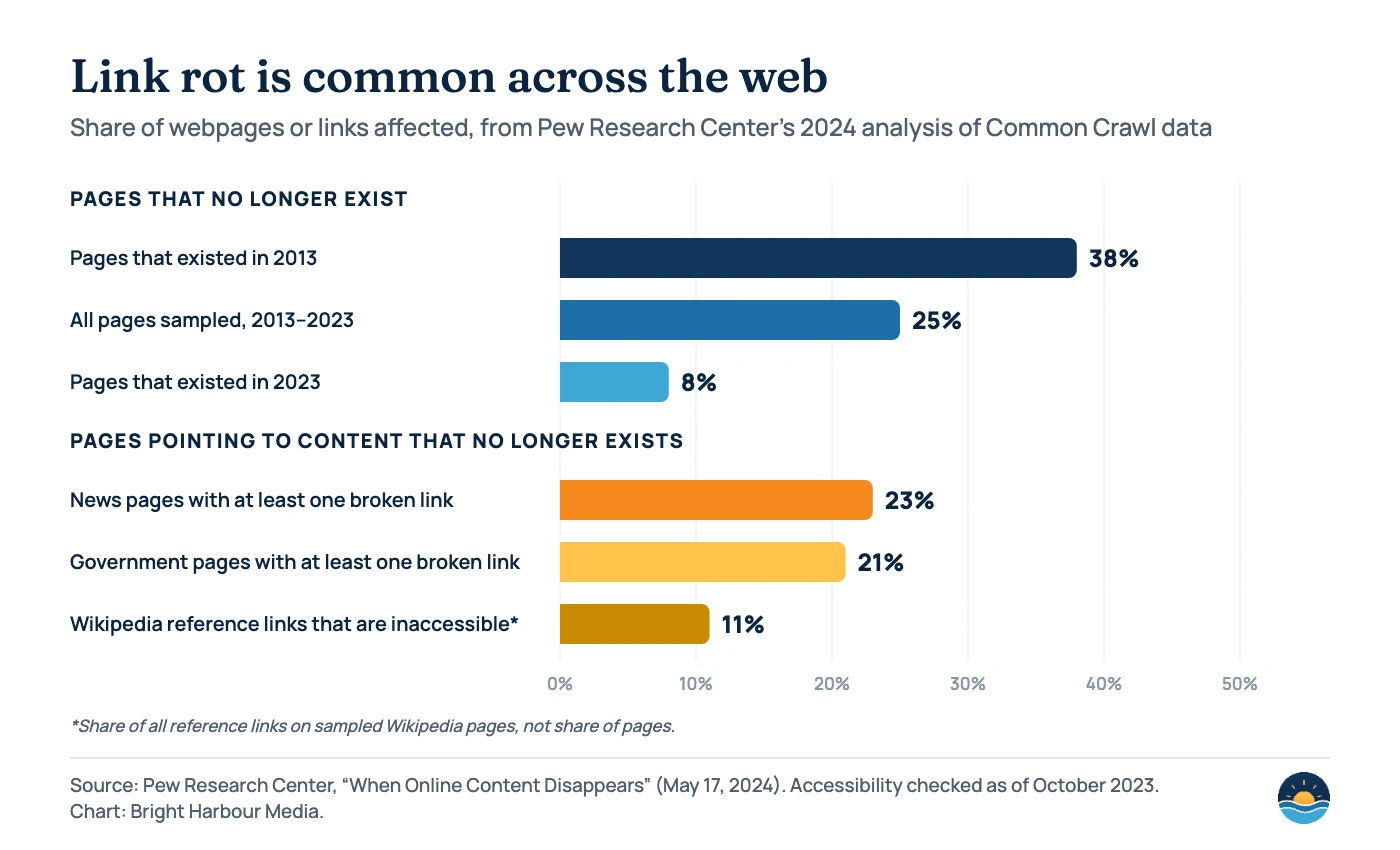
Links decay. Pages are deleted, sites are redesigned without redirects and organisations close. Pew Research Center measured this in its 2024 report “When Online Content Disappears”, which tracked nearly a million webpages from Common Crawl collected between 2013 and 2023. The older the page, the more likely it had vanished.
Every broken link in that data is a small problem for someone: a reader who clicks and hits an error page. That is what makes broken link building different from cold requests for links. You arrive with something useful — a fix — before you ask for anything.
| Finding | Figure |
|---|---|
| Webpages that existed in 2013 and were no longer accessible | 38% |
| All sampled webpages (2013–2023) no longer accessible | 25% |
| Webpages that existed in 2023 and were no longer accessible | 8% |
| News webpages with at least one broken link | 23% |
| Government webpages with at least one broken link | 21% |
| Wikipedia reference links no longer accessible | 11% |
Is broken link building allowed by Google?
Yes — as long as the link is editorial. Google’s spam policies define link spam as creating links primarily to manipulate rankings, and list examples including buying or selling links for ranking purposes, excessive link exchanges, using automated programs to create links, and requiring links as part of a contract. Suggesting a helpful replacement that a site owner is free to accept or ignore is none of these. Offering payment, a reciprocal link or a gift in return for the link changes that.
| Practice | Where it stands | Why |
|---|---|---|
| Pointing out a broken link and suggesting a relevant replacement | Fine | The site owner makes an editorial decision |
| Creating a better resource to replace a dead one | Fine | It adds genuine value for readers |
| Paying for the replacement link | Link spam unless qualified with rel=”sponsored” or rel=”nofollow” | Google lists buying links for ranking purposes as link spam |
| “I’ll link to you if you link to me” | Risky at scale | Google lists excessive link exchanges as link spam |
| Automated, mass-sent templated outreach | Avoid | Google lists automated programs to create links as link spam; it also gets ignored |
For a broader view of where tactics sit on the risk spectrum, see our comparison of link building vs digital PR.
How to do broken link building, step by step
- Choose topics you can genuinely cover. Start with subjects where you already have, or can create, a strong resource. Relevance matters more than volume.
- Find dead pages in your niche. Check resource pages, guides and articles in your industry for links that return errors. A crawler or a browser link-checker extension speeds this up; backlink tools can also list pages on other sites that return 404s.
- Confirm the page is really gone. Check the status code. A 404 or 410 is a clear signal; a redirect to a homepage or an empty page (a soft 404) usually is too.
- See what the page used to say. Look the URL up in the Internet Archive’s Wayback Machine to understand what readers expected to find. Your replacement must match that intent.
- Find everyone who linked to it. Use a backlink tool to list referring pages. One dead resource with many relevant linking pages is worth more than dozens of one-off finds.
- Create or choose a replacement that is genuinely better. Update the facts, cite primary sources and make it easy to reference — a clear definition, tables and a chart help.
- Reach out personally. Tell the editor which link is broken and where it appears, then suggest your page as one option. Keep it short and make it easy to say yes or no.
- Track and follow up once. Log every contact, response and won link. One polite follow-up is reasonable; more is not.
How to qualify a broken link opportunity
| Criterion | Strong opportunity | Weak opportunity |
|---|---|---|
| Relevance | Dead page covered a topic you serve | Only loosely related to your business |
| Linking pages | Several relevant sites still link to it | One link, or links from low-quality sites |
| Site activity | Linking pages are maintained and have a named editor | Abandoned blogs or directories |
| Replacement fit | Your page matches the original intent and adds more | Your page only partly overlaps |
| Link context | Link sits in body copy, citing a source | Link sits in a footer, sidebar or comment |
Google’s link best practices note that linking out can help establish trustworthiness — citing sources, for example — and that good anchor text is descriptive, reasonably concise and relevant. That is why editors fix broken citations: it protects their own credibility. Make your replacement easy to cite.
Writing outreach that gets a reply
Do
- Name the exact page and the broken link
- Lead with the fix, not the ask
- Explain in one line why your page is a fit
- Offer an alternative source if yours isn’t right
- Use the editor’s name and keep it brief
Don’t
- Send the same template to hundreds of sites
- Offer money, gifts or a reciprocal link
- Exaggerate what your page contains
- Follow up more than once
- Ask for specific keyword-rich anchor text
A simple structure works: a one-line greeting, the location of the broken link, a suggested replacement with a sentence on what it covers, and a thank-you whether or not they use it. Agencies that run outreach for you should be able to show you every email sent on your behalf — one of the questions in our guide to choosing an SEO agency.
Do not forget your own broken backlinks
The same decay happens on your site. When you delete or move a page that other sites link to, those links now point to an error. This is the easiest link “building” there is: find your URLs that return 404 but still have external links, and 301-redirect each one to the most relevant live page.
Google’s redirect documentation says a permanent server-side redirect (301 or 308) tells it to show the new target in search results, while a 404 or 410 leads it to remove the old URL from its index. Only redirect when there is a genuine replacement; our content refresh and pruning guide explains how to decide.
Frequently asked questions
Does broken link building still work?
The underlying opportunity is large: Pew Research Center found that 23% of news webpages and 21% of government webpages contained at least one broken link. Results depend on relevance, the quality of your replacement and how personal your outreach is.
Is it against Google’s guidelines?
Not when the link is editorial. Google’s spam policies target links created primarily to manipulate rankings — such as paid links without rel=”sponsored” or rel=”nofollow”, excessive link exchanges and automated link creation.
How do I know what a dead page used to contain?
Look up the URL in the Internet Archive’s Wayback Machine. Matching the original intent is what makes your replacement a genuine fix rather than a pitch.
Should I 404 or redirect my own deleted pages?
If a closely related page exists, use a permanent (301) redirect so visitors and links reach it. If nothing replaces it, a 404 or 410 is the honest answer.
Sources
- When Online Content Disappears — Pew Research Center, May 17, 2024 — link rot across webpages, news, government sites and Wikipedia
- Spam policies for Google web search — Google Search Central — link spam definition and examples
- Qualify your outbound links to Google — Google Search Central — rel=”sponsored”, rel=”ugc” and rel=”nofollow”
- Link best practices for Google — Google Search Central — anchor text and linking out to sources
- Redirects and Google Search — Google Search Central — permanent vs temporary redirects
- How HTTP status codes, and network and DNS errors affect Google Search — Google Search Central — 404, 410 and soft 404 handling
- Wayback Machine — Internet Archive — archived copies of webpages
Cite this article: Bright Harbour Media. “Broken Link Building: How to Earn Links From Dead Pages.” Bright Harbour Media Insights, October 2026. https://brightharbourmedia.com/broken-link-building/
You are welcome to reference the charts and frameworks in this article with a link back to this page.
Want links you never have to worry about? Our link building and digital PR team earns editorial links with resources worth citing — get in touch to talk it through.