
Original research for digital PR means publishing new data, such as a survey, an analysis of public datasets or your own anonymised records, and pitching the findings to journalists so they cite and link to your study. It works because both journalists and Google’s guidance reward information that nobody else has published.
Key takeaways
- In Muck Rack’s State of Journalism 2026 (897 responses analysed), 40% of journalists said PR pros should offer original data or research with a pitch, but 70% put clear relevance to their beat first.
- Cision’s 2026 State of the Media survey of 1,899 journalists names original research, expert access and embargoed information as what journalists value most in pitches.
- Google’s helpful content guide (updated Oct 5, 2026) opens its quality questions by asking whether content provides “original information, reporting, research, or analysis”.
- Data is now the default tactic: 95.9% of digital PR practitioners in BuzzStream’s 2026 survey pitch data-led content, so a study has to be relevant and credible to stand out.
- Credible studies disclose who paid for them, the sample, the dates, the exact questions and the limits. These are core items in AAPOR’s disclosure standards (revised June 2026).
What counts as original research in digital PR?
Original research is any finding you can say came from you. It does not have to be a large academic project. For most businesses it is one of five things: a survey, a fresh analysis of public data, a summary of your own first-party data, an index you update every year, or a small experiment you ran and documented.
What makes it “original” is the work, not the topic. Re-sharing someone else’s statistic is not research. Taking a public dataset and answering a new question with it is. Google’s helpful content guide makes the same distinction: attribution “doesn’t replace the need for original effort.”
| Research type | What it looks like | Strength | Main risk |
|---|---|---|---|
| Survey | Questionnaire sent to customers, a panel or a professional audience | Fast, flexible, quotable percentages | Small or self-selected samples; leading questions |
| Public data analysis | New cut of government, census or open data | Authoritative inputs; easy to verify | Others can repeat it; needs careful method notes |
| First-party data | Anonymised trends from your own bookings, orders or support tickets | Nobody else has it | Privacy, and a sample limited to your own customers |
| Annual index or ranking | The same comparison updated every year | Earns repeat coverage and links to one URL | Methodology changes break year-on-year comparisons |
| Experiment or test | A documented test with a clear before and after | Strong story; shows expertise | Hard to generalise from one site or one test |
Why do data studies earn links?
Journalists need sources, and many of their stories begin in a PR inbox. In Muck Rack’s 2026 survey, 86% of journalists said at least some of their stories start with a pitch. Cision’s 2026 State of the Media found that 66% rely on PR-provided content such as press releases, pitches and media kits for story ideas.
Those journalists are also overloaded. In the same Cision survey, 72% said fewer than a quarter of the pitches they receive are relevant. Muck Rack found 88% immediately disregard pitches that don’t match their coverage area. A data study gives a reporter something concrete that fits their beat: a number, a trend and a source to credit.
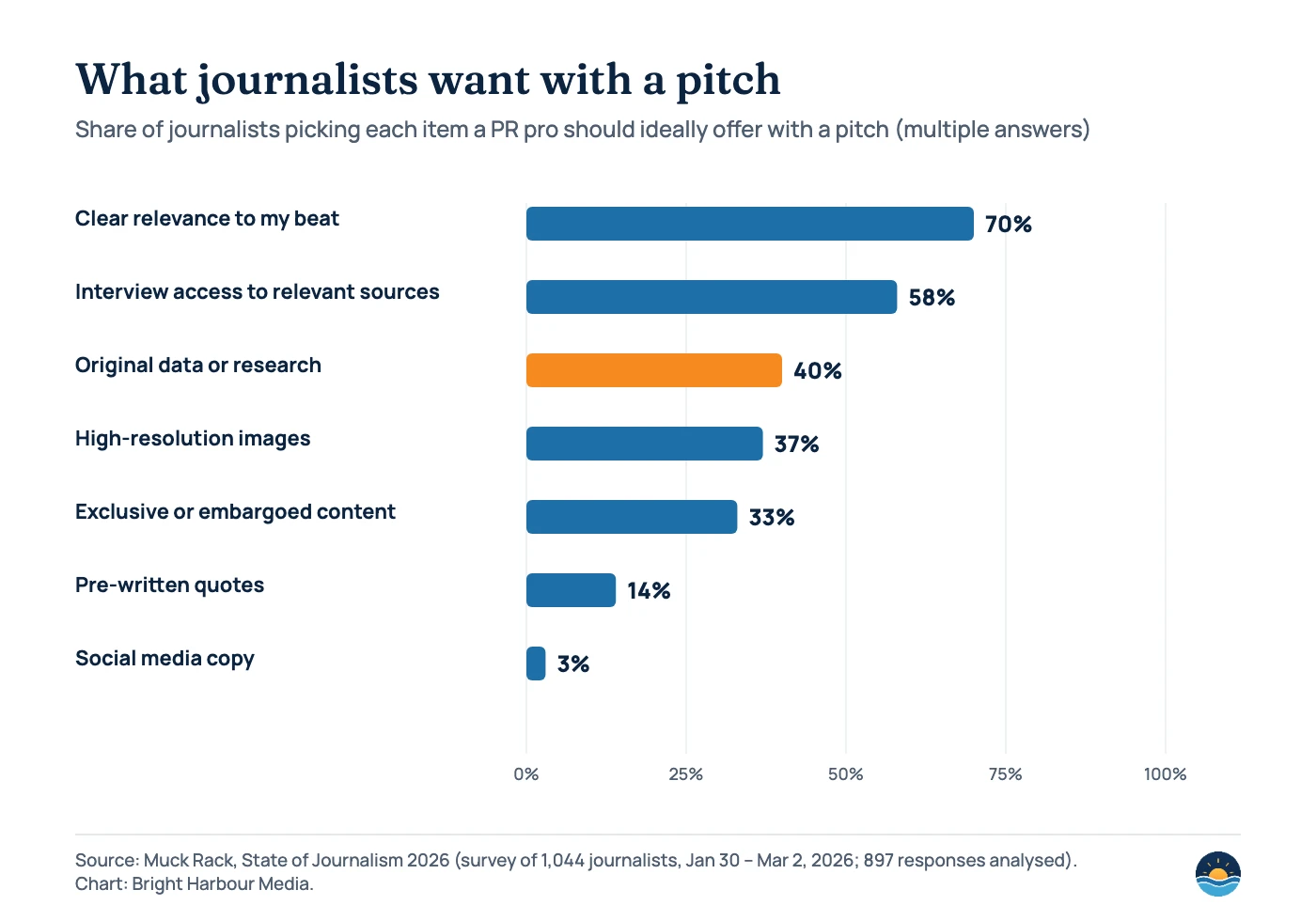
The chart is a useful reality check. Data helps, but it is not the first thing journalists look for. Relevance to their beat (70%) and access to a person they can interview (58%) both rank higher than original data (40%). The strongest pitches combine all three: a finding that matters to the reporter’s audience, plus an expert who can explain it.
Google’s documentation points the same way. Its helpful content guide asks whether content provides “insightful analysis or interesting information that is beyond the obvious”, and whether you would expect to see it referenced by a printed magazine, encyclopedia or book. A well-run study is one of the clearest ways to answer yes.
What do link studies actually show?
There is less hard evidence here than many agency blogs suggest. The large studies are vendor analyses, most are several years old, and all of them show correlation rather than cause. They still agree on one useful point: most content earns no links at all, and research-backed content tends to do better.
| Study | Sample | Finding | Caveat |
|---|---|---|---|
| Moz / BuzzSumo (Sept 2015) | 1 million articles; 750,000 for the share–link correlation | Research-backed content and opinion-forming journalism achieved “both higher shares and significantly more links”; 75% of a 100,000-post sample had zero external links and one or fewer referring domain links | Vendor data; about 11 years old |
| Backlinko / BuzzSumo (updated Feb 2019) | 912 million blog posts | 94% of blog posts had zero external links; “why” posts, “what” posts and infographics received 25.8% more links than videos and how-to posts | Vendor data; contradicts the 2015 study on list posts |
| Fractl (campaigns 2013–2016) | 345 of the agency’s own campaigns | Campaigns with 100+ placements were 3 times more likely to have a strong emotional hook; more than half of top performers were rankings or comparisons | One agency’s campaigns; “placements” include nofollow links and text credits |
| BuzzStream State of Digital PR (Feb 2026) | 150+ digital PR professionals interviewed | 95.9% pitch data-led content; 85.8% say building backlinks is the most effective use of digital PR | Practitioner survey, not a link measurement |
Two practical lessons follow. First, a study needs a hook a journalist can write a headline around, such as a ranking, a comparison or a surprising change. Second, because almost every agency now pitches data, the study has to be better documented and more relevant than the ten others in the reporter’s inbox that week. For a deeper look at the pitch itself, see our guide on how to pitch journalists.
How do you run a study that journalists can trust?
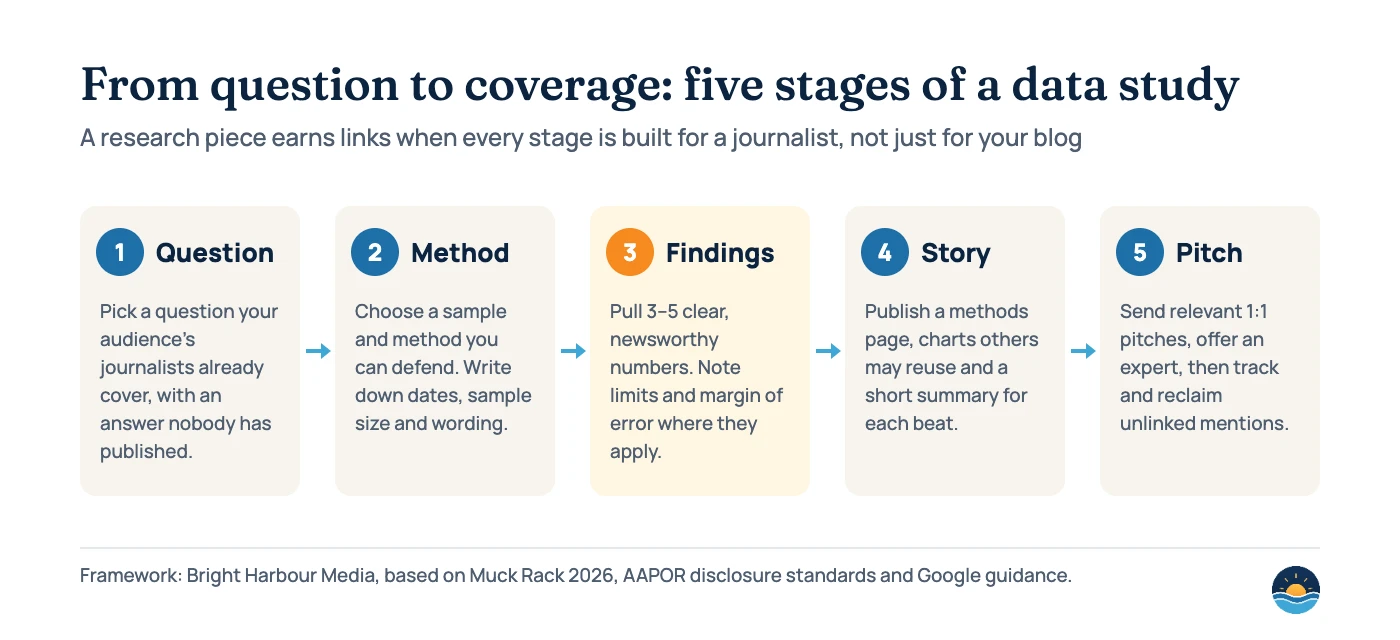
Journalists are wary of weak data. In Cision’s 2026 survey, accuracy, fact-checking and misinformation ranked as their No. 1 challenge. A study that hides its method gives them a reason to skip it. The American Association for Public Opinion Research (AAPOR) publishes a code with a list of items researchers should disclose when they release survey results. It is a good checklist for any PR survey.
| Disclose this | What to publish on your methods page |
|---|---|
| Sponsor and who ran it | Your company as sponsor, plus any panel provider or research firm that fielded the survey |
| Population and sample | Who you surveyed (for example “1,000 UK adults”), how they were recruited, and whether the sample is probability-based or opt-in |
| Dates and mode | The fieldwork dates and how answers were collected (online panel, phone, in-app) |
| Exact question wording | The full wording of every question you report, including answer options |
| Sample size and precision | Completed responses, plus the margin of error for probability samples, or a plain statement that it is not provided for opt-in samples |
| Weighting and quality checks | How data was weighted (or that it wasn’t) and how you removed low-quality responses |
| Limitations and AI use | A short statement of limits, and whether AI tools were used in the research |
Precision matters most when you slice the data. Pew Research Center explains that a simple random sample of 1,067 people has a margin of error of plus or minus 3 percentage points. A subgroup of about 160 people within that sample has a margin of about plus or minus 8 points, and the margin for the difference between two results is roughly twice the individual margin. So a headline such as “Gen Z is 5 points more likely than millennials to…” may be within the noise.
Most PR surveys use opt-in online panels. Pew notes that these are “generally easier and cheaper”, but questions about their accuracy remain. AAPOR’s code says that for non-probability samples you should state that measures of precision are not provided, unless you can describe the model behind them. Saying so openly builds trust; inventing a margin of error does the opposite.
If you publish the dataset itself, Google’s Dataset structured data (updated Sep 8, 2026) can help it appear in Dataset Search. The required properties are a name and a description between 50 and 5,000 characters.
Studies that tend to earn coverage
- Answer a question a specific beat already covers
- Lead with a ranking, comparison or clear change over time
- Include a methods page and downloadable charts
- Offer a named expert for interviews
- Repeat yearly at the same URL so links build up
Studies that tend to fall flat
- Survey a sample too small to split by region or age
- Ask leading questions that produce the answer you wanted
- Hide the sample, dates or question wording
- Bury the findings inside a sales page
- Send the same mass pitch to every outlet
Where does digital PR cross into link spam?
Earning a link because a journalist chose to cite your study is exactly the kind of link Google wants to count. Google’s spam policies (updated Aug 28, 2026) define link spam as creating links “primarily for the purpose of manipulating search rankings.” The problems start when the link stops being editorial.
The policy’s examples include “exchanging money for links, or posts that contain links”, “sending someone a product in exchange for them writing about it and including a link”, excessive link exchanges, and “links with optimized anchor text in articles, guest posts, or press releases distributed on other sites.” Paid placements are fine only when the links are qualified with rel="sponsored" or rel="nofollow". Our press releases and SEO article covers how wire services handle this.
Many journalists will mention a study without linking to it. That is still useful for reputation, and you can often ask politely for a link to the methods page. Our guide to brand mentions vs backlinks explains how to track and reclaim those mentions.
A seven-step process for a link-worthy data study
- Map the beats first. List the journalists and outlets you want to reach and the topics they covered in the last six months. Write your research question for them, not for your product.
- Choose the method that fits the question. Use public data when an authoritative dataset exists; use a survey only when you need opinions or behaviour nobody records.
- Write and test the questions. Keep wording neutral, include “don’t know” options and pilot the survey with a few people before fielding it.
- Plan the sample for the cuts you want to report. If you plan to compare regions or age groups, make sure each subgroup is large enough to say something meaningful.
- Publish a methods page with the findings. Cover the AAPOR items above, add charts others may reuse with credit, and keep everything at one permanent URL.
- Pitch one-to-one with an expert attached. Lead with the finding most relevant to each reporter’s beat and offer interview access, since 58% of journalists want it.
- Track coverage and update yearly. Log every citation, ask for links to the methods page where they are missing, and rerun the study with the same method so the URL earns links year after year.
Frequently asked questions
Do data studies still work for link building in 2026?
Yes, but they are no longer unusual. BuzzStream’s 2026 survey found 95.9% of digital PR practitioners pitch data-led content. Studies that are relevant to a specific beat, well documented and paired with an expert stand out; generic surveys rarely do.
How many survey responses do I need?
It depends on the comparisons you want to make. Pew notes that a simple random sample of 1,067 has a margin of error of about plus or minus 3 points, but subgroups have much wider margins. Plan the sample around the smallest group you intend to report on.
Is it against Google’s rules to promote a study to journalists?
No. Pitching research so journalists can choose whether to cite it is normal PR. Google’s spam policies target paying for links, exchanging products for links, excessive link swaps and optimized anchor text in press releases or guest posts, not editorial coverage.
Should the study live on our blog or a separate page?
Give it its own permanent URL with the findings, charts and a methods section, then link to it from related articles. One stable page collects links over time, especially if you update the study each year rather than publishing a new URL.
Sources
- State of Journalism 2026 — Muck Rack, March 2026; survey of 1,044 journalists (Jan 30 – Mar 2, 2026), what to offer with a pitch, pitch relevance figures
- PR Emerges as the Primary Source for Journalists in High-Pressure Newsrooms — Cision, May 13, 2026; 2026 State of the Media (1,899 journalists)
- Cision’s 2025 State of the Media Report Reveals a Tipping Point for Trust, Technology, and PR-Journalist Partnerships — Cision, May 7, 2025
- Creating helpful, reliable, people-first content — Google Search Central, last updated Oct 5, 2026
- Spam policies for Google web search — Google Search Central, last updated Aug 28, 2026; link spam examples
- SEO Starter Guide — Google Search Central, last updated Dec 10, 2025; promoting your website
- Dataset structured data — Google Search Central, last updated Sep 8, 2026
- AAPOR Code of Professional Ethics and Practices — American Association for Public Opinion Research, revised June 2026; disclosure items
- 5 key things to know about the margin of error in election polls — Pew Research Center, Sept 8, 2016
- What are nonprobability surveys? — Pew Research Center, Aug 6, 2018
- Content, Shares, and Links: Insights from Analyzing 1 Million Articles — Moz / BuzzSumo, Sept 8, 2015
- We Analyzed 912 Million Blog Posts — Backlinko / BuzzSumo, last updated Feb 19, 2019
- What 345 Content Marketing Campaigns Can Teach You About Earning Links — Fractl, undated; campaigns 2013–2016
- State of Digital PR Report (2026) — BuzzStream, last updated Feb 19, 2026
Cite this article: Bright Harbour Media. “Original Research for Digital PR: How Data Studies Earn Links.” Bright Harbour Media Insights, November 2026. https://brightharbourmedia.com/original-research-digital-pr/
You are welcome to reference the charts and frameworks in this article with a link back to this page.
Want a data study that journalists actually cite? Our link building and digital PR team plans, runs and pitches research campaigns built around your expertise. Get in touch to talk through an idea.