

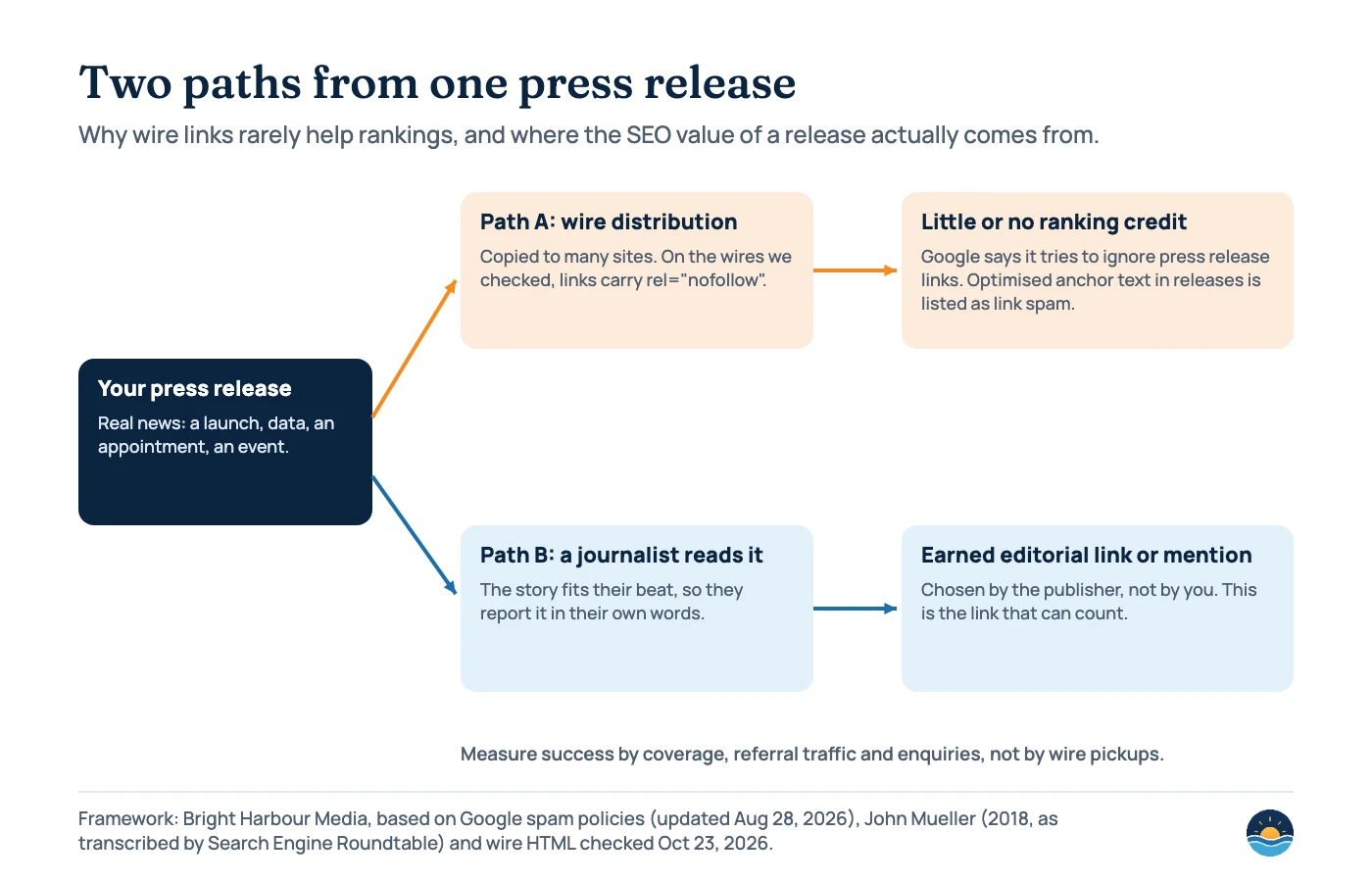
Press releases don’t build links that help rankings on their own. Google lists optimised-anchor links in distributed press releases as link spam, says it tries to ignore press release links, and the major wires we checked mark client links nofollow. A release earns SEO value only when it leads journalists to write their own stories that link to you.
Key takeaways
- Google’s spam policies (updated Aug 28, 2026) name “links with optimized anchor text in articles, guest posts, or press releases distributed on other sites” as an example of link spam.
- In 2018 John Mueller said Google tries to ignore links from press releases “because we know in general companies put the press releases out themselves.”
- On October 23, 2026, every client link we checked in live PR Newswire and EIN Presswire releases carried
rel="nofollow". - Journalists still use releases: 72% called them the most useful resource PR teams offer (Cision, 2025), and 66% rely on PR-provided content for story ideas (Cision, 2026).
- But 88% immediately disregard pitches that miss their beat (Muck Rack, 2026), so targeting decides whether a release becomes coverage.
What does Google say about links in press releases?
Google’s current position is in its spam policies for Google web search, last updated August 28, 2026. Link spam is defined as “creating links to or from a site primarily for the purpose of manipulating search rankings,” and the examples include advertorials where payment buys links that pass ranking credit, and “links with optimized anchor text in articles, guest posts, or press releases distributed on other sites.”
The same page says paid or promotional links are fine when they are qualified: “It’s not a violation of our policies to have such links as long as they are qualified with a rel=“nofollow” or rel=“sponsored” attribute value.” Google’s “Qualify your outbound links” page (updated December 10, 2025) prefers sponsored for paid placements and says links with these attributes “will generally not be followed.” We cover the attributes in detail in our guide to nofollow, sponsored and UGC links.
Wire services themselves are not the problem. The site reputation section of the same policy lists “wire service or press release service sites” among examples that are not considered inconsistent with that policy. The issue is using releases to manufacture ranking links.
| Date | Who | What was said | Type of source |
|---|---|---|---|
| Dec 2012 | Matt Cutts, Google | “I wouldn’t expect links from press release web sites to benefit your rankings” (forum post, as quoted by Local Search Forum) | Reported comment |
| Jul 2013 | Google link schemes guidelines | Listed “links with optimized anchor text in articles or press releases distributed on other sites” (as quoted by Search Engine Roundtable) | Google documentation (archived wording) |
| Jul 2013 | John Mueller, Google | Google wants links in press releases nofollowed and releases treated like ads; links in stories journalists write themselves don’t need to be (Search Engine Roundtable’s summary) | Reported comment |
| Jun 2018 | John Mueller, Google | “we do ignore most of those”; don’t rely on press releases as a link-building strategy | Reported comment (transcript) |
| Aug 28, 2026 | Google spam policies | Optimised anchor text in press releases, guest posts and articles listed as link spam; qualified links allowed | Current Google documentation |
The message has been consistent for more than a decade. What changed is the scope: today’s wording puts press releases in the same sentence as guest posts and articles, which matches the approach we described in guest posting for SEO.
Do press release wires add nofollow to links?
On the wires we could check, yes. On October 23, 2026 we inspected the HTML of recent releases. In a PR Newswire release dated October 22, 2026, all nine links in the body pointed to the client’s own sites and every one had rel="nofollow". On EIN Presswire, links to the client site used rel="external nofollow". The Canadian Cision wire (newswire.ca) also nofollowed body links and routed them through a click-tracking redirect.
Business Wire and GlobeNewswire blocked our automated check, so we can’t confirm their current markup. Business Wire’s own 2020 blog post on the topic said “News releases are not link-building tools” and that nofollow links “do not pass on link equity.” A newer Business Wire post from November 2024 describes links as helping rankings, so even vendor guidance is mixed. Check the HTML of your own release rather than relying on a sales page.
Syndicated copies add a second issue: duplicates. Google’s canonicalization troubleshooting guide (updated August 21, 2026) says the canonical link element “is not recommended” for syndication partners, and that “the most effective solution is for partners to block indexing of your content.” In practice, publish the full release on your own newsroom page first so the original exists on your domain.
Do journalists still read press releases?
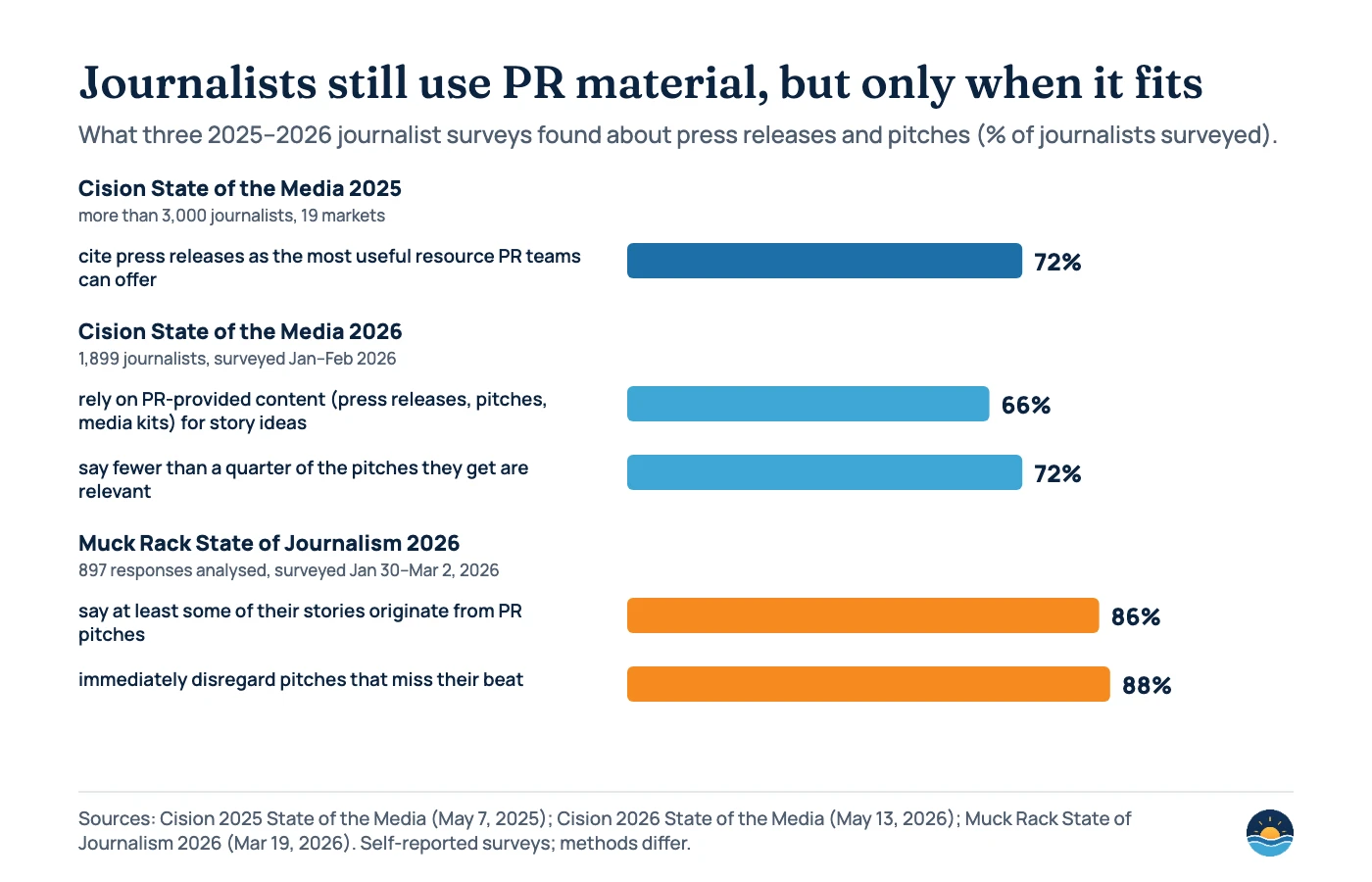
Yes, and that is where the SEO value comes from. Three large 2025–2026 surveys point the same way: PR material still feeds stories, but irrelevant material is ignored.
| Survey | Sample and timing | Finding |
|---|---|---|
| Cision 2025 State of the Media | More than 3,000 journalists in 19 markets; released May 7, 2025 | 72% cite press releases as the most useful resource PR teams can offer; 86% immediately reject pitches not aligned with their beat |
| Cision 2026 State of the Media | 1,899 journalists in North America, EMEA and APAC; surveyed Jan–Feb 2026 | 66% rely on PR-provided content for story ideas; 72% say fewer than a quarter of pitches are relevant; 53% oppose AI-generated pitches |
| Muck Rack State of Journalism 2026 | 1,044 surveyed, 897 responses analysed, mostly US; Jan 30–Mar 2, 2026 | 86% say at least some stories originate from PR pitches; 88% immediately disregard off-beat pitches |
The numbers explain the gap between “press releases work” and “press releases don’t work.” A release that reaches the right reporter with real news can become coverage. A release blasted to a wire for links becomes dozens of nofollowed copies that nobody reads.
Where does the SEO value of a press release come from?
Worth doing
- Publishing real news on your own newsroom page
- Sending a short, targeted pitch to reporters on that beat
- Including data, quotes and images a journalist can use
- Earning coverage that links because it helps readers
Not worth doing
- Paying for wire distribution to get backlinks
- Stuffing releases with keyword anchor text
- Counting wire pickups as “links built”
- Issuing releases with no news value to “stay visible”
Releases can still support SEO indirectly. Coverage can bring referral visits, branded searches and mentions that help people find and trust you. None of that depends on the wire link itself.
A seven-step press release process that supports SEO
- Start with news. A launch, original data, a notable hire, a local event or a response to something journalists are already covering. If it wouldn’t interest a reporter, don’t send it.
- Publish it on your site first. Put the full release on a newsroom or news page with a clear date, contact details and downloadable images, so the original lives on your domain.
- Build a small, relevant list. Find reporters who have covered the topic recently. Muck Rack’s 2026 survey found 88% disregard off-beat pitches, so ten right names beat a thousand wrong ones.
- Pitch personally. Send a short email that explains why it matters to their readers, with the release below or linked. Our guide on how to pitch journalists covers length and timing.
- Use a wire only for reach, not links. Wires suit regulated disclosures and broad announcements. Keep links branded or plain URLs, and let the wire’s nofollow stand.
- Ask for nothing link-related. Don’t request specific anchor text or a followed link in exchange for anything. Editorial links are the publisher’s choice.
- Measure coverage, not pickups. Track original articles, referral sessions, branded search trends and enquiries. Read our comparison of link building and digital PR for how these fit together.
Frequently asked questions
Can a press release get my site penalised?
A normal, newsworthy release with nofollowed or branded links is not a problem. The risk comes from using releases to place keyword-anchor links that pass ranking credit, which Google’s spam policies list as link spam. Google says sites that violate its policies may rank lower or not appear in results, and some violations lead to a manual action.
Are nofollow links from wire services worthless?
They don’t pass ranking credit in the way an editorial link can, and Google has said it ignores most press release links. They can still send a few visitors and help journalists find your story, which is where real coverage comes from.
Should I add rel=”sponsored” to links in my release?
If the release is paid distribution and the wire doesn’t already qualify links, sponsored or nofollow is the safe choice. Google prefers sponsored for paid placements and still accepts nofollow.
How often should a business send press releases?
Only when there is real news. Cision’s 2026 survey found 72% of journalists say fewer than a quarter of the pitches they receive are relevant, so frequency without news value mostly adds to the noise.
Sources
- Spam policies for Google web search — Google Search Central, last updated Aug 28, 2026 — link spam examples, qualified links, site reputation policy
- Qualify your outbound links to Google — Google Search Central, last updated Dec 10, 2025 — sponsored and nofollow
- Fix canonicalization issues — Google Search Central, last updated Aug 21, 2026 — syndicated content
- Google Ignores Press Release Links — Search Engine Roundtable, Jun 29, 2018 — John Mueller transcript
- Google Says Treat Press Releases As Advertisements; Nofollow Links In Press Releases — Search Engine Roundtable, Jul 30, 2013 — Mueller comments and 2013 guideline wording
- Matt Cutts Works on Christmas – Says Press Release Links Don’t Count — Local Search Forum, Dec 26, 2012 — quoted forum post
- Cision’s 2025 State of the Media Report — Cision, May 7, 2025 — press releases most useful resource
- PR emerges as the primary source for journalists in high-pressure newsrooms — Cision, May 13, 2026 — 2026 State of the Media findings
- Muck Rack’s 2026 State of Journalism report — Muck Rack via GlobeNewswire, Mar 19, 2026 — pitch findings and method
- Example PR Newswire release (link markup checked) — PR Newswire, Oct 22, 2026 — rel attributes inspected Oct 23, 2026
- Everything You Need to Know About Press Releases and SEO — Business Wire, last updated Jul 7, 2020 — vendor view on nofollow
Cite this article: Bright Harbour Media. “Press Releases and SEO: Do They Still Build Links?.” Bright Harbour Media Insights, October 2026. https://brightharbourmedia.com/press-releases-seo/
You are welcome to reference the charts and frameworks in this article with a link back to this page.
Want coverage that earns real links instead of wire pickups? Our link building and digital PR service builds stories journalists want to cover. Get in touch to talk about your next announcement.