
Guest posting is writing an article for another website, usually with a byline and a link back to your own site. Google allows it when the goal is to inform another site’s audience, but its spam policies treat paid guest posts with links that pass ranking credit, and links with optimised anchor text in guest posts distributed on other sites, as link spam.
Key takeaways
- Google’s spam policies (last updated Aug 28, 2026) list “links with optimized anchor text in articles, guest posts, or press releases distributed on other sites” as an example of link spam.
- Paid placements are allowed if the link is qualified with rel=”sponsored” or rel=”nofollow”; Google says sponsored is preferred for paid links.
- In a self-reported Q1 2026 survey of 500 SEO professionals, 42.4% used guest posts but only 18% named them their best-performing tactic.
- BuzzStream’s analysis of 257,267 guest post sites (updated June 15, 2026) classed 96.2% as low quality; the average vendor price was $461.
- Since Nov 19, 2024, Google says “no amount of first-party involvement” changes the third-party nature of content placed to exploit a host site’s ranking signals.
Is guest posting against Google’s guidelines?
No. Guest posting as such is not banned. In a May 25, 2017 post, Google’s webspam team wrote that it “does not discourage these types of articles in the cases when they inform users, educate another site’s audience or bring awareness to your cause or company.” The problem, in Google’s words, is “when the main intent is to build links in a large-scale way back to the author’s site.”
The current rules live in Google’s spam policies for Google web search, last updated on August 28, 2026. They define link spam as “creating links to or from a site primarily for the purpose of manipulating search rankings.” Two examples on that list matter most for guest posts: buying or selling links for ranking purposes (including “exchanging money for links, or posts that contain links”), and advertorials or native advertising where payment is received for articles with links that pass ranking credit, “or links with optimized anchor text in articles, guest posts, or press releases distributed on other sites.”
So the question is never “is this a guest post?” It is: why does this link exist, was anything exchanged for it, and how is it marked up? If you need a refresher on the difference between earning coverage and building links, read our guide to link building vs digital PR.
What makes a guest post risky?
Google’s 2017 reminder listed warning signs that, “when taken to an extreme,” point to a link scheme rather than genuine contribution. The 2026 spam policies add the payment and anchor-text tests. Put together, they give a practical risk check:
| Signal | Lower risk | Higher risk |
|---|---|---|
| Why the post exists | Teaches the host site’s readers something they want | Exists mainly to carry a link back to you |
| Payment or exchange | None, or paid and the link is rel=”sponsored” | Money, goods or services exchanged for a followed link |
| Anchor text | Your brand name, the article title or a plain URL | Keyword-rich anchors such as “best wedding rings” |
| Scale and spread | A few relevant publications | Many sites, or many articles on a few large sites |
| Author | Someone who knows the topic and is named | Writers hired with no knowledge of the topic |
| Content | Original to that publication | The same or similar article reused across sites |
For duplicated articles, Google’s 2017 post advised using rel=”canonical” in addition to rel=”nofollow”. It also asked publishers to vet contributors with questions such as “Do I know this person?” and warned that publishing articles made for links “could affect its ranking.”
How Google’s position has changed since 2014
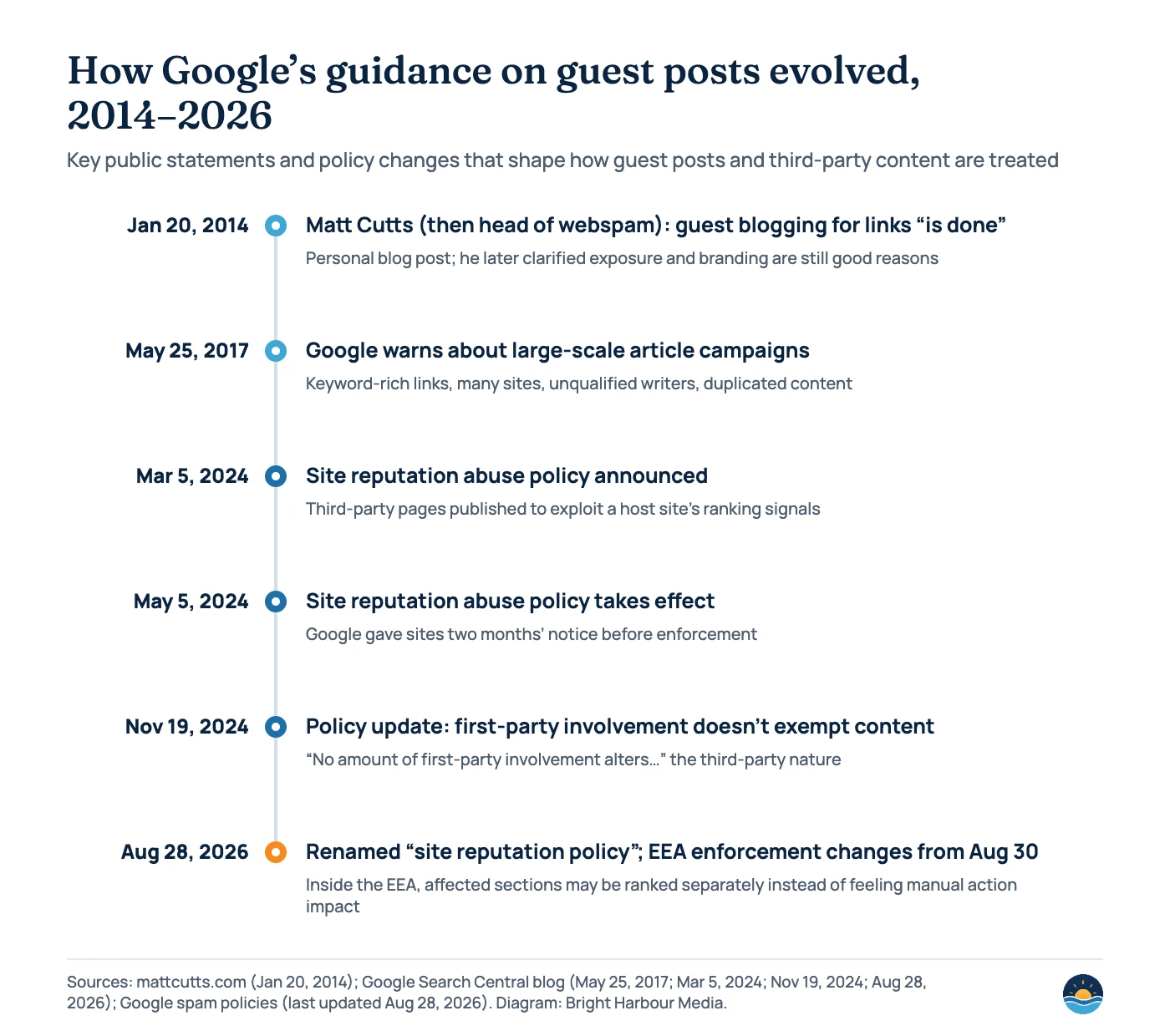
The shift started publicly on January 20, 2014, when Matt Cutts, then head of Google’s webspam team, wrote on his personal blog: “if you’re using guest blogging as a way to gain links in 2014, you should probably stop.” He later clarified that there are “still many good reasons to do some guest blogging (exposure, branding, increased reach, community, etc.)” and retitled the post to make clear he meant guest blogging for SEO.
Since then, the bigger change has come from the host side. On March 5, 2024 Google announced a site reputation abuse policy, effective May 5, 2024. On November 19, 2024 it tightened the definition: site reputation abuse is “publishing third-party pages on a site in an attempt to abuse search rankings by taking advantage of the host site’s ranking signals,” and “no amount of first-party involvement alters the fundamental third-party nature of the content.” On August 28, 2026 Google renamed it the site reputation policy and, following discussion with the European Commission, changed enforcement inside the European Economic Area from August 30, 2026: there, affected sections may be separated so they rank independently, while the manual action still applies outside the EEA.
Does the site reputation policy affect normal guest contributions?
Usually not. The current policy says “having third-party content alone isn’t inconsistent with the site reputation policy” and lists things that are not violations, including “columns, opinion pieces, articles, and other work of an editorial nature,” wire services, syndicated news and user-generated content. Google’s November 2024 FAQ also says “freelance content alone is not a violation.”
What it targets is content placed on a strong site mainly to borrow that site’s ranking signals, such as an unrelated “best casinos” advertising page on a medical site. Google weighs presentation, quality compared with the main domain, “stated or implied authorship,” and whether the same content appears “on multiple other sites in identical or near-identical form,” and says no single factor is “either necessary or sufficient on its own.” A named expert writing an original, on-topic column with editorial oversight sits at the safe end. An unauthored commercial page sold to the highest bidder does not.
Usually fine
- An original article for a relevant publication, written by a named expert
- A brand or URL link in the author bio
- A paid sponsored post with rel=”sponsored” on its links
- A column or opinion piece the editor commissioned
Likely link spam
- Paying for a guest post that includes a followed link
- Keyword-rich anchors placed in the body copy
- The same article spun across dozens of sites
- “Write for us” networks that exist to sell links
How common is guest posting, and what does it cost?
Good data on link building is scarce, and the best available numbers come from vendors, so treat them as indicators rather than census data.
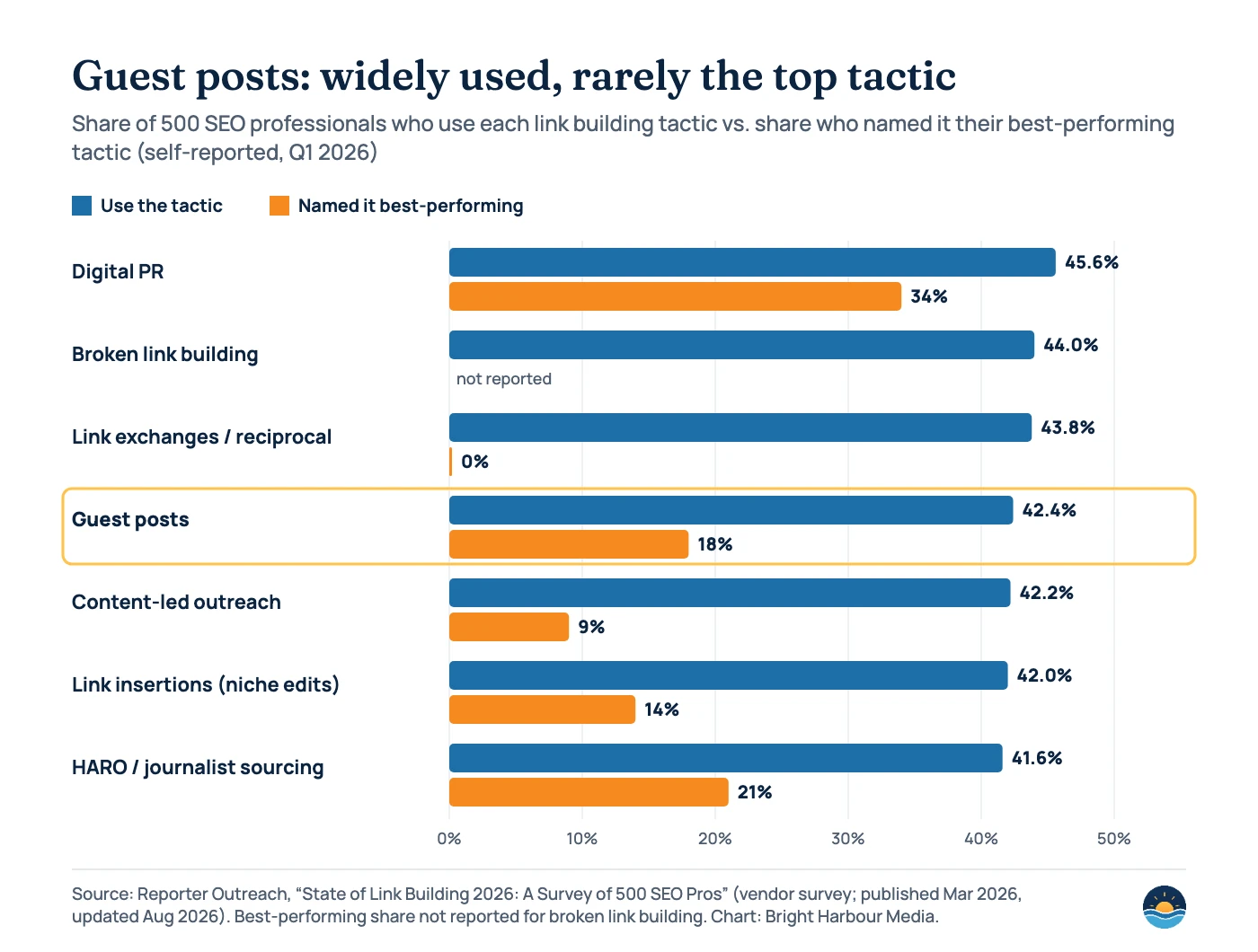
In Reporter Outreach’s State of Link Building 2026 survey of 500 SEO professionals (Q1 2026, self-reported), 42.4% said they use guest posts, roughly level with every other tactic listed. But only 18% named guest posts their best-performing tactic, compared with 34% for digital PR and 21% for journalist sourcing. Reporter Outreach sells link building services, which is worth bearing in mind.
| Measure | Figure | Notes |
|---|---|---|
| Average guest post price via a vendor | $461 | 257,267 sites with complete Ahrefs DR, traffic and price data |
| Average price buying directly from the site | $295 | Same dataset |
| Sites classed as “Low Quality” | 96.2% | Anything below the “Mid Quality” tier (DR 40–70 and 10,000+ monthly organic visits) |
| Average price, sites under 100 organic visits/month | $229 | Vendor price |
| Average price, “High Quality” sites (DR 71–80, 50,000+ visits) | $3,130 | Vendor price |
The pricing data shows how much of the guest post market is a link market. If a site lists a price for a post with a followed link, that is the “buying or selling links for ranking purposes” Google describes. The same placement with a rel=”sponsored” link is allowed, but then you are paying for audience and brand exposure, not ranking credit. Our guide to nofollow, sponsored and UGC links explains each value.
A seven-step process for guest posts that stay within the rules
- Start with the audience, not the link. Pick publications your customers actually read. If the post would be worth writing with no link at all, you are on the right track.
- Pitch an idea the editor can’t get elsewhere. Original data, a worked example or a specialist view. Our guide to pitching journalists covers what editors respond to.
- Write it yourself, or have a real expert write it. Google’s 2017 warning signs include writers “that aren’t knowledgeable about the topics they’re writing on.” Use a real name and bio.
- Keep links natural. A brand-name or URL link in the bio is enough. Avoid exact-match commercial anchors in the body.
- Qualify anything paid. If money, products or services change hands, ask for rel=”sponsored” (or rel=”nofollow”) on every link to you.
- Publish once. Don’t reuse the same article across sites. If you republish your own post, ask for rel=”canonical” to the original.
- Track the right outcome. Measure referral visits, brand searches, enquiries and the relationship with the editor, not just a new referring domain.
What should publishers that accept guest posts do?
If you run a site that accepts contributions, the policy risk sits with you as much as with the author. Google’s 2017 post said sites that publish articles made for links may see their rankings affected. Keep contributions on-topic, edit them as you would your own content, name the author, and mark paid or promotional links with rel=”sponsored”. Avoid selling “do-follow” placements. If a rival has built spammy guest post links to your site, you rarely need to act; our article on when to disavow links explains when Google says a disavow file is appropriate.
Frequently asked questions
Do guest post links still help SEO?
Google doesn’t publish how much any single link counts. Links in genuine editorial contributions are not against the rules, but links from paid or large-scale guest post campaigns are link spam. The safer value of guest posting is exposure to a relevant audience and referral traffic.
Should guest post links be nofollow?
If anything was exchanged for the post or the link, yes: Google asks for rel=”sponsored” (preferred) or rel=”nofollow”. For an unpaid, editorially chosen contribution, Google’s spam policies don’t require it, but keyword-rich anchor text in guest posts is listed as link spam.
Is it OK to pay for a sponsored post?
Yes, as advertising. Google says buying links for advertising and sponsorship is normal and not a violation as long as the links are qualified with rel=”sponsored” or rel=”nofollow”.
Can a guest post network get my site a manual action?
Google says it takes action on sites creating articles made for links, and outside the EEA third-party content that violates the site reputation policy may receive a manual action. Check the Manual actions report in Search Console if you suspect a problem.
Sources
- Spam policies for Google web search — Google Search Central, last updated Aug 28, 2026 — link spam examples, paid link qualification, site reputation policy and enforcement
- A reminder about links in large-scale article campaigns — Google Search Central blog, May 25, 2017 — warning signs, advice for publishers
- What web creators should know about our March 2024 core update and new spam policies — Google Search Central blog, Mar 5, 2024 — site reputation abuse announced, effective May 5, 2024
- Updating our site reputation abuse policy — Google Search Central blog, Nov 19, 2024 — first-party involvement, freelance content FAQ
- Update to the Site Reputation Policy — Google Search Central blog, Aug 28, 2026 — EEA enforcement change from Aug 30, 2026
- Qualify your outbound links to Google — Google Search Central, last updated Dec 10, 2025 — sponsored, ugc and nofollow values
- The decay and fall of guest blogging for SEO — Matt Cutts, Jan 20, 2014 — historical context
- State of Link Building 2026: A Survey of 500 SEO Pros — Reporter Outreach, Mar 2026, updated Aug 2026 — tactic usage and best-performing shares (self-reported vendor survey)
- The Cost of Guest Posts, Based on 500k Sites — BuzzStream, last updated June 15, 2026 — guest post prices and quality tiers
Cite this article: Bright Harbour Media. “Guest Posting for SEO: What Google’s Policies Allow.” Bright Harbour Media Insights, October 2026. https://brightharbourmedia.com/guest-posting-seo/
You are welcome to reference the charts and frameworks in this article with a link back to this page.
Want links you never have to worry about? Our link building and digital PR service earns coverage on sites your customers read, with every placement checked against Google’s policies. Get in touch to talk about your plan.