

SEO ROI is the value your organic search traffic produces, minus what you spent on SEO, divided by that spend. To measure it reliably, track leads and sales as key events in Google Analytics 4, put a value on them, and report the result with the time window and attribution model you used.
Key takeaways
- ROI formula: (value from organic search − SEO cost) ÷ SEO cost. A hypothetical $15,000 of value on $4,000 of cost is a 275% return.
- Google Analytics now calls important actions “key events”; key event reports credit the session’s starting point using last non-direct click.
- First click, linear, time decay and position-based attribution were removed from GA4 in November 2023; data-driven and last click remain.
- GA4’s default lookback window is 90 days for most key events and 30 days for acquisition events such as first visits.
- Pew Research (July 2025) found users clicked a traditional result in 8% of visits when an AI summary appeared, versus 15% without one, so clicks alone undercount search visibility.
What is SEO ROI and how do you calculate it?
Return on investment compares what you got with what you spent. For SEO, the “got” is the value of the leads, sales or sign-ups that came from organic search, and the “spent” is everything that went into earning them over the same period.
SEO ROI = (value from organic search − SEO cost) ÷ SEO cost
A hypothetical example: a service business gets 20 organic leads a month, closes 25% of them and earns $3,000 per sale. That is 5 sales and $15,000 of revenue. If SEO costs $4,000 a month, the return is ($15,000 − $4,000) ÷ $4,000 = 2.75, or 275%. Using gross profit instead of revenue gives a more honest figure, because the business also has costs to deliver each sale. The numbers here are illustrative only; your inputs will differ.

| Side of the equation | Include | Watch out for |
|---|---|---|
| Value | Online sales from organic sessions; lead value × close rate; phone calls and form fills tracked as key events | Counting every lead at full sale value; ignoring refunds or unqualified leads |
| Cost | Agency or staff time, content production, SEO tools, developer time for SEO fixes, digital PR | Leaving out internal time; mixing one-off rebuild costs with monthly costs without saying so |
| Time window | A period long enough for the work to show results, stated clearly | Comparing a month of cost with a week of results |
| Attribution | The model and lookback window used, written beside the number | Comparing figures produced with different models |
If you already report on traffic and rankings, ROI sits at the top of that stack. Our guide to SEO reporting and KPIs covers the metrics underneath it.
Which GA4 settings change your SEO ROI numbers?
Two businesses with the same results can report different ROI because of a few settings in Google Analytics 4. Know them before you compare months, channels or agencies.
Key events, not “conversions”. Google’s events and key events help page defines a key event as “an event that measures an action that’s particularly important to the success of your business.” In Google’s current wording, a “conversion” is the version used to measure and bid on Google Ads campaigns. The difference matters for SEO: key event reports use last non-direct click and credit the session’s starting point, while Ads conversions can use data-driven attribution across ad touchpoints. Google says key event reports are “designed for analyzing traffic acquisition, user behavior, and site journeys.”
Attribution models. According to Google’s advertising and attribution help, “The first click, linear, time decay, and position-based attribution models are no longer available as of November 2023.” Google Ads removed them on its own timeline in 2023. If your historical reports used one of those models, year-on-year comparisons need a note.
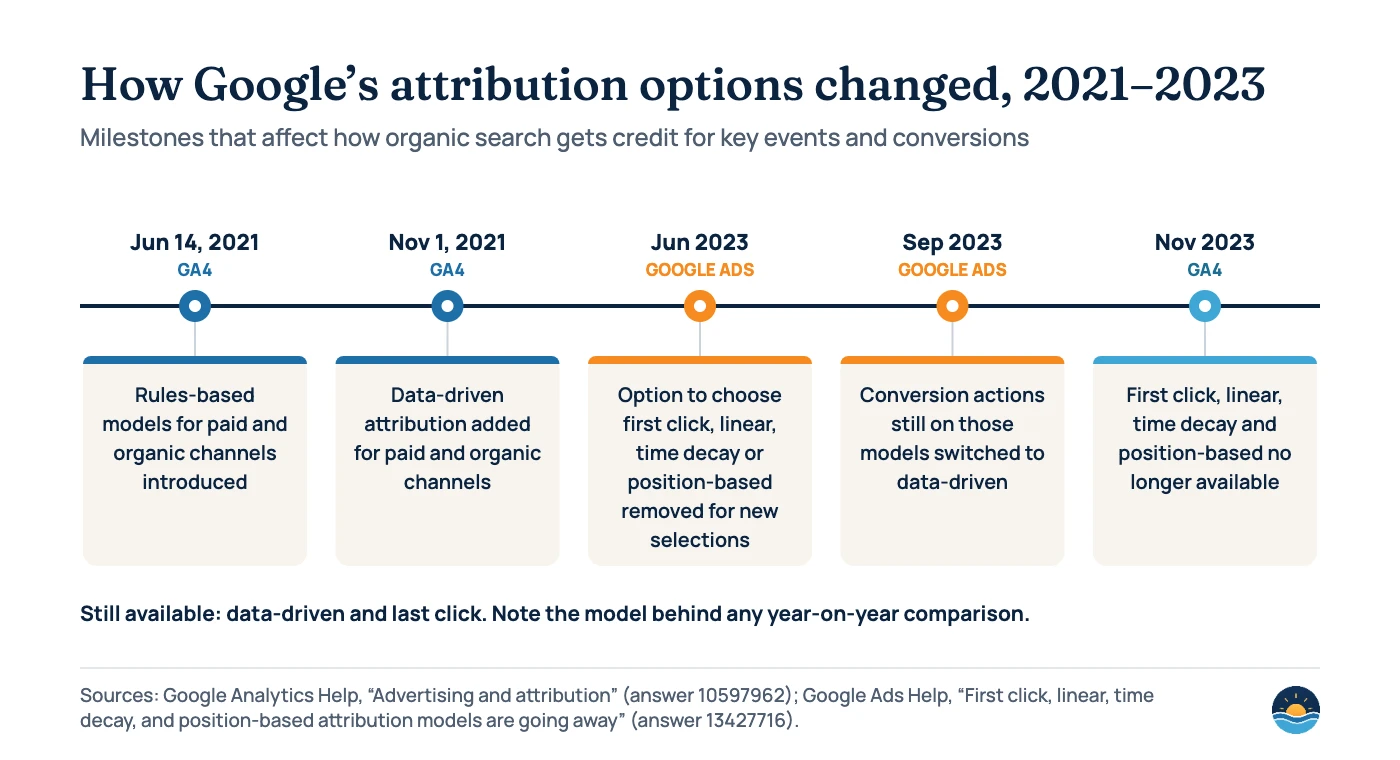
| GA4 setting | Options (per Google) | Effect on SEO ROI |
|---|---|---|
| Reporting attribution model | Data-driven or last click (first click, linear, time decay and position-based removed Nov 2023) | Changes how much credit organic search gets when people use several channels. Google notes that changing it “applies to historical and future data.” |
| Key event lookback window | Acquisition key events (first_visit, first_open): 30 days default, or 7. All other key events: 90 days default, or 30 or 60 | Shorter windows give less credit to early research visits, which are often organic |
| Channel credit setting | “Google paid channels” or “Paid and organic channels” (web only) | Only the second option lets organic search receive credit in the advertising reports |
| Default channel group | Organic Search covers non-ad search results, including Google AI Overviews and AI Mode; a separate AI Assistant channel covers sources such as ChatGPT, Gemini and Copilot | Decide whether AI Assistant traffic counts as part of your “SEO” value, and say so |
Where does Search Console fit in?
Search Console measures what happens before the click: impressions, clicks, average position and the queries behind them. Google Analytics measures what happens after it. Linking the two puts both views in one place. According to Google’s Search Console linking help, you need the Editor role on the Analytics property and must be a verified owner of the Search Console property. A web data stream can link to only one Search Console property, and the reverse is also true.
Once linked, two reports appear: Google Organic Search Queries and Google Organic Search Traffic. Search Console data arrives in Analytics 48 hours after Search Console collects it, and both tools keep a maximum of 16 months. Search Console metrics only combine with the Landing page, Device and Country dimensions, so you can’t join a query directly to a sale. Landing pages are the bridge: match the pages that earn impressions with the pages that start sessions ending in key events.
Why do clicks undercount SEO’s value?
An ROI model built only on last-click sessions misses part of what search does. In a Pew Research Center analysis of the browsing data of 900 U.S. adults in March 2025, users clicked a traditional search result in 8% of visits to a results page with an AI summary, compared with 15% without one. They clicked a link inside the summary in just 1% of such visits. AI summaries appeared on 18% of the 68,879 searches studied.
Fewer clicks don’t mean less influence. People still see your brand in results, then return later by typing your URL or searching your name. That is why it helps to track impressions and branded search alongside revenue, and to read our guide to AI Overviews and SEO before you judge a page by clicks alone.
Count in SEO ROI
Key events from Organic Search sessions; offline sales you can match to organic leads in your CRM; the cost of every input, including your own team’s time.
Report beside it, not inside it
Impressions and average position; branded search trends; AI Assistant referrals; assisted key events. These show direction even when you can’t put a dollar value on them.
A seven-step process to measure SEO ROI
- Define the actions that matter. Mark form submissions, calls, bookings and purchases as key events in GA4. Skip vanity events such as scrolls.
- Give each action a value. Use real revenue for sales. For leads, use average deal value × close rate from your CRM, and review it every quarter.
- Check your attribution settings. Note the reporting model, lookback windows and channel credit setting, and keep them stable.
- Link Search Console. Connect it to the right web data stream so landing-page visibility and outcomes sit side by side.
- Total the cost. Add agency fees, staff time, content, tools and development for the same period. Separate one-off costs from monthly ones.
- Calculate and annotate. Work out (value − cost) ÷ cost, and write the time window, model and any tracking changes beside the result.
- Act on the page-level picture. Find the landing pages that earn the most value per visit and prioritise work that grows them. Our guide to prioritising SEO work shows how to rank those tasks.
Frequently asked questions
How long does it take to see a return from SEO?
It depends on your starting point, competition and how much work is done, and nobody can promise a ranking. Google’s own advice for hiring an SEO is to ask what results they expect, in what timeframe, and how they measure success, and it warns that no one can guarantee a #1 ranking on Google.
What is a good SEO ROI?
Any return above 0% means SEO earned more than it cost over the period you measured. A better question is whether the return beats your other channels on the same attribution model and time window, and whether it is growing.
Can I measure SEO ROI without ecommerce?
Yes. Track leads, calls and bookings as key events, then estimate their value from your CRM: average deal value multiplied by the share of leads that become customers. Update the estimate as real sales data comes in.
Should traffic from ChatGPT count as SEO?
GA4 puts sources such as ChatGPT, Gemini and Copilot in a separate AI Assistant channel, while Google AI Overviews and AI Mode traffic stays in Organic Search. Many teams report AI Assistant value next to SEO rather than inside it. Whatever you choose, state it in the report.
Sources
- Events and key events — Google Analytics Help — key event definition; key events vs Google Ads conversions
- Advertising and attribution — Google Analytics Help — models removed Nov 2023, lookback windows, channel credit settings
- First click, linear, time decay, and position-based attribution models are going away — Google Ads Help — June and September 2023 changes in Google Ads
- [GA4] Default channel group — Google Analytics Help — Organic Search and AI Assistant channel definitions
- Connect Search Console to Google Analytics — Google Analytics Help — linking requirements, reports, 48-hour delay, 16 months of data
- Google users are less likely to click on links when an AI summary appears in the results — Pew Research Center, July 22, 2025 — click rates with and without AI summaries
- Do you need an SEO? — Google Search Central, last updated Jun 5, 2026 — questions to ask about results, timeframe and measurement
Cite this article: Bright Harbour Media. “How to Measure SEO ROI with GA4 and Search Console.” Bright Harbour Media Insights, October 2026. https://brightharbourmedia.com/measuring-seo-roi/
You are welcome to reference the charts and frameworks in this article with a link back to this page.
Need an SEO plan you can measure in dollars, not just rankings? Our SEO strategy and consulting service sets up the tracking, targets and reporting to show what search is worth to your business. Get in touch to start the conversation.