A brand mention is any reference to your business name on another website, with or without a link. Google has said for years that an unlinked mention is not treated as a link and passes no PageRank, yet the largest public studies of AI search find that brands mentioned widely across the web are the ones AI answers name most often. So you need both, and they do different jobs.
Key takeaways
- Google’s John Mueller said in December 2018 that an unlinked mention “doesn’t pass any PageRank”, and in April 2022 that “we don’t treat these as links.”
- Google’s ranking systems guide (updated Dec 10, 2025) says PageRank “continues to be part of our core ranking systems”, so earned links still matter for classic rankings.
- In Ahrefs’ study of 75,000 brands (May 26, 2025), branded web mentions had the strongest correlation with AI Overview mentions (0.664), well ahead of backlinks (0.218).
- Google’s Search Quality Rater Guidelines (Sept 11, 2025) tell raters that news articles, Wikipedia, blog posts and forum discussions “can all be great sources of reputation information.”
- In an Ahrefs check of 558 URLs, 164 (about 29%) contained unlinked mentions, so reclaiming a link is often a short, polite request rather than new outreach.
What is the difference between a brand mention and a backlink?
A backlink is a crawlable HTML link from another site to yours. Google’s link best practices say “Google uses links as a signal when determining the relevancy of pages and to find new pages to crawl,” and that Google can generally only crawl a link if it is an <a> element with an href attribute.
A brand mention is simply your name in someone else’s content: a news story, a supplier list, a podcast show-notes page, a Reddit thread or a review. Some mentions carry a link, many do not. The useful distinction for planning is not “mention or link” but which of three outcomes a placement can produce: a ranking signal through the link graph, a reputation signal that people (and quality raters) can read, or simple awareness that leads to branded searches.
| Unlinked mention | Followed editorial link | nofollow / sponsored / ugc link | |
|---|---|---|---|
| Is it a link for Google? | No. Mueller (2018, 2022): not treated as a link | Yes | Yes, but the rel value is treated as a hint |
| Passes PageRank? | No, according to Google’s on-record answers | Can do | A hint: Google decides whether to use it |
| Can send referral visits? | Only if readers search for you | Yes | Yes |
| Counts as reputation evidence for raters? | Yes, if from an independent source | Yes | Yes |
| Correlates with AI answer mentions (Ahrefs 2025)? | Strongest factor studied (0.664) | Backlinks 0.218; branded anchors 0.527 | Not measured separately |
For background on how qualified links work, see our guide to nofollow, sponsored and UGC links.
Does Google count unlinked brand mentions as links?
There is no Search Central documentation that treats unlinked mentions as links or “implied links”. What exists are on-record answers from Google’s John Mueller, reported by the search trade press:
- December 21, 2018 (Webmaster hangout): Google may pick up a mention, “but it’s not a link, it doesn’t pass any PageRank.” (Search Engine Roundtable)
- May 21, 2020 (Twitter): asked whether unlinked citations help a site’s trust, Mueller replied “The short version is ‘usually not, imo’.” (Search Engine Roundtable)
- Reported December 21, 2021 (hangout): mentions are “too confusing to use as a clear signal,” though they may make people aware of a brand and so have an indirect effect. (Search Engine Journal)
- Reported April 5, 2022 (office hours): “we don’t treat these as links.” (Search Engine Journal)
The phrase “implied links” comes from SEO readings of a 2012 Google patent. Search Engine Journal’s February 2022 analysis argues it was taken out of context, and a patent is not evidence that a system is in use. Google’s public How Search Works page does say that one quality factor is “understanding if other prominent websites link or refer to the content,” but it does not say how references without links are measured.
The practical reading: for classic organic rankings, an editorial link is worth more than the same mention without one. Google’s ranking systems guide still lists link analysis and PageRank among its core systems.
Why do brand mentions matter for AI search?
Google’s own position is that AI features use the same foundations as Search. Its AI features documentation (updated Dec 10, 2025) says “There are no additional requirements to appear in AI Overviews or AI Mode, nor other special optimizations necessary,” and that a page must be indexed and eligible to show with a snippet to appear as a supporting link.
Studies of which brands get named in AI answers point at mentions. Ahrefs analysed 75,000 brands (domains with Domain Rating above 40) against their mentions in millions of AI Overview responses, using Spearman correlation. About 26% of brands had no AI Overview mentions at all and were excluded.
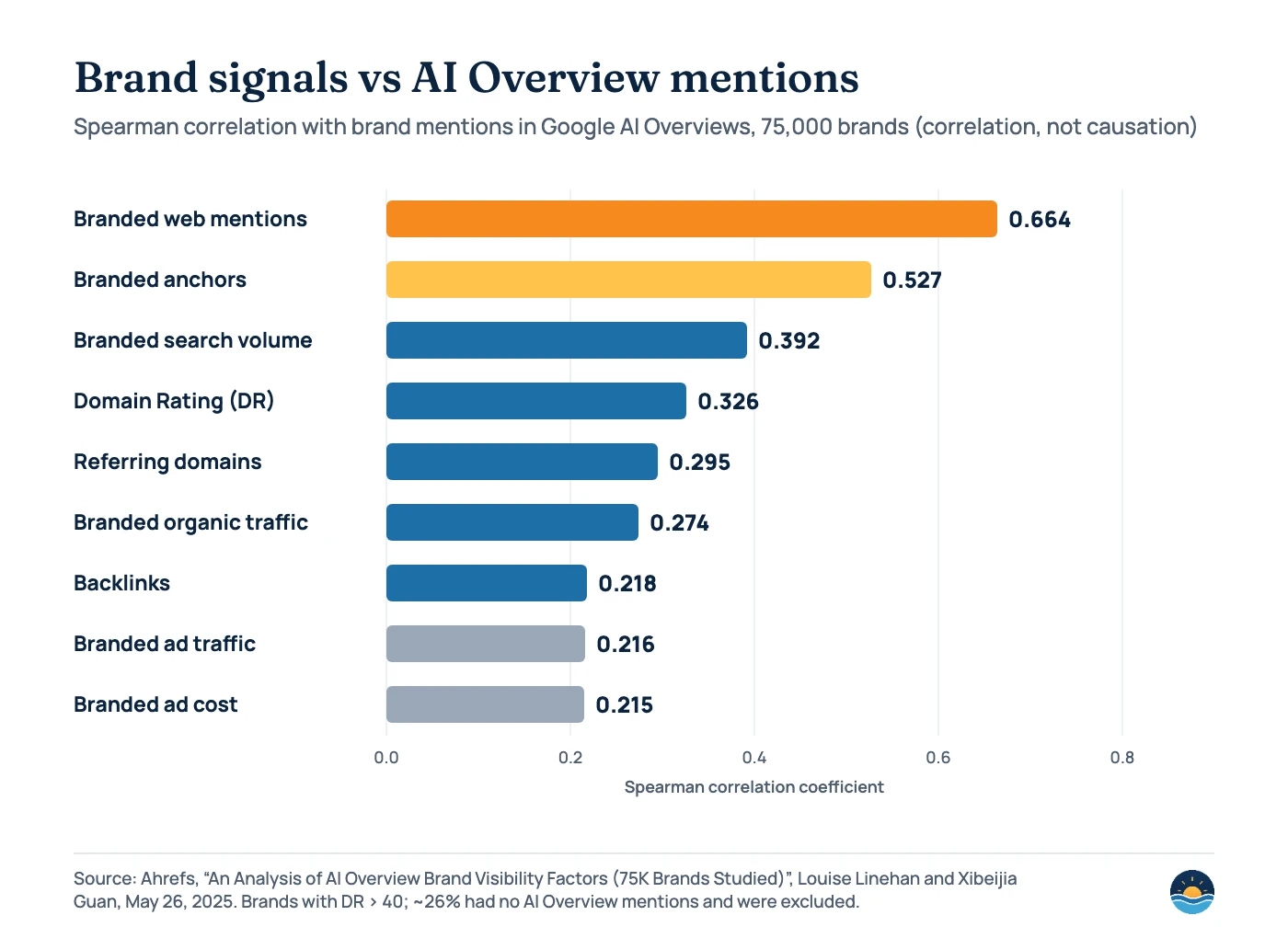
Ahrefs also reported that brands in the top quarter for web mentions averaged 169 AI Overview mentions, against 14 for the next quarter. Its December 12, 2025 follow-up extended the analysis to ChatGPT and AI Mode, where branded web mentions again correlated at 0.66 to 0.71, and YouTube mentions came out highest at about 0.737.
Two cautions matter. First, Ahrefs itself says “correlation ≠ causation” and that all the factors it studied showed moderate to very weak correlations. Big, well-known brands naturally have more mentions, more searches and more AI visibility at the same time. Second, links are not irrelevant: “branded anchors” (links whose anchor text is your brand name) were the second-strongest factor, and a Semrush study of 1,000 domains (Oct 16, 2025) found link-based authority also correlated with AI mentions. For more on the AI side, see our AI Overviews guide.
| Study | Sample and date | What it found | Caveat |
|---|---|---|---|
| Ahrefs, AI Overview brand visibility factors | 75,000 brands, published May 26, 2025 | Branded web mentions 0.664; branded anchors 0.527; backlinks 0.218 | Spearman correlation; brands with no AIO mentions excluded |
| Ahrefs, ChatGPT, AI Mode and AI Overviews | 75,000 brands, published Dec 12, 2025 | Branded web mentions 0.656–0.709 across the three platforms (highest, 0.709, in AI Mode); YouTube mentions ~0.737 | Same brand set; correlation, not causation |
| Seer Interactive, what drives brand mentions | 10,000 questions in finance and SaaS, GPT-4o, Jan 7, 2025 | Page-one Google rankings ~0.65 correlation; backlinks “weak or neutral” | Two industries, one model |
| Semrush, backlinks and AI search | 1,000 domains, five AI platforms, Oct 16, 2025 | Authority Score vs AI mentions: Pearson 0.65, Spearman 0.57 | Measures link metrics, not unlinked mentions |
How do raters and reputation fit in?
Google’s Search Quality Rater Guidelines (version dated September 11, 2025) make reputation research mandatory for page quality ratings. Section 3.3.1 tells raters to look for “independent reviews, references, recommendations by experts, news articles, and other sources,” and says news articles, Wikipedia articles, blog posts, magazine articles, forum discussions and ratings from independent organisations “can all be great sources of reputation information.”
Raters do not rank pages; their ratings help Google evaluate its systems. But the guidelines show what Google’s systems are designed to reward: a business that independent sources talk about. That is a mention-shaped signal, whether or not the writer adds a link. The guidelines even suggest searches such as [ibm -site:ibm.com] for finding what others say about a site, which doubles as a quick way to audit your own mentions.
Which should you prioritise: links or mentions?
Prioritise links when…
- A page you need to rank has few or no referring domains
- The mention is already on a relevant, editorial page that cites a fact or resource of yours
- A broken or outdated link to you can be fixed
- A local partner, supplier or association already lists you
Prioritise mentions when…
- You want your brand named in AI answers for category questions
- Reviews, roundups or forum threads shape buying decisions in your market
- You have expertise journalists can quote (links may or may not follow)
- Branded search demand is low and awareness is the real gap
Most businesses need both, and the same activity often produces both: good digital PR earns coverage that names you and sometimes links. The rule we use is to pursue mentions for reputation and AI visibility, then convert the best ones into links where it is natural.
How to find and reclaim unlinked brand mentions
Reclamation means asking a site that already mentions you to add a link. It works because the writer has already chosen to talk about you, so the request is small. In Ahrefs’ example, 329 of 393 mentions of “nike” in one week (about 84%) did not link, and a separate check found unlinked mentions on 164 of 558 URLs (about 29%).
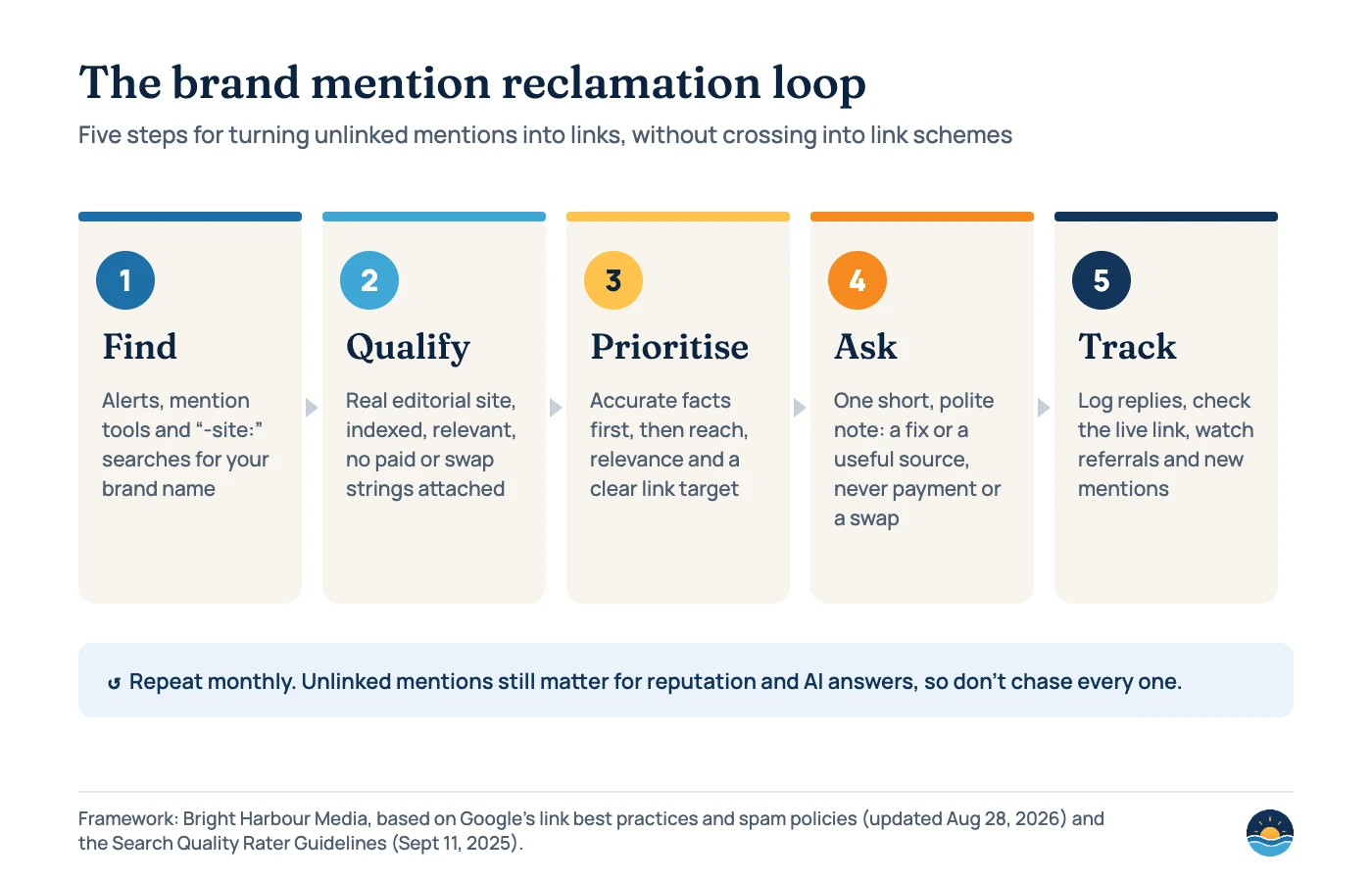
- Set up monitoring. Google Alerts emails you when new results for a name appear in Google Search, with options for frequency, sources, language and region. Paid tools such as Ahrefs Alerts and Content Explorer, or Semrush’s brand monitoring, can filter for mentions without links.
- Search manually once a quarter. Use quoted searches for your brand, products and founders, excluding your own site with
-site:, plus variations and common misspellings. - Qualify each mention. Keep editorial pages on real sites that are indexed and relevant. Skip scraped copies, spam directories and anything that would need payment.
- Fix the facts first. A wrong phone number, old name or outdated price is worth correcting even if no link follows. Accuracy is the easiest reason to get in touch.
- Suggest a specific link target. Point to the page that helps the reader most: the study they quoted, the product they named or your contact page. Keep anchor text natural; your brand name is usually right.
- Send one short, polite note. Thank them, give the URL and leave it there. No payment, no gifts in exchange for a link, no link swaps.
- Track the result. Log each request, check that any new link is a crawlable
<a href>, and watch referral traffic and branded searches over the following months.
Stay inside Google’s spam policies (updated Aug 28, 2026). They define link spam as creating links “primarily for the purpose of manipulating search rankings,” and list examples including sending someone a product in exchange for a review that includes a link, and excessive link exchanges. If a site asks for money, the link must be qualified with rel="sponsored" or rel="nofollow". Our guide to backlink anchor text covers why brand-name anchors are the safest default.
| Mention type | Worth asking for a link? | Why |
|---|---|---|
| News story quoting your data or expert | Yes, to the original data or page | Citing a source helps readers; journalists often add links on request |
| Supplier, partner or association list | Yes | A natural, relevant link that confirms the relationship |
| “Best of” roundup that names you | Yes, politely | Roundups often link other entries; ask to be treated the same way |
| Forum or Reddit thread | No | User-generated links are usually ugc/nofollow, and asking can look like spam |
| Review sites and directories | Check the profile instead | Most have their own website field; keep details accurate |
| Scraped or auto-generated copies | No | Low quality; a link there adds risk, not value |
How do you measure mentions and links together?
Track three numbers each month: new referring domains (from Search Console’s Links report or a backlink tool), new mentions from your alerts, and branded search impressions in Search Console. For AI visibility, run a fixed list of category questions in the AI tools your customers use and record whether your brand is named and which sources are cited. Treat that as a sample, not a rank tracker: answers vary between runs.
If mentions rise but branded searches and enquiries do not, the coverage may be in the wrong places. If links rise but AI visibility does not, you may be earning links that never mention your brand in context. Our guide to pitching journalists covers how to earn coverage that does both.
Frequently asked questions
Do unlinked brand mentions help SEO?
Not as links. Google’s John Mueller has said several times, most recently on record in April 2022, that unlinked mentions are not treated as links and pass no PageRank. They can still help indirectly through awareness, branded searches and reputation, and they correlate strongly with being named in AI answers.
Are backlinks still important in 2026?
Yes for classic rankings. Google’s ranking systems guide (updated Dec 10, 2025) says PageRank continues to be part of its core ranking systems, and its link best practices describe links as a relevance signal. Quality and relevance matter far more than volume.
How do I get my brand mentioned in AI Overviews?
Google says there are no special requirements beyond being indexed and eligible for a snippet. Beyond that, the brands AI answers name most tend to be widely mentioned across independent sites, according to Ahrefs’ 2025 study, so earned coverage, reviews and expert commentary are the levers. No one can guarantee a mention.
Is it OK to ask a site to turn a mention into a link?
Yes, as long as you only ask. Offering money, free products or a link swap in return would fall under Google’s link spam examples. If a site insists on payment, the link should carry rel=”sponsored” or rel=”nofollow”.
Sources
- An Analysis of AI Overview Brand Visibility Factors (75K Brands Studied) — Ahrefs (Louise Linehan, data by Xibeijia Guan), May 26, 2025 — correlation figures, quartile averages and caveats
- Top Brand Visibility Factors in ChatGPT, AI Mode, and AI Overviews (75k Brands Studied) — Ahrefs, Dec 12, 2025 — per-platform correlations and YouTube mentions
- STUDY: What Drives Brand Mentions in AI Answers? — Seer Interactive, Jan 7, 2025 — rankings vs backlinks correlation
- Do Backlinks Still Matter in AI Search? Insights from 1,000 Domains — Semrush, Oct 16, 2025 — Authority Score vs AI mentions
- A guide to Google Search ranking systems — Google Search Central, updated Dec 10, 2025 — link analysis and PageRank
- Link best practices for Google — Google Search Central, updated Dec 10, 2025 — links as a signal, crawlable links
- Spam policies for Google web search — Google Search Central, updated Aug 28, 2026 — link spam definition and examples
- AI features and your website — Google Search Central, updated Dec 10, 2025 — AI Overviews and AI Mode eligibility
- How Search Works: Ranking results — Google — “link or refer to the content” quality factor
- Search Quality Rater Guidelines — Google, version Sept 11, 2025 — reputation research, section 3.3
- Google Picks Up On Web Mentions But Says They Are Not Links — Search Engine Roundtable, Dec 21, 2018 — Mueller on PageRank
- Unlinked Citations Usually Do Not Help With Google Rankings — Search Engine Roundtable, May 21, 2020 — Mueller “usually not”
- Does Google Treat Unlinked Mentions Like Links? — Search Engine Journal, Apr 5, 2022 — Mueller “we don’t treat these as links”
- Google’s John Mueller on Brand Mentions — Search Engine Journal, Dec 21, 2021 — “too confusing to use as a clear signal”
- A Simple Guide to Turning (Unlinked) Brand Mentions into Links — Ahrefs (Joshua Hardwick), updated Dec 18, 2025 — unlinked mention examples
- Create an alert — Google Search Help — Google Alerts options
Cite this article: Bright Harbour Media. “Brand Mentions vs Backlinks: What Counts for SEO and AI Search.” Bright Harbour Media Insights, November 2026. https://brightharbourmedia.com/brand-mentions-vs-backlinks/
You are welcome to reference the charts and frameworks in this article with a link back to this page.
Want more of the coverage that names and links to your business? Our link building and digital PR service finds the mentions you already have, turns the right ones into links and earns new ones the safe way. Get in touch to talk it through.