
Anchor text is the visible, clickable text of a link. Google says it “tells people and Google something about the page you’re linking to,” so the words other sites use when they link to you help Google understand your pages. But anchors that you place or optimise on other sites to manipulate rankings count as link spam under Google’s policies.
Key takeaways
- Google’s link best practices (updated Dec 10, 2025) define good anchor text as “descriptive, reasonably concise, and relevant” to both the linking page and the page it links to.
- Google’s spam policies (updated Aug 28, 2026) list “links with optimized anchor text in articles, guest posts, or press releases distributed on other sites” as link spam.
- Anchor text has been part of Google since the start: Brin and Page’s 1998 paper indexed over 259 million anchors from a crawl of 24 million pages.
- In Ahrefs’ study of 384,614 pages, the correlation between exact-match anchors and rankings was only 0.1436, and the median exact-match share was zero at every ranking position.
- Since the December 2022 link spam update, Google uses SpamBrain to neutralise unnatural links, and “any credit passed by these unnatural links are lost.”
What is anchor text and why does Google use it?
Anchor text (also called link text) is the part of a link you can see and click. In the HTML <a href="https://example.com/cheese-types/">list of cheese types</a>, the anchor text is “list of cheese types”.
Using the words of a link to describe the page it points to is one of the oldest ideas in Google Search. In their 1998 paper describing the original Google, Sergey Brin and Lawrence Page wrote that most search engines associated link text with the page the link is on, but “we associate it with the page the link points to.” Their reasoning: “anchors often provide more accurate descriptions of Web pages than the pages themselves.”
Google’s current documentation says the same thing in plainer terms. It uses links “as a signal when determining the relevancy of pages,” and better anchor text makes it easier “for Google to understand what the page you’re linking to is about.” A few details are worth knowing:
- For an image link, Google uses the image’s
altattribute as the anchor text. - If a link has no text, Google can fall back to the link’s
titleattribute. - Context counts: Google says “the words before and after links matter,” so the surrounding sentence adds meaning.
- Length isn’t scored as such. John Mueller said in a November 2020 office-hours session that Google uses anchor text “as a way to provide extra context” and that shorter anchors are not better or worse, just “different context”.
What are the main types of backlink anchor text?
SEO tools sort anchors into a handful of types. These are the definitions Ahrefs used in its anchor text study, with examples for a page targeting “backlink checker”:
| Anchor type | Definition | Example |
|---|---|---|
| Branded | The name of the brand | Ahrefs |
| Naked URL | The raw URL as it appears in a browser | https://ahrefs.com/backlink-checker/ |
| Random / generic | An unspecific phrase without the target keyword | click here, this article |
| Exact match | The exact keyword the page wants to rank for | backlink checker |
| Phrase match | Contains the keyword phrase | Ahrefs’ backlink checker |
| Partial match | Has all the query words, but not as an exact phrase | checker for any backlink |
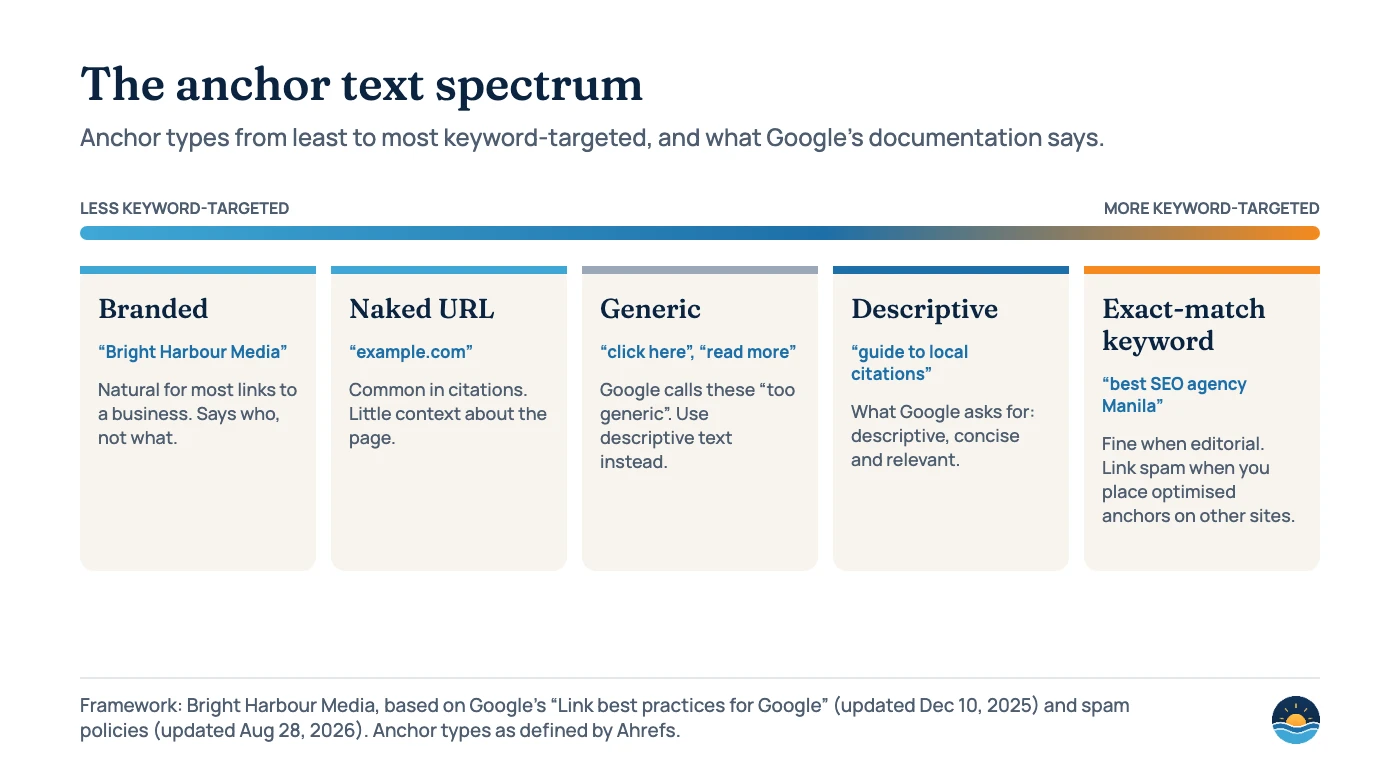
Most links a business earns naturally carry its brand name, its URL or a description of the page. Exact-match anchors do happen naturally, especially when a writer is describing a product or service, but a profile dominated by them is unusual, which is why they draw attention.
What does Google say about anchor text?
Google’s guidance comes from two directions: how to write good anchor text on your own site, and what crosses into link spam when links are created to manipulate rankings.
| Source | Date | What it says |
|---|---|---|
| Link best practices for Google | Updated Dec 10, 2025 | Good anchor text is “descriptive, reasonably concise, and relevant.” “Click here”, “read more”, “website” and “article” are labelled “too generic”. Resist the urge “to cram every keyword” into an anchor. |
| SEO Starter Guide | Updated Dec 10, 2025 | With good anchor text, “users and search engines can easily understand what your linked pages contain before they visit.” |
| Spam policies: link spam | Updated Aug 28, 2026 | Link spam includes optimised anchor text in articles, guest posts or press releases distributed on other sites; keyword-rich links in widgets; widely distributed footer or template links; and forum comments with optimised links in the post or signature. |
| “Another step to reward high-quality sites” (the update later known as Penguin) | Apr 24, 2012 | Targeted webspam “from keyword stuffing to link schemes”; affected about 3.1% of English queries “to a degree that a regular user might notice.” |
| “Penguin is now part of our core algorithm” | Sep 23, 2016 | Penguin became real-time and “more granular”, devaluing spam “rather than affecting ranking of the whole site.” |
| July 2021 link spam update | Jul 26, 2021 | Flagged “campaigns of low quality sponsored and guest posts primarily intended to gain links”; affiliate links should use rel="sponsored". |
| December 2022 link spam update | Dec 14, 2022 | SpamBrain detects “both sites buying links, and sites used for the purpose of passing outgoing links.” Credit from unnatural links is lost. |
Two points stand out. First, Google’s 2012 announcement doesn’t mention anchor text by name; the link between Penguin and over-optimised anchors comes from how the SEO industry interpreted it, not from Google’s wording. Second, the current spam policies do name optimised anchor text explicitly, but only in the context of links created on other sites to manipulate rankings. An editor choosing a keyword-rich anchor to describe your page is not the problem; you engineering that anchor across many placements is. Our guides to guest posting and press releases cover where those lines fall.
Does exact-match anchor text still help rankings?
The best public data suggests the effect is small. Ahrefs looked at the top 20 results for 19,840 keywords (384,614 pages) and measured how the share of each anchor type correlated with ranking position.
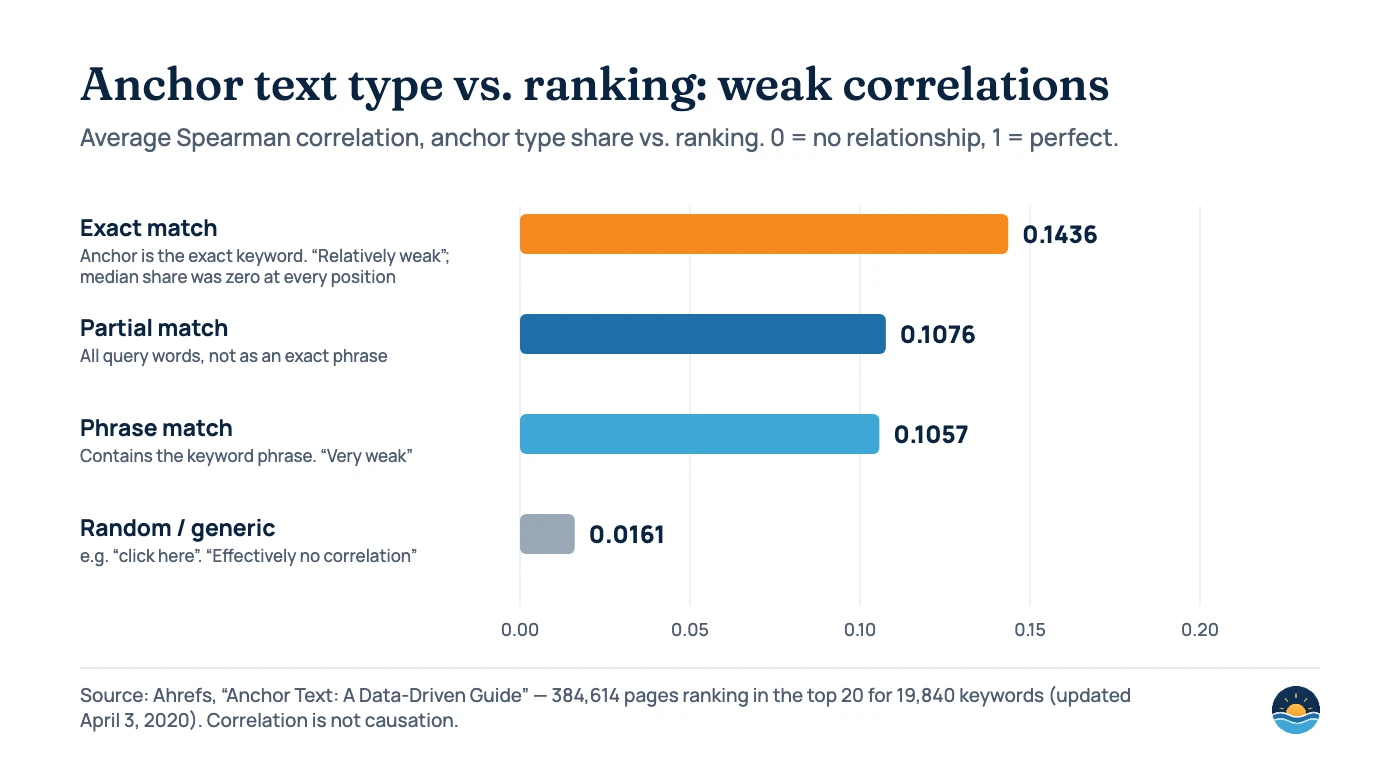
Ahrefs described the exact-match correlation as “relatively weak” and the generic one as “effectively no correlation.” Just as telling, the median share of exact-match anchors was zero at every ranking position: plenty of top-ranking pages had no exact-match backlinks at all. The author also flagged limits. Pages rank for hundreds of keywords, so the “exact” phrase for each page is a guess, and the study is several years old.
A newer, vendor-run analysis points the same way. SEOJuice reported in April 2026, from 12,000+ site audits, that sites in the top three positions typically had exact-match anchors in the 3–8% range, compared with 14–25% for sites in positions 20–50. That is the company’s own audit data, correlational and not independently verified, so treat it as directional rather than as a target.
| Study | Sample | Finding | Caveat |
|---|---|---|---|
| Ahrefs | 384,614 pages; top 20 for 19,840 keywords | Exact match 0.1436, partial 0.1076, phrase 0.1057, generic 0.0161 average correlation | Correlation only; exact keyword per page is estimated; last updated 2020 |
| Ahrefs (surrounding text) | 16,000 pages | Keywords in the text around links showed effectively no correlation with rankings | Same caveats as above |
| SEOJuice | 12,000+ site audits, 2024 to early 2026 | Top-three sites: exact-match share typically 3–8%; positions 20–50: 14–25% | Vendor data; interquartile ranges; “isn’t necessarily causal” |
Which anchors can you actually control?
You control
- Internal links on your own site, where descriptive anchors are encouraged (see our internal linking guide)
- Links in content you write or pay for elsewhere, which should use branded or descriptive anchors and
rel="sponsored"ornofollowwhen paid - Author bios, profiles and directory listings you fill in yourself
You don’t control (and shouldn’t try to)
- How journalists, bloggers and customers describe you when they link
- Old links from sites you have no relationship with
- Spammy links pointed at your site by others: Google says it “can assess which links to trust without additional guidance”
The distinction matters because Google’s policies target links created “primarily for the purpose of manipulating search rankings.” Asking a partner to change a natural link to an exact-match keyword turns an editorial link into an engineered one. For paid or sponsored placements, the safe route is to qualify the link, as explained in our guide to nofollow, sponsored and UGC links.
How to review your backlink anchor text in six steps
- Pull your anchors. In Search Console’s Links report, the “Top linking text” table shows anchor text from links outside your property, grouped by exact match and sorted by count. It is a sample, and tables are limited to 1,000 rows, so add a third-party backlink tool if you need more.
- Classify them. Sort anchors into branded, URL, generic, descriptive and exact match. Most healthy business profiles lean heavily towards branded and URL anchors.
- Look for patterns you created. Repeated keyword anchors from guest posts, press releases, widgets, site-wide footers or forum signatures are the patterns Google’s spam policies name.
- Fix what you control. Update your own bios and profiles to branded anchors, and ask for paid or sponsored links to be qualified with
rel="sponsored"ornofollow. - Don’t chase a ratio. Google publishes no ideal anchor text percentage. Earn links with useful pages and let editors describe them in their own words.
- Only disavow in serious cases. Google says to disavow only if you have “a considerable number of spammy, artificial, or low-quality links” that have caused, or likely will cause, a manual action. Our disavow guide explains when that applies.
Frequently asked questions
What percentage of anchors should be exact match?
Google doesn’t publish a ratio. In Ahrefs’ study the median exact-match share was zero at every ranking position, and a 2026 vendor analysis found top-three sites typically in the 3–8% range. Treat any “ideal” figure as opinion, not guidance.
Is branded anchor text good for SEO?
Branded anchors are what most natural links to a business look like, so they are normal and safe. They tell Google who you are rather than what a page is about, and the page content and surrounding text supply the rest of the context.
Should I ask sites to change the anchor text on existing links?
Usually not. Asking for keyword anchors on links you didn’t pay for turns editorial links into engineered ones. Requests to fix a wrong URL or a misspelt brand name are fine.
Do image links have anchor text?
Yes, in effect. Google says it uses the image’s alt attribute as the anchor text for image links, so a descriptive alt attribute helps in the same way descriptive link text does.
Sources
- Link best practices for Google — Google Search Central, last updated Dec 10, 2025: anchor text guidance and examples
- Spam policies for Google web search — Google Search Central, last updated Aug 28, 2026: link spam examples involving anchor text
- SEO Starter Guide — Google Search Central, last updated Dec 10, 2025
- Another step to reward high-quality sites — Google Search Central Blog, Apr 24, 2012
- Penguin is now part of our core algorithm — Google Search Central Blog, Sep 23, 2016
- A reminder on qualifying links and our link spam update — Google Search Central Blog, Jul 26, 2021
- December 2022 link spam update releasing for Google Search — Google Search Central Blog, Dec 14, 2022
- The Anatomy of a Large-Scale Hypertextual Web Search Engine — Sergey Brin and Lawrence Page, Computer Networks and ISDN Systems, 1998: anchor text section
- Anchor Text: A Data-Driven Guide (384,614 Web Pages Studied) — Ahrefs, updated Apr 3, 2020: anchor type correlation data
- Anchor Text Guide: What Actually Moves Rankings in 2026 — SEOJuice, Apr 21, 2026: vendor audit data on anchor distribution
- Google’s John Mueller: Long Anchor Text Gives Us More Context — Search Engine Journal, Nov 28, 2020
- Links report — Google Search Console Help: top linking text, sampling and row limits
- Disavow links to your site — Google Search Console Help: when to disavow
Cite this article: Bright Harbour Media. “Backlink Anchor Text: What Google’s Guidance Says.” Bright Harbour Media Insights, October 2026. https://brightharbourmedia.com/anchor-text-backlinks/
You are welcome to reference the charts and frameworks in this article with a link back to this page.
Want links that hold up to Google’s policies? Our link building and digital PR service earns editorial coverage rather than engineered anchors. Get in touch for a review of your backlink profile.