
Bing SEO is the work of getting your pages crawled, indexed and ranked by Microsoft Bing. That same index also feeds Copilot answers and Bing’s grounding results. Microsoft publishes six main ranking parameters (relevance, quality and credibility, user engagement, freshness, location and language, and page load time), so most good Google SEO carries over. Bing does add its own tools, chiefly IndexNow and Bing Webmaster Tools.
Key takeaways
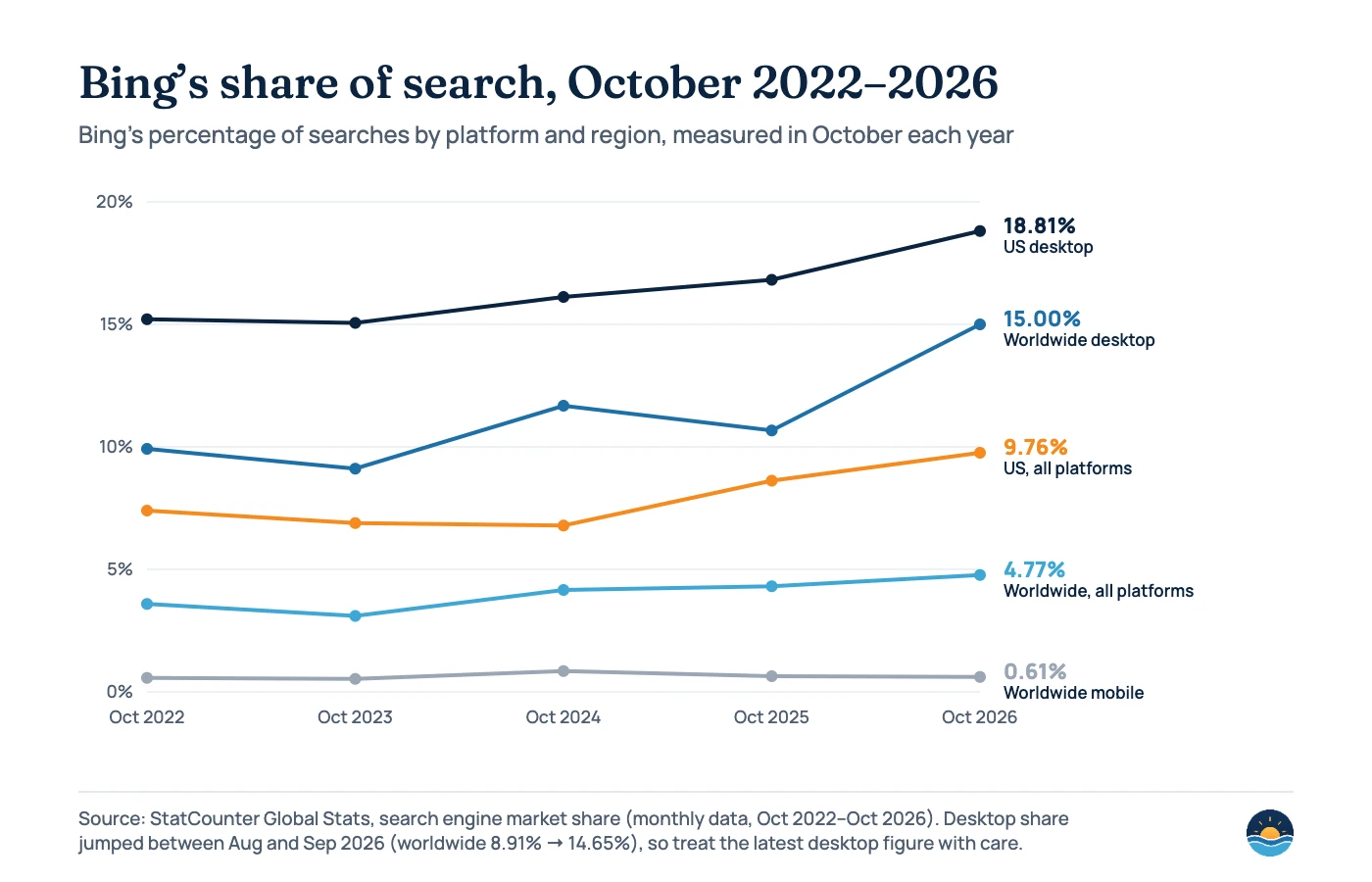
- In October 2026 Bing had 4.77% of searches worldwide but 9.76% in the US and 18.81% on US desktop (StatCounter).
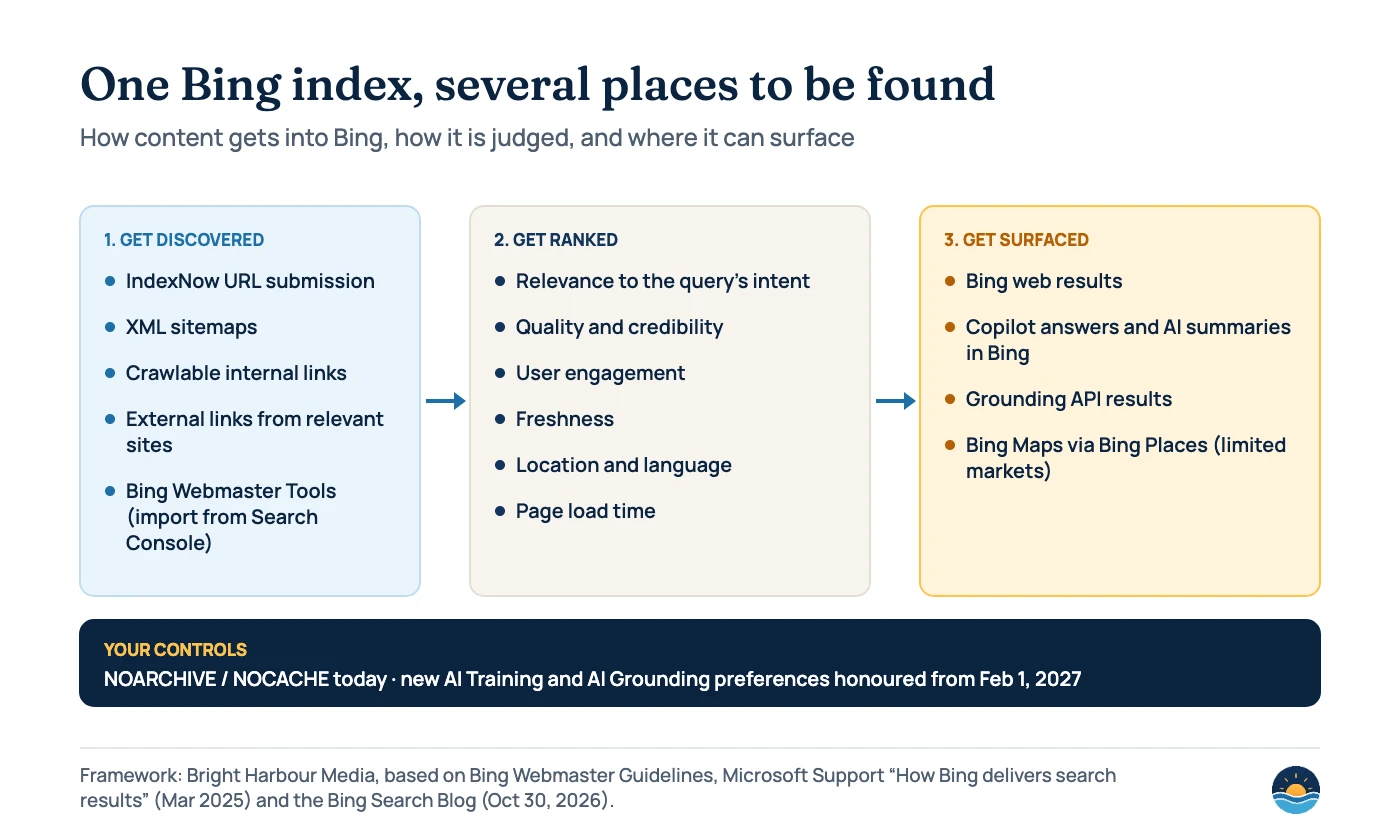
- Microsoft lists six main ranking parameters, including user engagement and page load time (Microsoft Support, last updated March 2025).
- Bing’s Webmaster Guidelines now cover Bing search, Copilot and grounding API results, and call IndexNow a discovery method.
- IndexNow accepts up to 10,000 URLs per request, and participating engines share submitted URLs with each other. Google isn’t on indexnow.org’s list of participating engines.
- From February 1, 2027, Microsoft will honour new AI Training and AI Grounding preferences. After March 1, 2027, NOARCHIVE and NOCACHE will no longer be read as those preferences.
How much search traffic does Bing actually get?
Worldwide, not much. StatCounter puts Bing at 4.77% of all searches in October 2026, against Google’s 91.04%. That figure hides big differences by device and country. Bing is close to absent on mobile (0.61% worldwide) but much stronger on desktop, and stronger again in the US.
| Market (Oct 2026) | Bing | |
|---|---|---|
| Worldwide, all platforms | 91.04% | 4.77% |
| Worldwide, desktop | 77.93% | 15.00% |
| Worldwide, mobile | 96.31% | 0.61% |
| United States, all platforms | 85.45% | 9.76% |
| United States, desktop | 74.82% | 18.81% |
Read the desktop numbers with care. Between August and September 2026, worldwide desktop share for Bing rose from 8.91% to 14.65%, and US desktop from 12.94% to 18.83%. A jump that size in one month can reflect measurement as much as behaviour. Even the 2022–2025 desktop figures show Bing above 15% of US desktop searches every October, which matters for B2B audiences who search at work.
Bing’s reach also goes beyond bing.com. DuckDuckGo says it “largely” sources its traditional links and images from Bing. Microsoft’s own guidelines cover “Bing search experiences, Copilot, and grounding API results”. A page that isn’t in Bing’s index can miss all of those surfaces at once.
How does Bing rank pages?
Microsoft’s support page How Bing delivers search results (last updated March 2025) lists the “main parameters of ranking”. Bing says it “relies on machine learning” trained on user interactions and on data labelled by human judges and/or AI systems with human oversight. It also says websites can’t pay to improve their organic positions.
| Parameter | What Microsoft says | What to do |
|---|---|---|
| Relevance | How closely the page matches “a user’s intent behind a search query”, including anchor text and synonyms | Match search intent; use clear headings and descriptive internal anchors |
| Quality and credibility | Clarity of purpose, usability and presentation; reputation (“What types of other websites link to the site?”), level of discourse, distortion, transparency of ownership | Show who runs the site, cite sources, earn links from relevant sites |
| User engagement | Did users click, spend time on the result, “or quickly return to Bing”, or reformulate the query | Write titles that match the page; answer the query early |
| Freshness | “Generally, Bing prefers fresh content” | Update key pages and signal changes with IndexNow |
| Location and language | User location, where the page is hosted, page language, and the location of other visitors | Localise pages and keep business details consistent |
| Page load time | Slow pages are “a poor user experience and a less helpful search result” | Fix slow templates first; measure in the field |
Two points stand out against Google’s public documentation. Bing names user engagement as a ranking parameter outright. And it names page ownership transparency as a credibility signal. Neither changes good practice much, but both reward pages that are clear about who wrote them and why.
What changed in Bing’s Webmaster Guidelines?
Bing rewrote its Webmaster Guidelines in early 2026. Search Engine Journal reported the change on February 27, 2026 and noted that Microsoft didn’t publish a separate announcement. The current page says Bing and Copilot “rely on the same core crawling, indexing, and ranking foundation as traditional search”, and it now sends readers to the Microsoft Support page for ranking details.
- Discovery: IndexNow, XML sitemaps, crawlable internal links and external links from relevant websites. Bing says to avoid batch submissions “when possible” because streaming submissions give faster updates.
- Redirects: “Use 302 redirects only for very short-term changes (less than 2 days)”, and “Use redirects instead of canonical tags” where you can.
- Content: “Thin, ad heavy, or affiliate-only URLs may lose ranking eligibility and grounding visibility.” Missing, duplicate or very short titles and meta descriptions may reduce indexing reliability.
- AI content: large-scale content generated “without oversight, quality control, or editorial review” may be excluded from indexing. AI-assisted content isn’t banned as such.
- Abuse: ten named practices, from cloaking and link schemes to misleading structured data and “Prompt Injection and AI Manipulation”.
- Measurement: “A decline in clicks does not always indicate a loss of visibility”, since a page can be cited in AI answers without a click.
The guidelines also introduce Generative Engine Optimization (GEO) and say plainly that “GEO does not guarantee grounding or citations in AI experiences.” For the wider click picture, see our analysis of zero-click searches.
What is IndexNow, and should you use it?
IndexNow is an open protocol for telling search engines that a URL has been added, updated or deleted. You host a key file (8 to 128 hexadecimal characters) on your site, then ping an endpoint with the changed URLs. You can send up to 10,000 URLs per request. Participating engines agree that submitted URLs “will be automatically shared with all other participating search engines.” indexnow.org lists Bing, Yandex, Seznam, Naver, Yep, the Internet Archive and Amazon. Google is not on that list.
IndexNow speeds up discovery, but it doesn’t guarantee indexing. The FAQ says every submitted URL “counts toward your site’s crawl quota” and that each engine decides for itself whether to index it. Submit real changes, not your whole site every day. Many CMS and SEO plugins can send IndexNow pings automatically, and Bing reported in August 2022 that more than 16 million websites were publishing over 1.2 billion URLs a day through the API. Sitemaps still matter for every engine, and our guide to XML sitemaps and crawl budget covers them.
What carries over from Google SEO
Crawlable links, accurate titles and descriptions, fast pages, helpful original content, clean redirects, honest structured data and links from relevant sites. Bing’s guidelines and ranking page reward all of them.
What is Bing-specific
IndexNow submissions, Bing Webmaster Tools (including AI Performance citation data), NOARCHIVE/NOCACHE controls for Copilot, the new AI preferences from 2027, and Bing Places for local listings in supported markets.
Which Bing Webmaster Tools reports are worth checking?
Setup is quick if you already use Google Search Console. Bing lets you import sites from Search Console, and imported sites “get automatically verified”. Data usually appears within 48 hours. Four reports cover most needs:
- Search Performance: clicks, impressions and keywords for up to the past six months.
- URL Inspection: index status, SEO errors and markup for a URL, plus a live view of “exactly what the Bingbot sees”.
- Site Explorer: a folder view of your site that flags redirects, crawl issues and URLs blocked by robots.txt.
- AI Performance: launched in public preview on February 11, 2026. It shows citations of your pages in Copilot and AI summaries in Bing, with metrics such as Total Citations and grounding queries. Bing says it “does not measure rankings, authority, performance, or importance.” Citation Share and Topics features followed in June and October 2026.
Report AI citations alongside clicks, not instead of them. Our SEO reporting KPIs guide shows how to keep visibility metrics separate from outcomes.
How do you control how Bing and Copilot use your content?
Bing supports the usual robots meta rules (noindex, nosnippet, data-nosnippet, max-snippet and others), which can also be sent as X-Robots-Tag headers. Two Bing-specific rules affect Copilot today: NOARCHIVE “prevents content from being used in Copilot responses and grounding results”, and NOCACHE limits Copilot to the URL, title and snippet.
That is changing. On October 30, 2026, Microsoft announced separate preferences for AI training (set in robots.txt, following the IETF AI Preferences draft, or at page level) and AI grounding (page level, with Allow, Disallow and DisallowExtended options). Microsoft says it will honour them from February 1, 2027. After March 1, 2027, NOARCHIVE and NOCACHE will no longer be read as training or grounding preferences. Microsoft also warns that opting out of grounding means “reduced brand visibility in AI experiences.” Our guide to AI crawlers and robots.txt covers the other engines.
A seven-step Bing SEO checklist
- Check how much Bing matters to you. Look at desktop share, your country and your audience. B2B and desktop-heavy sites usually see more Bing traffic.
- Verify in Bing Webmaster Tools. Import from Search Console and submit your XML sitemap.
- Turn on IndexNow. Use your CMS or SEO plugin, and ping only new, changed or deleted URLs.
- Fix crawl and redirect issues. Use Site Explorer and URL Inspection. Replace 302s that have lasted more than a couple of days with permanent redirects.
- Tighten titles and descriptions. Bing’s guidelines tie missing or duplicate tags to weaker indexing and grounding eligibility.
- Decide your AI policy. Review NOARCHIVE/NOCACHE use now, and plan your AI Training and AI Grounding preferences before February 1, 2027.
- Measure monthly. Track Bing clicks, AI Performance citations and leads from Bing as separate lines in your report.
Frequently asked questions
Is Bing SEO different from Google SEO?
Mostly not. Microsoft’s ranking parameters (relevance, quality, engagement, freshness, location and speed) line up with good Google practice. The differences are tools and controls: IndexNow, Bing Webmaster Tools and Bing’s own Copilot content directives.
Does Google use IndexNow?
Google is not listed as a participating engine on indexnow.org. Use XML sitemaps and Google Search Console for Google, and IndexNow for Bing and the other participating engines.
Is Bing worth the effort for a small business?
Usually, because the extra work is small. In October 2026 Bing had 9.76% of all US searches and 18.81% of US desktop searches (StatCounter). Verifying Bing Webmaster Tools and enabling IndexNow takes little time.
Does blocking Copilot remove my site from Bing search?
No. NOARCHIVE and NOCACHE limit how Copilot uses your content; noindex is what removes a page from Bing results. From February 2027 Microsoft will use separate AI Training and AI Grounding preferences instead.
Sources
- How Bing delivers search results — Microsoft Support, last updated March 2025 — main ranking parameters, paid placement, Bing Places
- Bing Webmaster Guidelines — Microsoft Bing, no date shown (accessed Nov 7, 2026) — discovery, redirects, content quality, abuse, GEO
- Bing Adds GEO To Official Guidelines, Expands AI Abuse Definitions — Search Engine Journal, Feb 27, 2026 — timing of the guidelines rewrite
- Search Engine Market Share Worldwide — StatCounter Global Stats, monthly data Oct 2022–Oct 2026 (worldwide, US, desktop, mobile)
- IndexNow documentation — IndexNow.org — key format, 10,000 URLs per request, URL sharing
- IndexNow FAQ — IndexNow.org — crawl quota, indexing decisions
- IndexNow participating search engines — IndexNow.org — list of participating engines
- IndexNow adoption gains momentum — Bing Webmaster Blog, August 2022 — 16 million sites, 1.2 billion URLs per day
- Add and verify site — Bing Webmaster Tools Help — Search Console import, 48 hours
- Introducing AI Performance in Bing Webmaster Tools Public Preview — Bing Webmaster Blog, Feb 11, 2026 — AI citation reporting
- Robots meta tags and attributes that Bing supports — Bing Webmaster Tools Help — noarchive, nocache, max-snippet, data-nosnippet
- Your content, your choice: clearer preferences for training and grounding — Bing Search Blog, Oct 30, 2026 — AI Training and AI Grounding preferences, Feb 1 and Mar 1, 2027 dates
- Where do your search results come from? — DuckDuckGo Help, no date shown — results “largely” sourced from Bing
Cite this article: Bright Harbour Media. “Bing SEO: How Bing Ranks Sites and Why It Matters.” Bright Harbour Media Insights, November 2026. https://brightharbourmedia.com/bing-seo/
You are welcome to reference the charts and frameworks in this article with a link back to this page.
Not sure how much of your search traffic you’re leaving with Bing and Copilot? Our SEO strategy and consulting service sizes the opportunity across search engines and AI assistants. Get in touch to start.