
A zero-click search is a search that ends without the searcher clicking through to any result: they get the answer on the results page, search again or leave. In SparkToro’s 2026 analysis of Similarweb clickstream data, 68.01% of US Google searches from January to April 2026 ended without a click.
Key takeaways
- SparkToro and Similarweb found 68.01% of US Google searches ended without a click in January–April 2026, and 62.1% to 69.5% across six countries. SparkToro’s 2024 study with Datos put the US at 58.5%, using a different panel.
- Pew Research Center found users clicked a traditional result on 8% of visits to a results page with an AI summary, against 15% without one (900 US adults, March 2025).
- Ahrefs found an AI Overview correlated with a 58% lower average click-through rate for the top-ranking page in December 2025, up from 34.5% in its first study.
- Google says total organic click volume has been “relatively stable year-over-year” but has published no data behind that claim.
- Search Console now reports AI Overview and AI Mode impressions: the generative AI performance reports reached all websites on 31 August 2026.
What counts as a zero-click search?
Clickstream studies count a search as zero-click when the searcher does not click any result before doing something else. In SparkToro’s 2024 study, which used Datos panel data from September 2022 to May 2024, that “something else” split two ways in the US: 37.1% of searches ended with no further action and 21.4% led to another search.
Not every click goes to an independent website either. In the same study, 28.5% of US clicks went to Google-owned properties such as YouTube, Maps, Images and News. That is why SparkToro reports a second number: clicks that reach the open web, which it put at 360 per 1,000 US searches in 2024.
Some zero-click searches are good for a business. A searcher who sees your opening hours, phone number or review rating in a Google Business Profile may call or visit without visiting your website. Others are simply lost traffic: the question was answered by an AI Overview or a featured snippet built from someone’s content.
How common are zero-click searches in 2026?
SparkToro’s June 2026 update, based on a Similarweb desktop and mobile panel, found 68.01% of US Google searches ended without a click between January and April 2026. Clicks of any kind fell 9.51 percentage points compared with 2024, and the share of searchers who performed another search rose by 7.2 points. AI Mode accounted for only 0.34% of searches in the period.
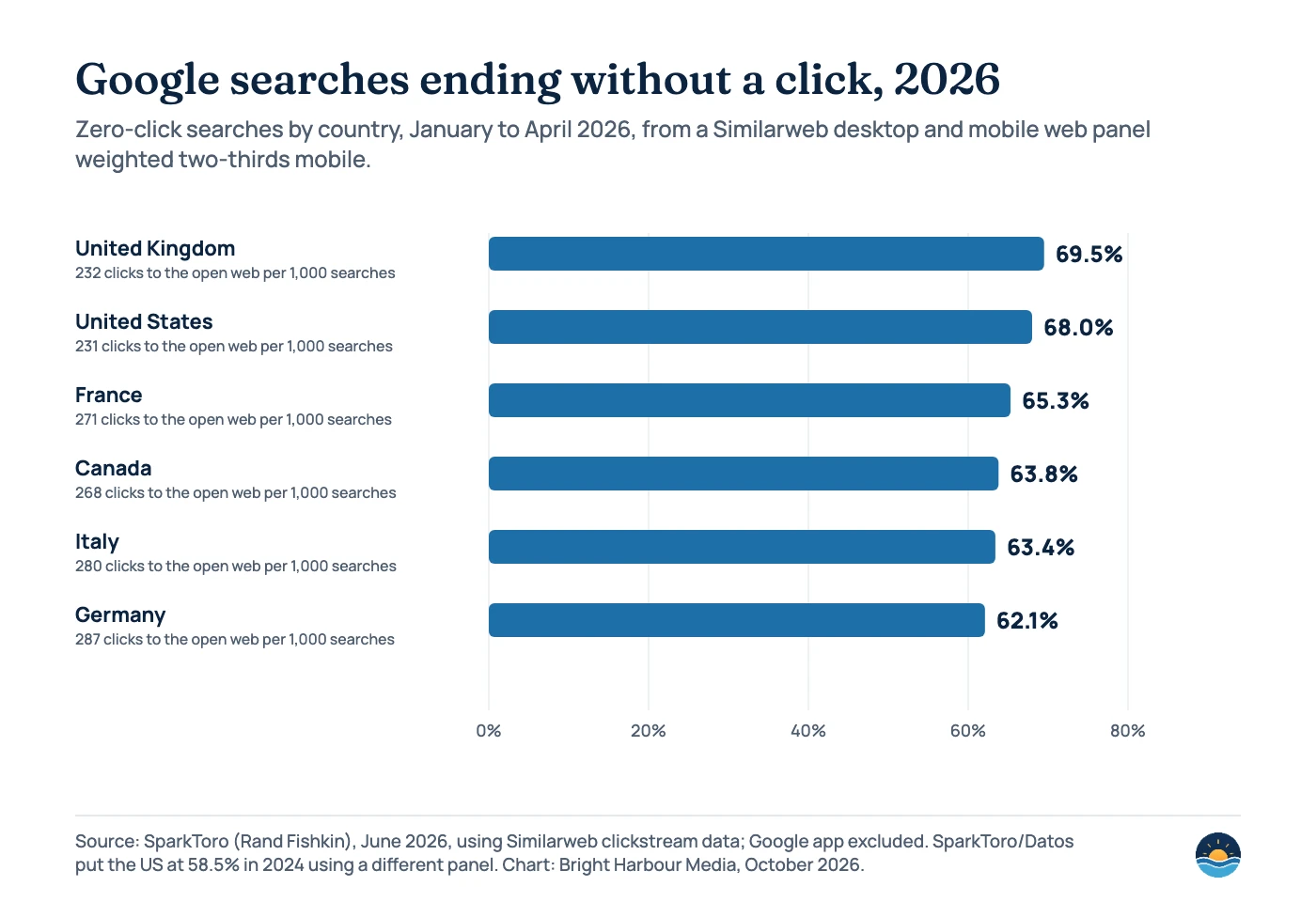
Treat year-on-year comparisons with care. The 2024 study used Datos data and reported 58.5% for the US; the 2026 post gives the 2024 US figure as 60.45%, and Rand Fishkin himself describes comparing panels across years as “a bit of apples and oranges.” Both data sets point the same way, but the size of the change depends on which baseline you use.
| Study | Data and period | Main finding |
|---|---|---|
| SparkToro / Datos (Jul 2024) | Datos clickstream panel, US and EU, Sep 2022–May 2024 | US: 58.5% zero-click; 360 open-web clicks per 1,000 searches. EU: 59.7%; 374 per 1,000 |
| SparkToro / Similarweb (Jun 2026) | Similarweb desktop and mobile panel, US, Jan–Apr 2026; Google app excluded | 68.01% zero-click; clicks of any kind down 9.51 points |
| SparkToro / Similarweb (Jun 2026) | Same panel, six countries, Jan–Apr 2026 | UK highest at 69.5%; Germany lowest at 62.1% |
| Pew Research Center (Jul 2025) | Browsing data from 900 US adults, March 2025; 68,879 searches | About two-thirds of searches ended without a result click; 18% of searches showed an AI summary |
| Similarweb via TechCrunch (Jul 2025) | News-related searches only | Zero-click news searches grew from 56% to nearly 69% by May 2025 |
Do AI Overviews reduce clicks?
Most independent studies say yes for informational queries, but they measure different things. Pew observed real behaviour: with an AI summary on the page, users clicked a traditional result on 8% of visits against 15% without one, clicked a link inside the summary on 1% of visits, and ended their browsing session on 26% of visits against 16%. Our guide to AI Overviews and SEO covers how those summaries choose their sources.
Studies based on Search Console data look at click-through rate for sets of keywords. Ahrefs compared 300,000 keywords and found an AI Overview correlated with a 34.5% lower average CTR for the top-ranking page in March 2025, and a 58% lower CTR when it re-ran the study with December 2025 data. Seer Interactive’s tracking shows a partial rebound: organic CTR on queries with an AI Overview rose from 1.3% in December 2025 to 2.4% in February 2026.
| Study | Method | Finding |
|---|---|---|
| Pew Research Center (22 Jul 2025) | Observed browsing, 900 US adults, March 2025 | 8% click a result with an AI summary vs 15% without; 1% click a link in the summary |
| Ahrefs (17 Apr 2025) | 300,000 keywords, Search Console data, March 2024 vs March 2025 | 34.5% lower average CTR for position one when an AI Overview appears |
| Ahrefs (4 Feb 2026) | Same method, December 2023 vs December 2025 | 58% lower average CTR for position one |
| Seer Interactive (4 Nov 2025) | 3,119 informational queries, 42 organisations, Jun 2024–Sep 2025 | Brands cited in the AI Overview got 35% more organic clicks than brands not cited |
| Seer Interactive (24 Apr 2026) | 53 brands, 5.47M queries, Jan 2025–Feb 2026 | AI Overview CTR rebounded 85% (1.3% to 2.4%); citation brought 120% more organic clicks per impression |
| Semrush (updated 15 Dec 2025) | 10M+ keywords plus Datos clickstream on 200K+ keywords, Jan–Oct 2025 | On keywords that gained an AI Overview, zero-click rate fell from 33.75% to 31.53% |
The Semrush result is the outlier, and it is a reminder that query mix matters. Seer found AI Overviews on 36% of informational queries but only 8% of commercial and 5% of transactional queries. A business whose leads come from “near me” or service-plus-city searches is exposed differently from a publisher answering how-to questions.
What does Google say about clicks?
Google disputes the more dramatic estimates. In an August 2025 blog post, Liz Reid, Google’s head of Search, wrote that “total organic click volume from Google Search to websites has been relatively stable year-over-year” and that Google is sending “slightly more quality clicks”, which she defined as clicks where users “don’t quickly click back.” She described third-party reports as often based on “flawed methodologies” but did not publish Google’s own figures.
Google’s documentation focuses on measurement. Traffic from AI features is included in Search Console’s Performance report under the “Web” search type, and Google says there are “no additional requirements to appear in AI Overviews or AI Mode.”
| What you want to know | What Search Console does |
|---|---|
| Is an AI Overview link an impression? | Yes. “An AI Overview occupies a single position in search results, and all links in the AI Overview are assigned that same position.” |
| Does a click on an AI Overview link count? | Yes. Clicking an external link in an AI Overview or AI Mode counts as a click |
| Can I see AI feature visibility separately? | Yes. Generative AI performance reports show impressions in AI Overviews and AI Mode by page, country, device and date (all sites since 31 Aug 2026) |
| Can I separate brand searches? | Yes. The branded queries filter, announced 20 Nov 2025, is available to all eligible sites (top-level properties) |
| Does an impression mean someone saw it? | Not necessarily. An impression counts when the item appears on the current results page, “whether or not the item is scrolled into view” |
How should zero-click searches change your SEO strategy?
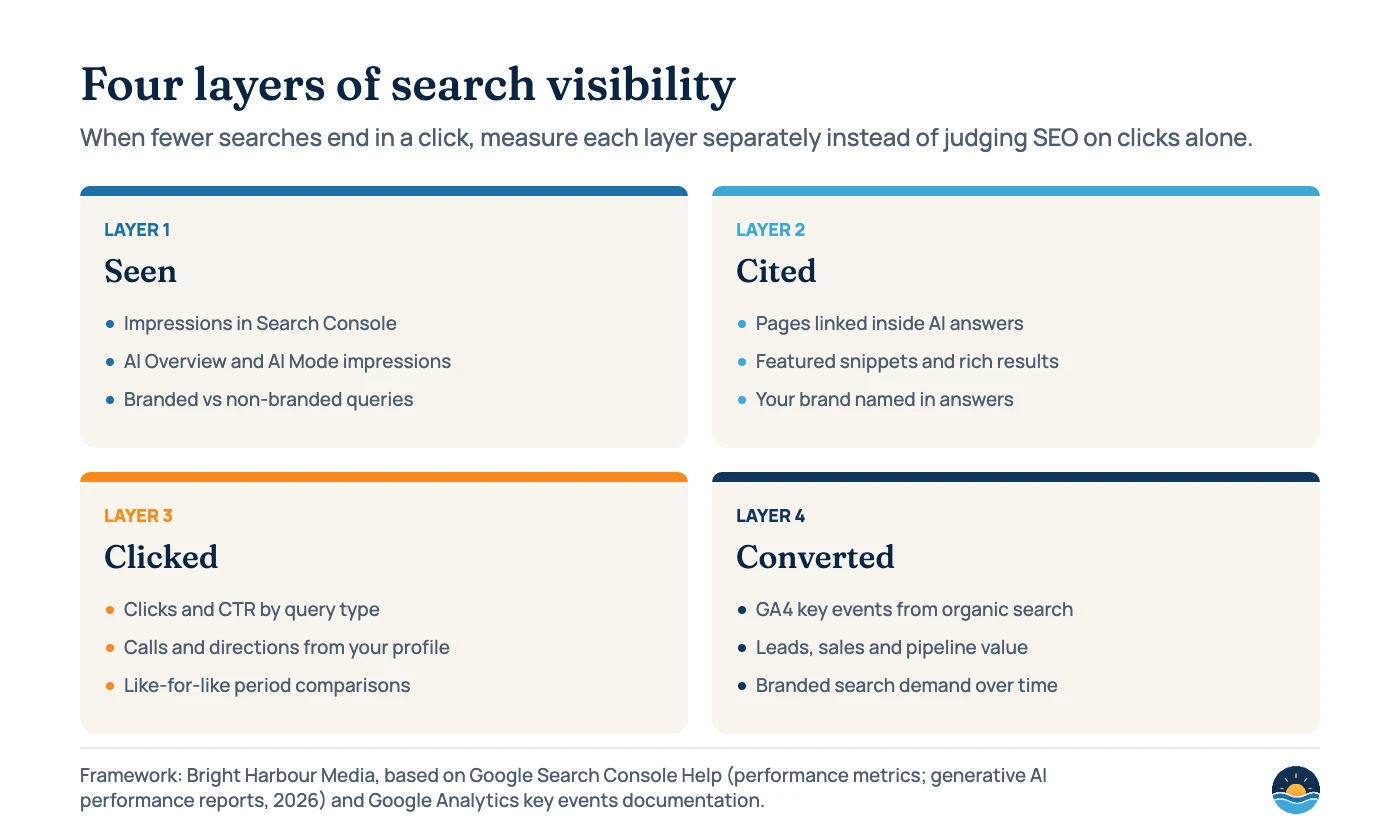
Zero-click searches don’t make SEO pointless, but they do make clicks a worse measure of it on their own. We split search visibility into four layers and report on each one, so a fall in clicks on informational queries is not mistaken for a fall in demand.
More likely to stay zero-click
- Simple facts, definitions and conversions
- “How to” questions answered in a few lines
- Weather, sports scores and quick calculations
- Business details shown on a Business Profile
Still worth chasing for clicks
- Comparisons and decisions with real trade-offs
- Service, location and pricing searches
- Original data, tools and templates
- Branded searches for your business
Being cited matters. Seer’s data suggests cited brands win noticeably more clicks than uncited ones on the same queries, and original data is one of the few things an AI summary has to attribute. Pages built around unique evidence, like the charts in our Insights articles, are easier to cite than pages that restate common knowledge. Featured snippets follow similar logic.
A seven-step plan for a zero-click world
- Split your queries. Use the branded queries filter and group the rest into informational, commercial and local or transactional searches.
- Find where clicks fell but impressions held. Compare like-for-like periods in the Performance report; flat impressions with falling CTR usually point to a changed results page, not lost rankings.
- Check AI feature visibility. Use the generative AI performance reports to see which pages appear in AI Overviews and AI Mode.
- Rework at-risk pages. Add original data, examples and decision help that a two-line answer can’t replace.
- Shift effort towards commercial and local queries. These are less likely to show an AI Overview and closer to a lead.
- Make your Business Profile complete. For local businesses, calls, directions and website clicks from the profile are often the click.
- Report on all four layers. Track impressions, citations, clicks and conversions together, as set out in our guide to SEO reporting KPIs, and tie them to SEO ROI.
Frequently asked questions
What percentage of Google searches are zero-click?
It depends on the data set. SparkToro’s analysis of Similarweb data found 68.01% of US Google searches ended without a click in January–April 2026. Its 2024 study using Datos data found 58.5%. Neither is directly comparable with Google’s own figures, which it hasn’t published.
Are AI Overviews the only cause of zero-click searches?
No. Zero-click searches were common before AI Overviews: SparkToro reported in 2019 that fewer than half of Google searches led to a click. AI Overviews add to existing answer features such as featured snippets, knowledge panels and Business Profiles.
Can I see zero-click searches in Search Console?
Not directly. Search Console shows impressions and clicks for your own site, so queries with high impressions and few clicks are the closest signal. The generative AI performance reports show impressions in AI Overviews and AI Mode.
Is SEO still worth it if most searches don’t click?
For most businesses, yes. Commercial, local and branded searches still send clicks and convert, and visibility on informational queries builds brand demand. What changes is how you measure success and which queries you prioritise.
Sources
- In 2026, Less than One Third of Google Searches Still Send a Click — SparkToro (Rand Fishkin), June 2026 — US zero-click rate, Similarweb panel
- Zero-Click Searches: Highest in the UK, Lowest in Germany, and France has the Most Efficient Searchers — SparkToro, June 2026 — six-country data
- 2024 Zero-Click Search Study — SparkToro (Rand Fishkin), July 2024 — Datos panel, US and EU
- Less than Half of Google Searches Now Result in a Click — SparkToro, August 2019 — background
- Google users are less likely to click on links when an AI summary appears in the results — Pew Research Center, 22 July 2025
- AI Overviews Reduce Clicks by 34.5% — Ahrefs, 17 April 2025
- Update: AI Overviews Reduce Clicks by 58% — Ahrefs, 4 February 2026
- AIO Impact on Google CTR: September 2025 Update — Seer Interactive, 4 November 2025
- AIO Impact on Google CTR: 2026 Update — Seer Interactive, 24 April 2026
- Semrush AI Overviews Study — Semrush, updated 15 December 2025
- ChatGPT referrals to news sites are growing, but not enough to offset search declines — TechCrunch, 2 July 2025 — Similarweb news data
- AI in Search: Driving more queries and higher quality clicks — Google (Liz Reid), 6 August 2025
- AI features and your website — Google Search Central, last updated 10 December 2025
- What are impressions, position, and clicks? — Search Console Help
- Introducing Search Generative AI performance reports in Search Console — Google Search Central blog, 3 June 2026 (all sites from 31 August 2026)
- Introducing the branded queries filter in Search Console — Google Search Central blog, 20 November 2025
Cite this article: Bright Harbour Media. “Zero-Click Searches: What the Data Says and How to Plan.” Bright Harbour Media Insights, October 2026. https://brightharbourmedia.com/zero-click-searches/
You are welcome to reference the charts and frameworks in this article with a link back to this page.
Want to know how much of your search traffic is at risk from zero-click results, and where to focus instead? Our SEO strategy and consulting service maps your queries and builds a plan around the ones that still convert. Get in touch to start.