
Google’s reviews system is a ranking system that “aims to better reward high quality reviews”: first-party articles that recommend, compare or analyse products, services and other things, written by people who know the topic well. It favours reviews with in-depth research and first-hand evidence over thin pages that only summarise what others have said.
Key takeaways
- Google says the system rewards reviews that “share in-depth research, rather than thin content that simply summarizes a bunch of products, services or other things.”
- It covers first-party review content on any topic, including services and ranked lists. It does not evaluate user reviews posted in a reviews section.
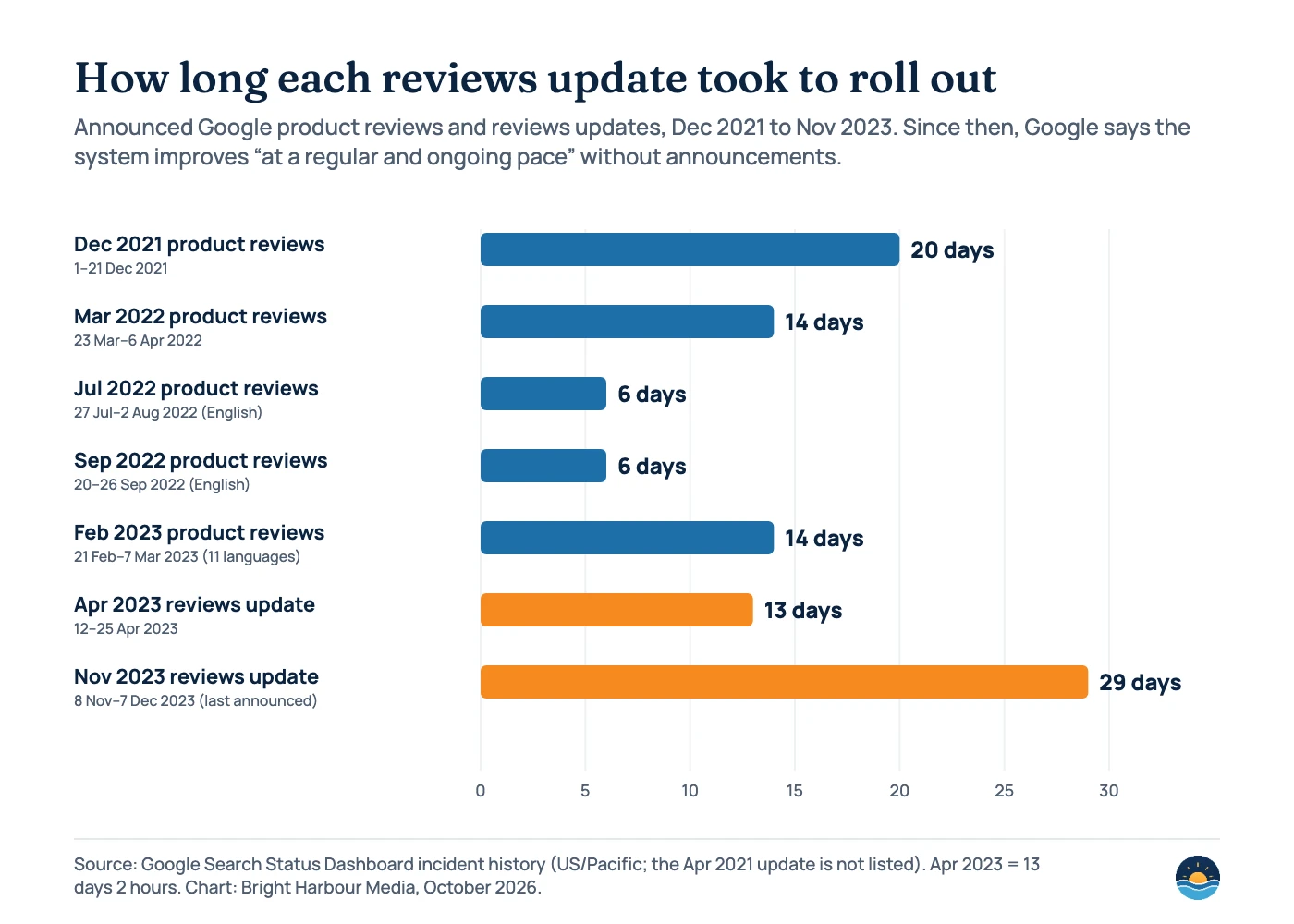
- Google announced seven product reviews or reviews updates on its Search Status Dashboard between December 2021 and November 2023, with rollouts lasting 6 to 29 days. Since November 2023 the system has been improved “at a regular and ongoing pace” without announcements.
- Google’s “Write high quality reviews” guidance (last updated 10 December 2025) asks for first-hand evidence, quantitative measurements, comparisons with alternatives and, where it makes sense, links to more than one seller.
- Reviews also have to stay honest: Google won’t show star snippets for self-serving reviews on LocalBusiness or Organization pages, and the US FTC’s fake reviews rule has applied since 21 October 2024.
What is Google’s reviews system?
Google’s guide to its ranking systems lists the reviews system alongside systems such as helpful content and spam detection. Its dedicated documentation page (last updated 10 December 2025) explains that it looks at “first-party standalone content written with the purpose of providing a recommendation, giving an opinion, or providing analysis.” That can be a review of a single thing, a head-to-head comparison or a ranked list of recommendations, and Google says reviews “can be about any topic.”
It is not the same as the star ratings customers leave on your Google Business Profile. Those are user reviews, and Google states plainly that the system “does not evaluate third-party reviews, such as those posted by users in the reviews section.” If you are working on customer reviews, our guide to Google review management covers that side.
| Question | What Google’s documentation says |
|---|---|
| What content is evaluated? | First-party, standalone content that recommends, gives an opinion on or analyses something |
| What formats? | Single reviews, head-to-head comparisons and ranked lists of recommendations |
| Which topics? | Any topic. Google’s examples include laptops, winter jackets, movies, video games, restaurants and fashion brands |
| User reviews? | Not evaluated (for example, reviews posted by users in a reviews section) |
| Page or site level? | “Primarily” page level, but on sites with “a substantial amount of review content, any content within a site might be evaluated” |
| Languages | English, Spanish, German, French, Italian, Vietnamese, Indonesian, Russian, Dutch, Portuguese and Polish |
| Structured data? | Product structured data “might help” Google identify reviews, but Google doesn’t “solely depend on it” |
| Recovery? | Sites “may recover over time” if they improve their content |
The page-level point matters for small businesses. Google says that if you “don’t have a lot of reviews, a site-wide evaluation is not likely to happen.” A service firm with a handful of comparison pages is judged mostly page by page. A site built around reviews can be judged as a whole.
How has the reviews system changed since 2021?
The system started life as the “product reviews update” on 8 April 2021, which Google said “only involves English language reviews for now.” It then widened in three directions: more evidence requirements, more languages and more kinds of review.
| Date | Change | Source |
|---|---|---|
| 8 Apr 2021 | Product reviews update launches for English reviews, with nine self-assessment questions | Google Search Central blog |
| 1 Dec 2021 | “The first major update since April”; adds evidence of first-hand testing and links to multiple sellers as best practices | Google Search Central blog |
| 23 Mar 2022 | Third update; Google says updates “apply to all forms of review content”, including ranked lists | Google Search Central blog |
| Jul and Sep 2022 | Two further English-language updates, each rolled out in 6 days | Search Status Dashboard |
| 21 Feb 2023 | Expands to 11 languages | Search Status Dashboard |
| 12 Apr 2023 | Renamed the reviews update; “now covers reviews about products, services, and things” | Search Status Dashboard |
| 8 Nov 2023 | Last announced update; Google says it will “no longer be posting about future updates” | Search Status Dashboard; Search Central blog (2 Nov 2023) |
The practical consequence is that you can no longer wait for an announced update to judge whether a review page is working. Google’s November 2023 Q&A said improvements to the reviews system “will be happening at a regular and ongoing pace”, so review content needs the same steady attention as the rest of a site. Our article on content refresh and pruning explains how to decide what to update, merge or retire.
What does Google count as a high-quality review?
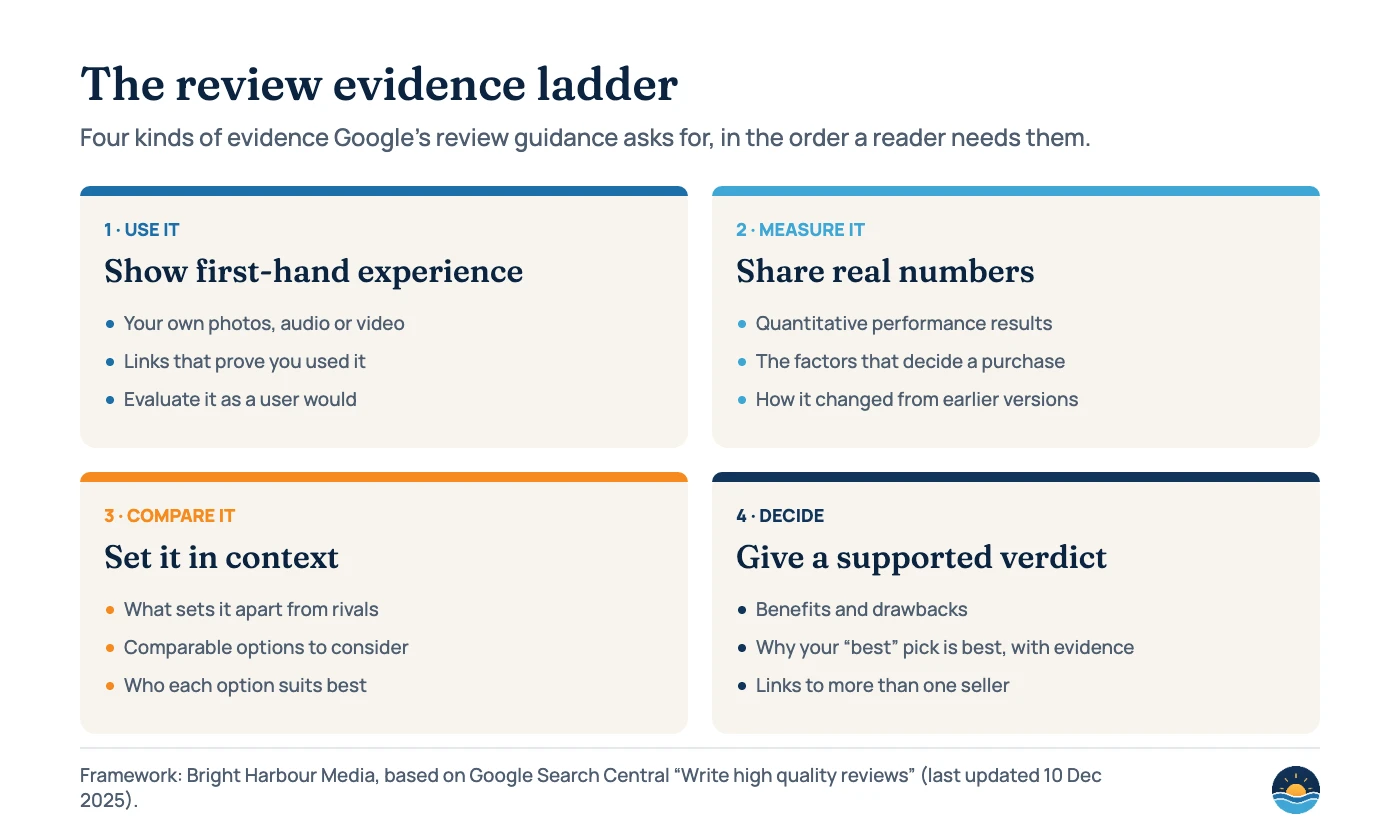
Google’s “Write high quality reviews” page lists 14 best practices and adds that you should “focus on the quality and originality of your reviews, not the length.” We group them into four kinds of evidence, in the order a reader needs them.
| Evidence type | Google’s best practice (paraphrased unless quoted) | What it looks like on a service business site |
|---|---|---|
| Use it | “Provide evidence such as visuals, audio, or other links of your own experience”; evaluate from a user’s perspective | Photos from real jobs, screenshots of the tool you tested, notes from your own trial |
| Use it | “Demonstrate that you are knowledgeable about what you are reviewing” | A named author with relevant experience and a linked bio |
| Measure it | “Share quantitative measurements about how something measures up” | Test results, response times, costs over 12 months, energy use |
| Measure it | Focus on the most important decision-making factors; describe how a product has evolved from earlier versions | Lead with the two or three factors that actually decide the choice |
| Compare it | Explain what sets something apart from competitors and cover comparable things to consider | A comparison table plus “best for” guidance by situation |
| Decide | Discuss benefits and drawbacks “based on your own original research” | Honest drawbacks, including where you would not recommend it |
| Decide | For a “best” pick, “include why you consider it the best, with first-hand supporting evidence” | A short, evidenced reason for every ranked item |
| Decide | Consider links to multiple sellers; include links to other useful resources | Where readers can buy or book, not just your affiliate partner |
Notice how much of this overlaps with Google’s wider advice on experience and expertise. If your reviews carry no author or the author has no visible track record, our guide to E-E-A-T and author pages is the place to start.
Does the reviews system apply to services and “best of” lists?
Yes on both counts. The April 2023 update extended the system to “reviews about products, services, and things”, so a page comparing accounting software, ranking local wedding venues or reviewing a type of roofing material is in scope. Google’s March 2022 post also addressed ranked lists directly, asking writers to “demonstrate expertise and reinforce authenticity in a more concise way” and, for “best” picks, to “include supporting first-hand evidence.”
The current guidance adds that ranked lists should have “enough useful content … for them to stand on their own.” A list of ten options with a stock photo and two lines each is exactly the thin summary content the system is designed to rank below in-depth research.
Strengthens a review
- Original photos or video from your own use
- Measured results, with how you measured them
- A clear verdict, including who should not buy
- Comparisons with real alternatives
- A named author with relevant experience
Weakens a review
- Rewritten manufacturer descriptions
- Lists with no evidence for the ranking
- Only positive points, no drawbacks
- One affiliate link and nothing else useful
- Mass-produced pages with the same template text
Affiliate links, review stars and the law
Affiliate links are allowed, but Google’s spam policies (last updated 28 August 2026) describe thin affiliate pages as ones where “product descriptions and reviews are copied directly from the original merchant without any original content or added value.” The same policy says good affiliate sites add value through “original product reviews, rigorous testing and ratings, navigation of products or categories, and product comparisons.” Scaled content abuse rules also apply: using generative AI or similar tools “to generate many pages without adding value for users” is listed as an example. Our article on AI-generated content and SEO covers where Google draws that line.
Review star snippets have their own rules. Google’s review snippet documentation (last updated 8 September 2026) says pages using LocalBusiness or Organization markup are ineligible for stars when “the entity that’s being reviewed controls the reviews about itself”, and that includes embedded review widgets. For more on which markup is worth adding, see structured data for service businesses.
| Rule | Who sets it | What it means for review content |
|---|---|---|
| Thin affiliate pages | Google spam policies (28 Aug 2026) | Copied merchant descriptions without added value can be treated as spam |
| Scaled content abuse | Google spam policies (28 Aug 2026) | Many low-value review pages generated at scale, by AI or otherwise, are a violation |
| Self-serving review stars | Google review snippet docs (8 Sep 2026) | No star snippets for reviews a business controls about itself on LocalBusiness/Organization pages |
| Review markup scope | Google review snippet docs | Mark up a specific item, not a category or a list; don’t aggregate ratings from other sites |
| Fake and insider reviews | US FTC, 16 CFR Part 465 (effective 21 Oct 2024) | Bans fake reviews, reviews bought for a particular sentiment and undisclosed insider reviews |
The FTC rule applies to US businesses, but its principles are a good standard anywhere: don’t publish reviews by people who don’t exist, don’t pay for a particular sentiment, and clearly disclose reviews written by staff or managers.
A seven-step process for auditing review content
- List every review-type page. Include single reviews, comparisons, “best” lists and “vs” pages, plus their impressions and clicks from Search Console.
- Check who wrote each one. Add a named author and a short note on their relevant experience; remove or rewrite anonymous filler.
- Add first-hand evidence. Replace stock and manufacturer images with your own photos, screenshots or video wherever you can.
- Add measurements. State what you tested, how and for how long, and give the numbers.
- Rewrite the verdict. Give clear pros and cons, say who each option suits, and support every “best” pick with evidence.
- Review links and markup. Link to more than one seller where it makes sense, qualify affiliate links, and make sure review markup describes one specific item.
- Consolidate the thin pages. Merge near-duplicate lists, retire pages you cannot support with evidence, and recheck performance over the following months.
Frequently asked questions
Is the reviews system the same as Google Business Profile reviews?
No. The reviews system evaluates first-party review content you publish, such as comparisons and “best” lists. Google says it does not evaluate third-party user reviews, like those in a reviews section or on a Business Profile.
Does Google still announce reviews updates?
No. The last announced reviews update ran from 8 November to 7 December 2023. Google said improvements would then happen “at a regular and ongoing pace” and that it would stop posting future updates on the Search Status Dashboard.
Can one weak review page hurt the whole site?
Google says the system works primarily at page level, so for most sites the effect is page by page. On sites with a substantial amount of review content, Google says any content on the site might be evaluated, so a large body of thin reviews is a site-wide risk.
Do longer reviews rank better?
Not by length alone. Google’s review guidance asks you to focus on quality and originality, not length. A shorter review with real measurements and photos beats a long one that repeats the manufacturer’s description.
Sources
- Write high quality reviews — Google Search Central, last updated 10 December 2025 — the 14 best practices
- Google Search’s reviews system and your website — Google Search Central, last updated 10 December 2025 — scope, page vs site level, languages
- A guide to Google Search ranking systems — Google Search Central, last updated 10 December 2025 — reviews system definition
- What creators should know about Google’s April 2021 product reviews update — Google Search Central blog, 8 April 2021
- December 2021 product reviews update and your site — Google Search Central blog, 1 December 2021
- Improving Product Review ranking, one year on — Google Search Central blog, 23 March 2022
- A Q&A on Google Search updates — Google Search Central blog, 2 November 2023 — ongoing updates
- Google Search Status Dashboard: ranking incident history — Google — rollout dates and durations, 2021–2023
- Review snippet structured data — Google Search Central, last updated 8 September 2026 — self-serving reviews, required properties
- Spam policies for Google web search — Google Search Central, last updated 28 August 2026 — thin affiliation, scaled content abuse
- Trade Regulation Rule on the Use of Consumer Reviews and Testimonials — US Federal Trade Commission, Federal Register, 22 August 2024 — effective 21 October 2024
- 16 CFR Part 465 — Electronic Code of Federal Regulations — fake, bought and insider reviews
Cite this article: Bright Harbour Media. “Google’s Reviews System: How to Write Reviews That Rank.” Bright Harbour Media Insights, October 2026. https://brightharbourmedia.com/google-reviews-system/
You are welcome to reference the charts and frameworks in this article with a link back to this page.
Publishing comparisons or “best of” pages that aren’t earning their place in search? Our content strategy service audits review content against Google’s guidance and rebuilds it around real evidence. Get in touch to talk it through.