
AI-generated content is text, images or other material produced with generative AI tools. Google doesn’t penalise content for being made with AI: its guidance says “appropriate use of AI or automation is not against our guidelines”. What breaks its spam policies is using AI (or anything else) to mass-produce pages that add no value, mainly to manipulate rankings.
Key takeaways
- Google’s position since February 8, 2023: it rewards quality “however it is produced”, and “using AI doesn’t give content any special gains.”
- Its spam policies (updated Aug 28, 2026) list “using generative AI tools… to generate many pages without adding value for users” as scaled content abuse.
- Google’s generative AI guide (updated Oct 1, 2026) calls it “critical” to fact-check all AI output, including titles, meta descriptions, structured data and alt text.
- Ahrefs found AI content in 86.5% of 600,000 top-20 ranking pages, with a near-zero correlation (0.011) between AI share and ranking position.
- Graphite’s detectors classed only 14% of ranking articles and 7% of #1 results as AI-generated. The two studies measure different things.
Does Google penalise AI-generated content?
No, not for being AI-generated. Google set out its position in a Search Central blog post on February 8, 2023, titled “Google Search’s guidance about AI-generated content”. The key line: “Our focus on the quality of content, rather than how content is produced, is a useful guide”. Its FAQ is blunt: “Using AI doesn’t give content any special gains. It’s just content.”
The same post draws the line where the intent is manipulation: “Using automation—including AI—to generate content with the primary purpose of manipulating ranking in search results is a violation of our spam policies.” It also notes that “not all use of automation, including AI generation, is spam”. Its examples of useful automation are sports scores, weather forecasts and transcripts.
Since then, the guidance has grown into four documents that agree with each other:
| Google source | Last updated | What it says about AI |
|---|---|---|
| Blog: guidance about AI-generated content | Feb 8, 2023 | Quality matters, not production method; AI used to manipulate rankings is spam |
| Spam policies: scaled content abuse | Aug 28, 2026 | Many pages made “for the primary purpose of manipulating search rankings”, “no matter how it’s created”. Generative AI is the first example |
| Guidance on using generative AI content | Oct 1, 2026 | Fact-check everything; add context on how content was made; Merchant Center images need IPTC metadata |
| Creating helpful, reliable, people-first content | Oct 5, 2026 | Ask “Who, How, and Why”; disclose automation where readers would expect it; don’t fabricate authors |
| Search Quality Rater Guidelines | Sept 11, 2025 | Lowest rating for low-effort AI or copied content, but AI use “alone” doesn’t set the rating |
What is scaled content abuse?
Scaled content abuse is the spam policy most AI content problems fall under. Google defines it as when “many pages are generated for the primary purpose of manipulating search rankings and not helping users”, and says the policy applies “no matter how it’s created”. The first example listed is “using generative AI tools or other similar tools to generate many pages without adding value for users.”
The other examples matter just as much, because AI makes them cheap. They include scraping, synonymising or auto-translating content, “stitching or combining content from different web pages without adding value”, and pages stuffed with keywords that make little sense to a reader. If you’re planning templated pages at scale, our programmatic SEO guide covers where Google draws the line.
Google’s quality raters are told the same thing. The Search Quality Rater Guidelines (version dated September 11, 2025) reserve the Lowest rating for pages where almost all main content is “copied, paraphrased, embedded, auto or AI generated, or reposted from other sources with little to no effort”. They add a balancing line: “the use of Generative AI tools alone does not determine the level of effort or Page Quality rating.” Google says raters’ ratings don’t directly influence ranking, but the guidelines show what its systems are trying to reward.
How much AI content already ranks in Google?
A lot, if you count any AI-written text on the page. In a study published July 7, 2025, Ahrefs took 100,000 random keywords and ran the top 20 results for each, 600,000 pages, through its own AI content detector. It found that “86.5% of top-ranking pages contain some amount of AI-generated content.” Only 4.6% were pure AI and 13.5% pure human. Most pages were a mix.
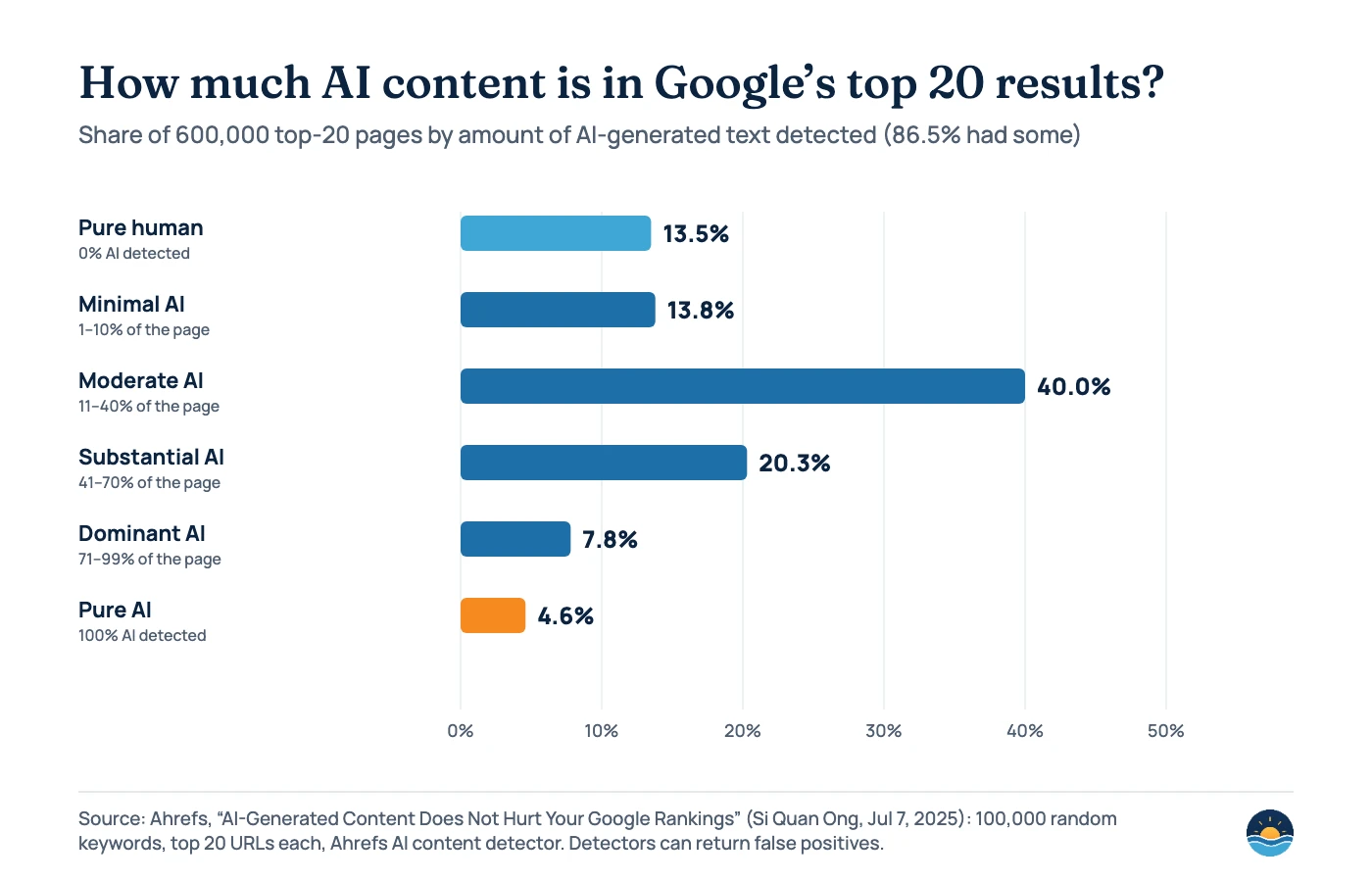
Ahrefs measured the correlation between a page’s AI share and its ranking position at “0.011, effectively zero”, though #1 results “tend to have slightly less AI-generated content.” Graphite, using a different method, reached a result that sounds opposite but isn’t. Graphite counts a page as AI only if most of it is AI-written. By that measure, “86% of articles ranking in Google Search are written by humans”, and “only 7% of the articles ranking number one are AI-generated.”
| Study | Sample | How AI was counted | Finding |
|---|---|---|---|
| Ahrefs, top-20 rankings (Jul 7, 2025) | 600,000 pages from 100,000 keywords | Any detected AI text (Ahrefs detector) | 86.5% contain some AI; 4.6% pure AI; correlation with rank 0.011 |
| Ahrefs, new web pages (May 19, 2025) | 900,000 new English pages, April 2025 | Any detected AI text (bot_or_not) | 74.2% contain AI content; 2.5% pure AI; 25.8% pure human |
| Ahrefs, AI Overview citations (Jul 14, 2025) | 500,000 cited URLs | Any detected AI text | 87.8% mixed, 3.6% pure AI, 8.6% pure human; correlation with citation order 0.017 |
| Graphite, search and answer engines (Oct 14, 2025) | 31,493 keywords, June 2025 SERPs | Article mostly AI (Surfer detector) | 14% of ranking articles AI; 7% of #1 results; 18% of ChatGPT/Perplexity citations |
| Graphite, articles published (May 15, 2026) | 55,400 Common Crawl articles, 2020–Mar 2026 | Average of three detectors | About half of new articles AI-written since 2025 (49.9% in Q1 2026) |
Read these numbers as rough signals. Every study relies on AI detectors, which Ahrefs says “always carry the risk of false positives.” What they do show is consistent with Google’s guidance: AI involvement alone doesn’t stop a page ranking, and the pages at the very top lean slightly towards more human writing.
What does Google expect when you use AI?
Google’s “Guidance on using generative AI content on your website” (updated October 1, 2026) is the most practical document. It warns that “generative AI outputs may contain inaccuracies (also known as hallucinations)” and says: “It is critical to manually factcheck and review all AI-generated content for accuracy and trustworthiness before publishing.” That review also covers title elements, meta descriptions, structured data and image alt text, which AI tools often write without anyone checking.
The helpful content guide (updated October 5, 2026) adds the authorship rule. Google encourages accurate bylines, but warns that “fabricating creator profiles (such as by using AI-generated headshots, made-up names, or false credentials…) is a form of deception.” Our E-E-A-T and author pages guide explains how to set up genuine author profiles.
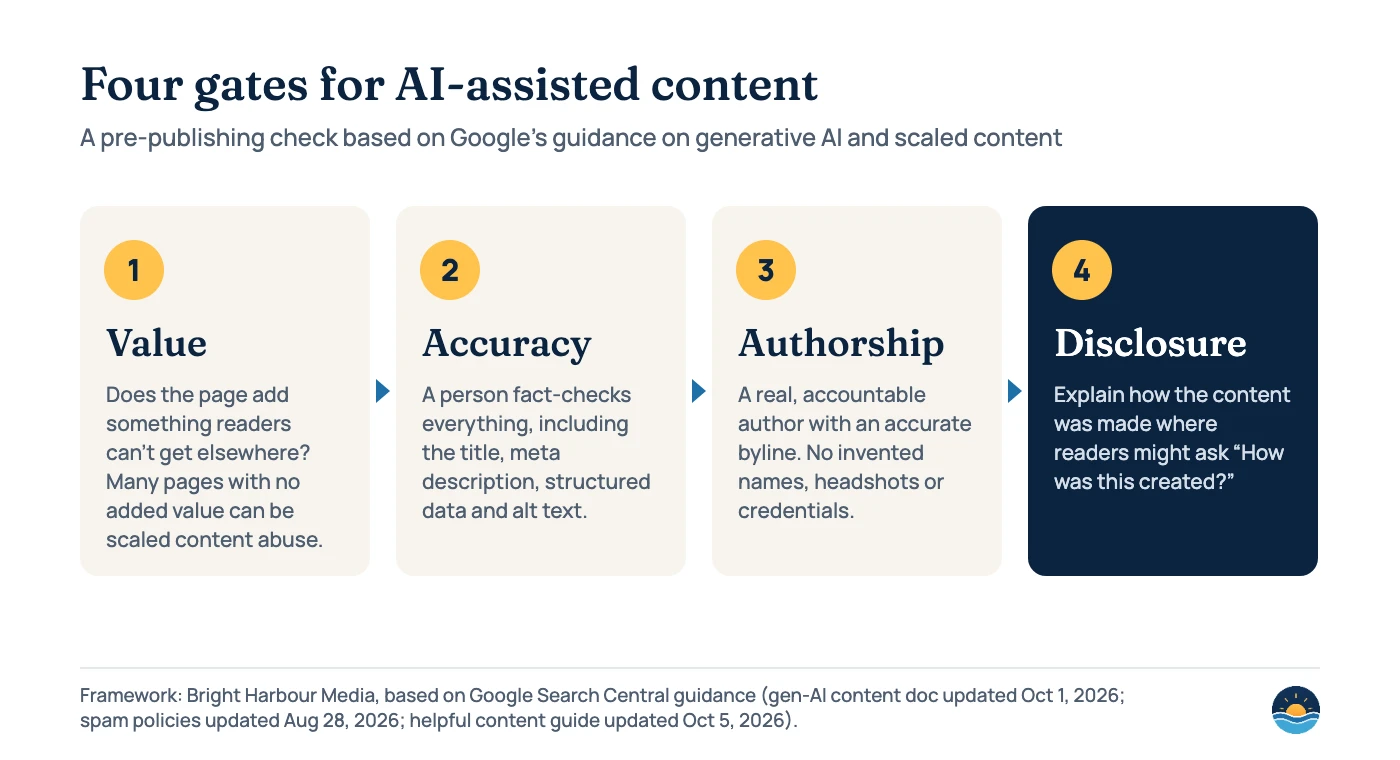
On disclosure, Google is pragmatic rather than strict. Its 2023 post says “AI or automation disclosures are useful for content where someone might think ‘How was this created?’” It also says “giving AI an author byline is probably not the best way to follow our recommendation”. Ecommerce is the exception with firm rules: in Merchant Center, “AI-generated images must contain metadata using the IPTC DigitalSourceType TrainedAlgorithmicMedia metadata”, and AI-written product titles and descriptions must be labelled.
Usually fine
- Drafting outlines, summaries or first drafts that an expert rewrites and checks
- Turning structured data into useful pages (scores, forecasts, product specs) where the data adds value
- Translating or editing your own content with human review
- Generating alt text or meta descriptions that a person checks
Likely to cause problems
- Publishing hundreds of near-identical pages that only swap a keyword or city
- Rewriting competitors’ articles without adding anything new
- Invented authors, headshots or credentials
- Unchecked AI facts, statistics or quotes, and AI-written fake reviews (covered by the FTC rule in force since Oct 21, 2024)
A seven-step process for publishing AI-assisted content
- Start from what you know. Write down the first-hand experience, data or opinion the page will add before opening an AI tool.
- Use AI for structure and speed, not for facts. Treat every statistic, date and quote it produces as unverified.
- Fact-check against primary sources. Check claims against the original documents, and link to them.
- Edit for people. Cut filler and repetition. Google’s guidance says length alone isn’t a ranking factor; see our content length guide.
- Check the metadata. Review the title, meta description, structured data and alt text with the same care as the body.
- Put a real person’s name on it. Use an accurate byline and author page, and add a short note on how the content was made where readers would expect one.
- Watch the scale. Before publishing pages in bulk, ask whether each one would be worth visiting if search engines didn’t exist.
Frequently asked questions
Is AI-generated content against Google’s guidelines?
No. Google says appropriate use of AI or automation isn’t against its guidelines. Using AI mainly to manipulate rankings, or to mass-produce pages without value, breaks its scaled content abuse policy.
Can Google detect AI-generated content?
Google hasn’t said it uses AI detection to demote content. Its 2023 post says systems such as SpamBrain look for spam “however it is produced”. The focus is on quality and intent, not the tool.
Should I label AI-generated content?
Google recommends disclosure where readers might reasonably ask how content was created. Labels aren’t required for ordinary web content, but Merchant Center requires metadata on AI-generated product images and labels on AI-written product text.
Does AI content rank as well as human content?
Studies suggest AI involvement alone doesn’t stop ranking. Ahrefs found AI text in 86.5% of top-20 pages, with almost no correlation to position. Graphite found mostly-AI articles were only 7% of #1 results. Quality and usefulness decide the outcome.
Sources
- Google Search’s guidance about AI-generated content — Google Search Central Blog, Feb 8, 2023. Quality over production method; disclosure; SpamBrain
- Guidance on using generative AI content on your website — Google Search Central, last updated Oct 1, 2026. Fact-checking, metadata, Merchant Center IPTC rules
- Spam policies for Google web search — Google Search Central, last updated Aug 28, 2026. Scaled content abuse definition and examples
- Creating helpful, reliable, people-first content — Google Search Central, last updated Oct 5, 2026. Who/How/Why; fabricated creator profiles
- Search Quality Rater Guidelines — Google, version Sept 11, 2025. Sections 4.6.5–4.6.6 on scaled and low-effort content
- AI-Generated Content Does Not Hurt Your Google Rankings (600,000 Pages Analyzed) — Ahrefs, Jul 7, 2025. Top-20 AI share and correlation
- 74% of New Webpages Include AI Content (Study of 900k Pages) — Ahrefs, May 19, 2025. New page AI share
- AI Overviews Cite AI-Generated Content More Than Human Writing — Ahrefs, Jul 14, 2025. AI Overview citation study
- How Does AI-Generated Content Perform in Search and Answer Engines? — Graphite, Oct 14, 2025. 14% of ranking articles, 7% of #1 results
- AI Now Writes as Many Online Articles as Humans — Graphite, May 15, 2026. Share of AI-written articles over time
- Trade Regulation Rule on the Use of Consumer Reviews and Testimonials — US Federal Register, Aug 22, 2024. Effective Oct 21, 2024; covers AI-generated reviews
Cite this article: Bright Harbour Media. “AI-Generated Content and SEO: What Google Allows.” Bright Harbour Media Insights, October 2026. https://brightharbourmedia.com/ai-generated-content-seo/
You are welcome to reference the charts and frameworks in this article with a link back to this page.
Using AI in your content workflow and want it to stay on the right side of Google? Our content strategy service builds editorial processes that combine speed with expert review. Get in touch to talk it through.