Local link building is the work of earning links to a local business’s website from other sites in its area and industry: suppliers, associations, community groups, local media and useful local resources. Google says the number of websites linking to a business is part of how it judges local prominence, but links bought or swapped mainly to influence rankings break its spam policies.
Key takeaways
- Google’s Business Profile help says local results are mainly based on relevance, distance and popularity, and that prominence draws on “how many websites link to your business”.
- In Whitespark’s 2026 survey of 47 local search experts, link signals made up 24% of local organic ranking factors but only 8% for the local pack and Maps.
- The same experts ranked the quality and authority of links to a domain the #3 factor (of 187) for local organic results.
- Google’s spam policies (updated Aug 28, 2026) say paid and sponsorship links are fine only when qualified with rel=”sponsored” or rel=”nofollow”.
- Google’s John Mueller has said a thank-you link from a local club you sponsor is not something to worry about; sponsoring many sites mainly for links is.
What counts as a local link?
A local link is any editorial or relationship-based link from a website with a real connection to your area or your trade. Think of the stockist page on a supplier’s site, a member listing on a trade association, a story in the local paper, or a neighbourhood guide that recommends you.
They are different from local citations. A citation is a mention of your business name, address and phone number, often on a directory, and may or may not include a link. Citations help confirm that your business exists and where it is. Links do a different job: they tell search engines that other sites vouch for your website.
Do links still matter for local SEO?
Yes, though how much depends on where you want to appear. Google’s Business Profile help page on local ranking says results are “mainly based on relevance, distance, and popularity”. Its explanation of prominence says the factor is “based on info like how many websites link to your business and how many reviews you have.” It also states plainly: “There’s no way to request or pay for a better local ranking on Google.”
Google doesn’t publish weights, so the most detailed view comes from expert surveys. Whitespark’s Local Search Ranking Factors 2026, published November 6, 2025, asked 47 local search specialists to score 187 factors for the local pack and Maps, local organic results, conversions and, for the first time, visibility in AI search. Whitespark is clear that “none of the experts have special access” to Google’s algorithm, so treat the results as informed opinion, not measurement.
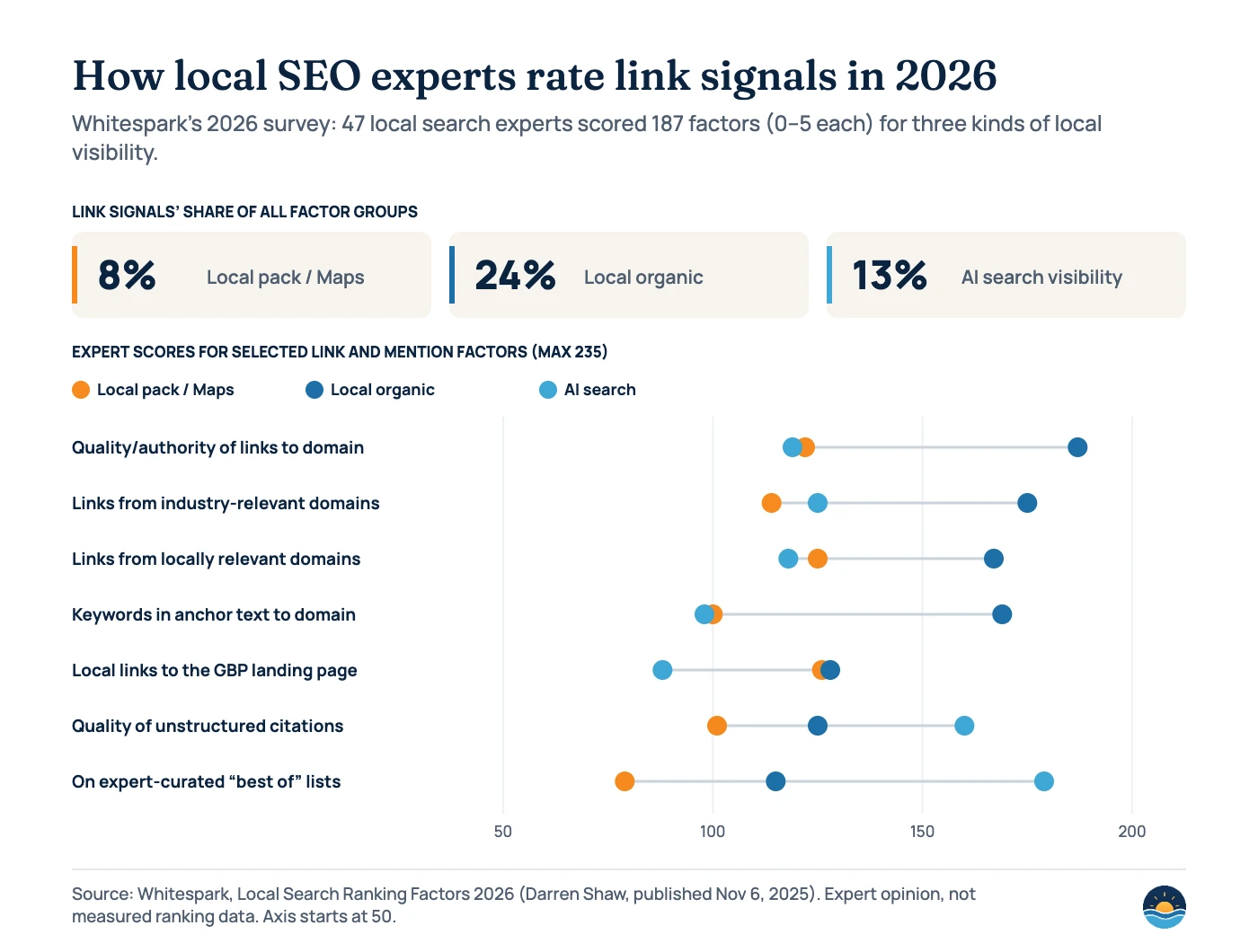
The pattern is clear. For the local pack, your Google Business Profile (32%) and reviews (20%) dominate and links are 8% of the picture. For the ordinary organic results below the map, links rise to 24%, second only to on-page signals at 33%. For AI search visibility, link signals sit at 13%, while mentions on “best of” lists, industry sites and the press score highest of all.
| Link factor (Whitespark 2026) | Local pack / Maps | Local organic | AI search |
|---|---|---|---|
| Quality/authority of inbound links to domain | #31 | #3 | #29 |
| Links to domain from industry-relevant domains | #39 | #5 | #23 |
| Keywords in anchor text of links to domain | #65 | #10 | #50 |
| Diversity of inbound links to domain | #61 | #12 | #64 |
| Links to domain from locally relevant domains | #27 | #13 | #30 |
| Quality/authority of links to the GBP landing page | #25 | #29 | #69 |
| Links to the GBP landing page from locally relevant domains | #26 | #36 | #66 |
| Presence on expert-curated “best of” lists | #107 | #48 | #1 |
| Quantity of unlinked brand mentions | #126 | #73 | #12 |
Two practical lessons follow. First, a handful of relevant, trusted links usually beats a long list of weak ones: quality and relevance outrank raw quantity in every column. Second, links to the page your Google Business Profile points to (often the home page or a location page) appear in the experts’ top 30 for the map pack, so it’s worth earning some links there rather than only to blog posts.
Where do local businesses find links?
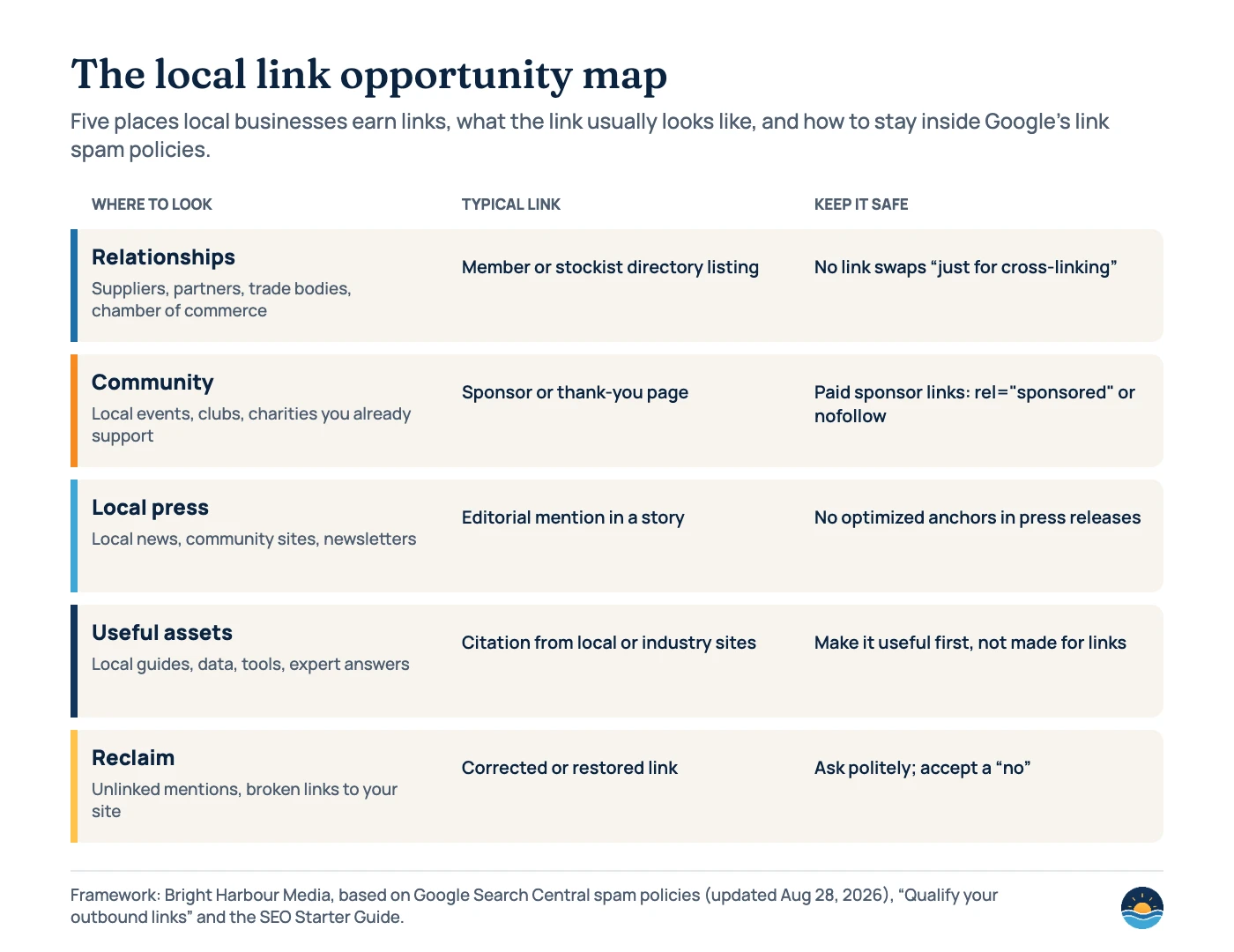
Most good local links come from relationships you already have. Google’s SEO Starter Guide says links from other sites happen “naturally over time”, and lists community engagement, offline and online advertising and word of mouth as ways to promote a site. It even suggests making sure your URL is on your business cards, letterhead and posters. The map below groups the main sources.
| Opportunity | Example | Google policy point | Link to expect |
|---|---|---|---|
| Supplier or manufacturer | “Where to buy” or approved installer page | Fine if editorial. Exchanging goods or services for links is listed as link spam. | Followed link, if they choose |
| Trade or business association | Member directory, chamber of commerce listing | Membership is fine; “low-quality directory or bookmark site links” are spam examples. | Often followed; sometimes nofollow |
| Local sponsorship or charity | Youth sports club, festival, charity event | Paid placements should be qualified with rel=”sponsored” or nofollow. | Sponsored or nofollow is the safe default |
| Local news and community sites | Story, expert comment, event listing | Optimized anchor text in press releases distributed on other sites is link spam. | Editorial, often branded |
| Useful local content | Area guide, cost data, seasonal checklist | “Low-value content primarily for the purposes of manipulating linking” is spam. | Editorial, earned over time |
| Partners and neighbours | Venue recommends caterer; agent recommends builder | “Excessive link exchanges” and partner pages purely for cross-linking are spam. | Occasional, genuine recommendations |
What about sponsorships and paid links?
Sponsorship is where local link building most often drifts into risk. Google’s spam policies say “buying and selling links is a normal part of the economy of the web for advertising and sponsorship purposes”, and that such links are not a violation “as long as they are qualified with a rel=”nofollow” or rel=”sponsored” attribute”. Google’s guidance on outbound links says to mark “advertisements or paid placements” as sponsored. We explain the attributes in our guide to nofollow, sponsored and UGC links.
Google has also spoken about local cases. In December 2016, asked about donating to charities in exchange for links, John Mueller replied on Twitter: “It’s just a paid link, right?” (reported by Search Engine Roundtable). In a 2018 video answer, reported by the same site, a business asked about a followed thank-you link from a local hockey club it sponsored. Mueller said that if it’s one of many links, you know the club and they can’t easily change it, “the web spam team is not going to worry about that.” But if you sponsor “lots of different clubs and sites where it looks like the primary intent is to get a link there”, the web spam team “might take action”.
Our reading: sponsor things you would support anyway, for the local goodwill and visibility. If the club or charity adds a link, great. Don’t pay for a link as such, don’t ask for keyword anchor text, and don’t build a programme of sponsorships chosen for their domain metrics.
Worth pursuing
- Supplier, distributor and approved-installer pages
- Trade association and chamber of commerce memberships you value anyway
- Local news coverage of real stories, data or expertise
- Community events and causes you genuinely support
- Fixing broken links and unlinked mentions
Skip or qualify
- Paying a site for a followed link, in money or in kind
- Link swaps and “partner” pages built only to cross-link
- Bulk directory and bookmark submissions
- Sponsorships picked for their links rather than the cause
- Keyword-stuffed anchors such as “best plumber [city]”
Anchor text deserves a special mention. In Whitespark’s survey, keywords in anchor text ranked #10 for local organic results, yet Google’s spam policies name optimized anchors in guest posts and press releases as link spam, and its own forum-spam example is a local one: “paul’s pizza san diego pizza best pizza san diego”. Let other sites link with your business name or a natural description; our guide to backlink anchor text covers the detail.
A seven-step local link building process
- Audit what you have. Export your linking domains from Search Console’s Links report or a backlink tool, and note which local and industry sites already link to you.
- List your real-world relationships. Suppliers, manufacturers, associations, landlords, clients, venues, schools and clubs you already work with. Each is a possible, natural link.
- Check the obvious pages. Many suppliers and associations have stockist, installer or member pages. Ask to be listed accurately, with your business name and website.
- Give local media a reason to cover you. Offer expert comment, local data or a genuine story. Our guide to pitching journalists covers what editors want.
- Create one genuinely useful local resource. A cost guide, seasonal checklist or area guide that answers questions your customers ask, and that local sites would reasonably cite.
- Reclaim lost value. Find mentions of your business without a link and broken links pointing at old URLs, and ask politely for a fix.
- Qualify anything paid and review quarterly. Make sure sponsored placements use rel=”sponsored” or nofollow, then track new linking domains and local organic rankings each quarter.
Links are one part of local visibility. For the bigger picture, see our guide to local SEO ranking factors.
Frequently asked questions
Do backlinks help Google Maps rankings?
Google says prominence, which feeds local results, considers how many websites link to your business. In Whitespark’s 2026 expert survey, link signals were 8% of map pack factors versus 24% for local organic results, so profile and review work usually matters more for Maps.
Is a chamber of commerce link worth it?
It can be a relevant local link and a useful membership in its own right. Google has published no specific guidance on chambers of commerce, so join for the business value and treat any link as a bonus, not a ranking shortcut.
Should sponsorship links be nofollow?
If the link is part of what you paid for, Google’s spam policies say it should be qualified with rel=”sponsored” or rel=”nofollow”. Mueller has said a thank-you link from a local club you genuinely support is not a worry; a pattern of sponsorships bought for links is.
How many links does a local business need?
There is no published target. Whitespark’s experts rated the quality and relevance of links above their quantity, so a few links from respected local and industry sites usually do more than many weak ones.
Sources
- Tips to improve your local ranking on Google — Google Business Profile Help, read Oct 28, 2026 — relevance, distance, popularity/prominence
- Spam policies for Google web search — Google Search Central, last updated Aug 28, 2026 — link spam examples and sponsorship links
- Qualify your outbound links to Google — Google Search Central, last updated Dec 10, 2025 — rel=”sponsored”
- SEO Starter Guide — Google Search Central, last updated Dec 10, 2025 — promoting your site
- Local Search Ranking Factors 2026 — Whitespark (Darren Shaw), Nov 6, 2025 — factor group weights and link factor ranks
- Google Says Giving Charity In Exchange For A Link, Is A Paid Link — Search Engine Roundtable, Dec 6, 2016 — Mueller tweet
- Google Canada Paid Link For Non-Profit Charity Contribution — Search Engine Roundtable, Sept 13, 2018 — Mueller on local sponsorship links
Cite this article: Bright Harbour Media. “Local Link Building: How Local Businesses Earn Links That Count.” Bright Harbour Media Insights, October 2026. https://brightharbourmedia.com/local-link-building/
You are welcome to reference the charts and frameworks in this article with a link back to this page.
Want links that build real local authority? Our link building and digital PR service focuses on relationships, local press and assets worth citing — or get in touch to talk through your local link profile.