A local citation is any online mention of a business’s name, address and phone number (NAP) — in a directory listing, a map app, a news story or a blog post. NAP consistency means those details match your website and Google Business Profile everywhere they appear, so search engines, AI tools and customers all see the same, correct facts.
Key takeaways
- Google says local results are mainly based on relevance, distance and prominence — and that prominence draws on information such as how many websites link to a business and how many reviews it has.
- Google gathers business information from sources such as user reports and licensed content, and may update your profile if they say your details are wrong. If you don’t respond to a suggested edit within 4 days, it may be published.
- In Whitespark’s 2026 Local Search Ranking Factors (47 experts, 187 factors), “website NAP matches Google Business Profile” ranks #15 for the map pack, and consistency on Google, Bing and Apple Maps ranks #28.
- For AI search visibility, the same experts ranked presence on expert-curated “best of” lists #1 — and three of the top five AI factors are citation factors.
- Mismatched NAP or tracking phone numbers across the data ecosystem appears in both the survey’s negative ranking factors (#24) and its suspension risk factors (#22).
What counts as a local citation?
Structured citations
Listings in a set format: map platforms such as Bing Places and Apple Maps, general directories, industry directories and data aggregators that supply other sites. You usually create or claim these yourself, and they are where inconsistencies pile up after a move, a rebrand or a new phone number.
Unstructured citations
Mentions in ordinary content: local news, association member pages, event sponsorships, blog posts and “best of” round-ups. You earn these rather than submit them. They often carry more authority, and they are the citations AI tools tend to read and quote.
Do citations still help local rankings?
Yes, but not in the way they did a decade ago. Google’s own explanation of local ranking names three main factors — relevance, distance and prominence — and says prominence is “based on info like how many websites link to your business and how many reviews you have.” Citations feed that picture of how well known a business is, and they help Google confirm that your details are accurate. We cover the wider set of signals in our guide to local SEO ranking factors.
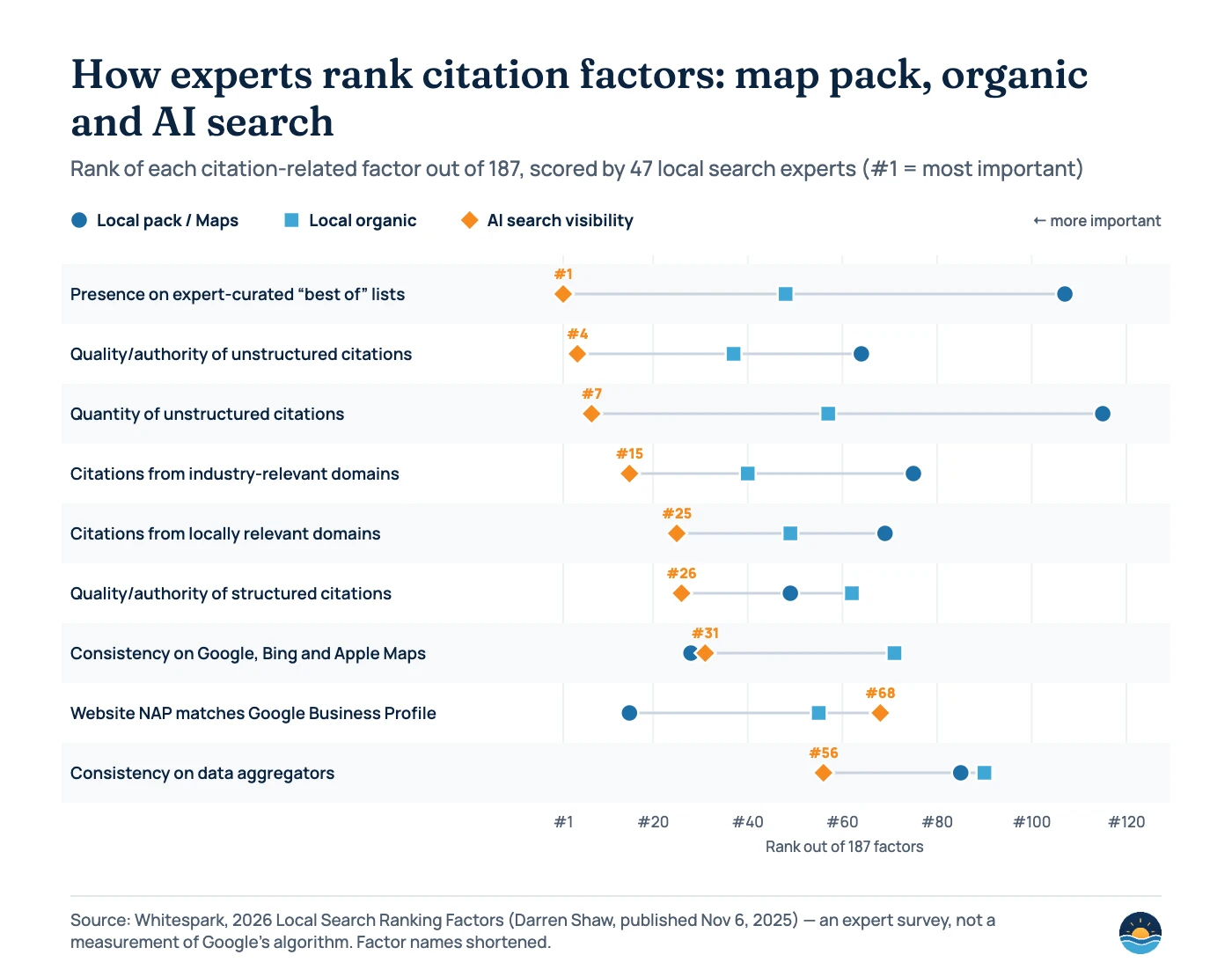
The best independent view is Whitespark’s Local Search Ranking Factors survey. Its 2026 edition (published November 6, 2025) asked 47 local search experts to score 187 factors. Darren Shaw notes that the citation group “lost about half a percentage point” of weighting for the map pack, continuing a long decline — but this edition also added a new AI search score, and that is where citations jump.
| Citation factor (Whitespark 2026) | Local pack / Maps | Local organic | AI search |
|---|---|---|---|
| Presence on expert-curated “best of” and similar lists | #107 | #48 | #1 |
| Quality/authority of unstructured citations (news, blogs, gov sites, associations) | #64 | #37 | #4 |
| Quantity of citations from industry-relevant domains | #75 | #40 | #15 |
| Quality/authority of structured citations | #49 | #62 | #26 |
| Consistency of citations on primary search engines (Google Maps, Bing Maps, Apple Maps) | #28 | #71 | #31 |
| HTML NAP matching Google Business Profile NAP | #15 | #55 | #68 |
| Consistency of citations on data aggregators | #85 | #90 | #56 |
Two patterns stand out. For the map pack, the consistency factors that sit closest to Google — your website matching your profile, and your listings on Google, Bing and Apple Maps — matter most. For AI search, the experts favour earned mentions: “best of” lists, authoritative unstructured citations and industry-relevant sites. As Shaw puts it, “In AI SEO, mentions (citations) are the new link.” Treat that as informed opinion rather than measurement, but it matches the shift we describe in our guide to SEO for AI Overviews.
Why does NAP consistency matter?
Because Google checks your profile against the rest of the web. Its help pages say Google “gathers info from different sources, like user reports and licensed content,” and that if those sources report your information is incorrect or outdated, Google may update your profile; changed fields show in blue in the profile editor. When a user suggests an edit that needs your review, you have 4 days to accept or reject it — after that, Google may publish it “if it is supported by other publicly available information, such as your business website.”
In other words, an old address on your own site or a wrong phone number on a popular directory can end up on your Business Profile. Edits you make yourself are reviewed too: Google says that usually takes up to 10 minutes but can take up to 30 days, and it may not approve changes it can’t confirm. Consistent citations make those confirmations easier. The survey’s negative factors point the same way:
| Problem | Negative ranking factors | Suspension risk factors |
|---|---|---|
| Absence of crawlable NAP on the website | #10 | #21 |
| Absence of crawlable NAP on the Google Business Profile landing page | #14 | #25 |
| Mismatched NAP / tracking phone numbers across the data ecosystem | #24 | #22 |
What should your name, address and phone number look like?
Your Google Business Profile is the reference version, so start with Google’s rules for it and copy the result everywhere else:
| Field | What Google’s guidelines say | Consistency tip |
|---|---|---|
| Name | Reflect your “real-world name” as used consistently on your storefront, website and stationery; no taglines, store codes, phone numbers, URLs or location and service details | Use the same name on every listing — no extra keywords on directories either |
| Address | Use a precise, accurate address and/or service area; P.O. boxes and remote mailboxes aren’t acceptable; suite numbers go in address line 2; service-area businesses hide their address | Pick one format (e.g. “Suite 4” vs “#4”) and reuse it; check old addresses after a move |
| Phone | A number that connects to your individual location, local rather than a central call centre “whenever possible”, under the business’s direct control; no numbers that redirect users to landing pages | Use one primary local number on the profile, website and citations |
| Website | Should represent your individual business location; no URLs that redirect or refer users elsewhere, including social media pages | Link each location’s listings to that location’s page |
| Hours | Your regular customer-facing hours; set special hours and mark seasonal closures | Update hours on the main platforms at the same time |
On your website, show the same NAP as crawlable text (not only in an image) and repeat it in LocalBusiness structured data. Google’s LocalBusiness documentation (updated September 8, 2026) requires name and address, recommends telephone with the country and area code, and says the url must be a working link to the specific business location. Our guide to structured data for service businesses includes a full example.
Which citations should you prioritise?
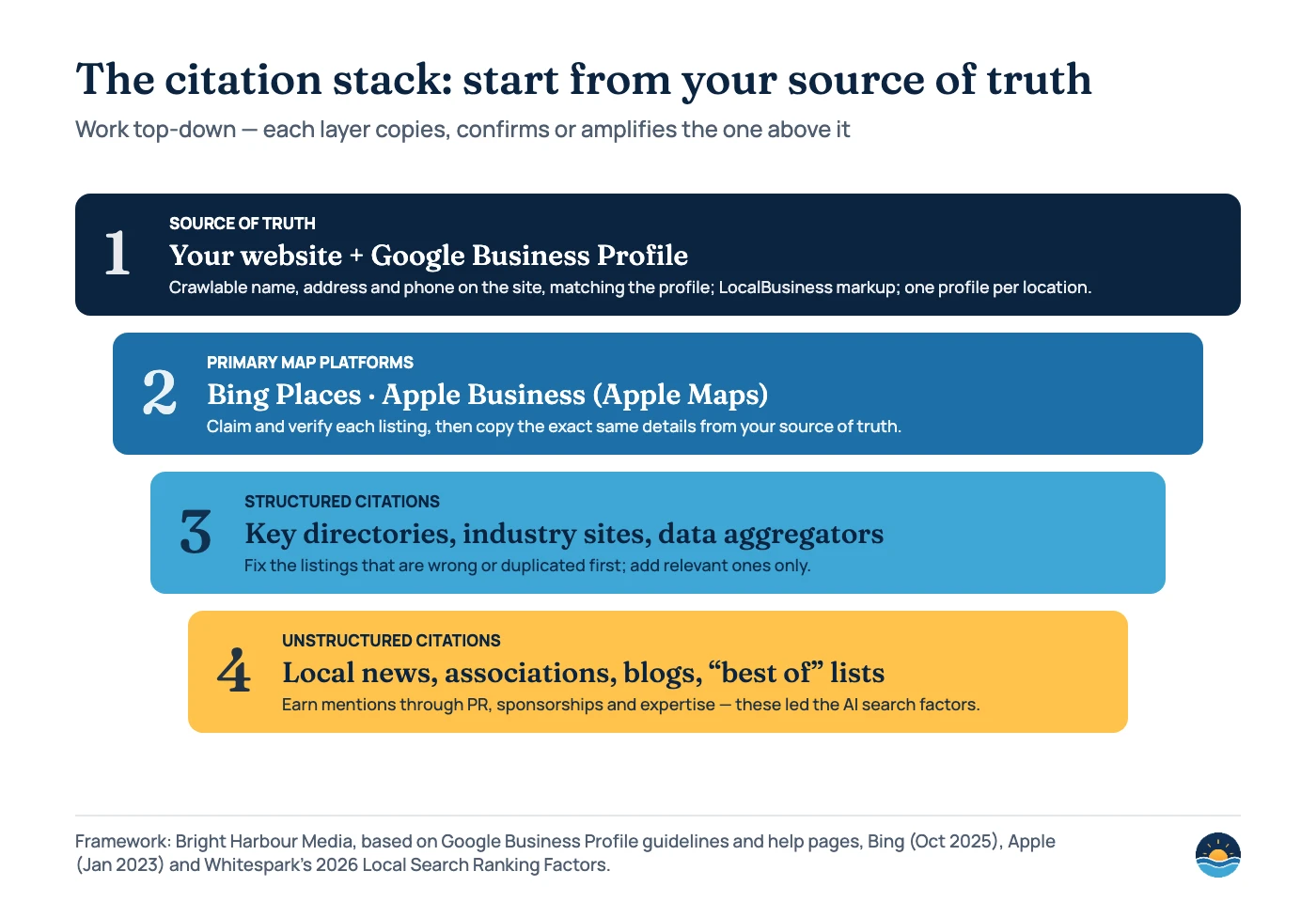
Work outwards in layers, as in the diagram above. Get the source of truth right first — your website and Google Business Profile — then the other map platforms, then directories, and earn unstructured mentions throughout.
- Bing Places. Microsoft relaunched Bing Places for Business in October 2025 as a free platform for appearing in Bing search results and Bing Maps, moved it to bing.com/forbusiness, and improved importing listings from Google.
- Apple Maps. Apple launched Business Connect in January 2023 as a free tool to claim and customise place cards seen across Apple Maps, Messages, Wallet, Siri and other apps. Apple’s support pages now describe it as part of Apple Business.
- Key and industry directories. Focus on the sites that already rank for your services in your area and the directories specific to your industry; fix wrong or duplicate listings before adding new ones.
- Unstructured, earned mentions. Local news coverage, association memberships, sponsorships and inclusion in credible “best of” lists — the citation types the experts rated highest for AI search.
Multi-location brands need one accurate citation set per location, each pointing to its own location page — see our multi-location SEO guide. If you serve customers at their address and hide yours, keep citations consistent with that choice, as covered in our guide to service-area business SEO.
A seven-step citation audit and clean-up
- Set the master record. Write down the exact name, address format, primary phone number, website URL, categories and hours, matching your Google Business Profile and the guidelines above.
- Fix your own website first. Make sure NAP appears as crawlable text on the contact or location page and in LocalBusiness markup, and that old addresses or numbers are gone.
- Review Google’s updates. In your Business Profile, look for fields Google has changed (shown in blue) and pending suggested edits, and accept or correct them.
- Claim the main map platforms. Claim or create Bing Places and Apple Maps listings and copy the master record exactly.
- Find existing listings. Search for your business name, current and old phone numbers and previous addresses to find directory listings, duplicates and outdated mentions.
- Correct, merge or close. Update wrong details, ask sites to merge or remove duplicates, and keep a log of what you changed and when.
- Earn new mentions and re-check. Pursue relevant local and industry mentions, then repeat the check after any move, rebrand or phone change — and at least once a year.
Citations work best alongside the other prominence signals, especially reviews; our guide to Google review management covers that side.
Frequently asked questions
Are local citations still a ranking factor?
Google doesn’t publish a list of local ranking factors, but it says prominence is based on information such as how many websites link to a business and how many reviews it has. In Whitespark’s 2026 expert survey, citation consistency still ranks in the top 30 map pack factors, while citation volume ranks much lower.
Does my NAP need to match exactly, character for character?
Aim for the same name, address and phone number everywhere, in one consistent format. Small formatting differences such as “St” versus “Street” matter far less than a wrong number, an old address or a different business name.
Can I use a call-tracking number in my citations?
Google requires a phone number that connects to your individual location, is under your direct control and doesn’t redirect users to landing pages. Experts in Whitespark’s survey list mismatched NAP and tracking numbers as both a negative ranking factor and a suspension risk, so keep one primary local number consistent across the profile, website and citations.
Do citations help with AI search?
The experts surveyed by Whitespark think so: presence on expert-curated “best of” lists ranked #1 for AI search visibility, and three of the top five AI factors were citation factors. This is expert opinion rather than measured data, so treat it as a strong direction rather than a rule.
Sources
- Tips to improve your local ranking on Google — Google Business Profile Help — relevance, distance and prominence
- Guidelines for representing your business on Google — Google Business Profile Help — name, address, phone, website and hours rules
- Understand Google updates on your Business Profile — Google Business Profile Help — Google updates and suggested edits (4-day review)
- Understand what happens to your Business Profile edits — Google Business Profile Help — edit review times (up to 30 days)
- 2026 Local Search Ranking Factors — Whitespark (Darren Shaw), published Nov 6, 2025 — 47 experts, 187 factors
- Local business (LocalBusiness) structured data — Google Search Central (last updated Sept 8, 2026)
- Introducing the New Bing Places for Business — Microsoft Bing Blog, October 2025
- Introducing Apple Business Connect — Apple Newsroom, Jan 11, 2023
Cite this article: Bright Harbour Media. “Local Citations and NAP Consistency: What Still Matters.” Bright Harbour Media Insights, October 2026. https://brightharbourmedia.com/local-citations-nap/
You are welcome to reference the charts and frameworks in this article with a link back to this page.
Not sure how consistent your business details are across the web? Our local SEO service starts with a citation and Business Profile audit — get in touch and we’ll show you what needs fixing first.