
A title tag is the HTML <title> element Google uses as its main source for the clickable headline (the “title link”) in search results, and a meta description is a short page summary Google may use for the snippet underneath. Google rewrites both often, so the goal is not to fight rewrites but to write titles and descriptions accurate enough that Google has little reason to change them.
Key takeaways
- Google said in September 2021 that it used the HTML title element around 87% of the time, up from around 80% before its title update.
- Independent studies measured far more change: 33.4% of titles (Ahrefs, 953,276 pages, 2021), 61.6% (Zyppy, Q1 2022 data) and 76% (John McAlpin, Q1 2025).
- Google rewrote 62.78% of meta descriptions in Ahrefs’ 2020 study, and 25.02% of top-ranking pages had no meta description at all.
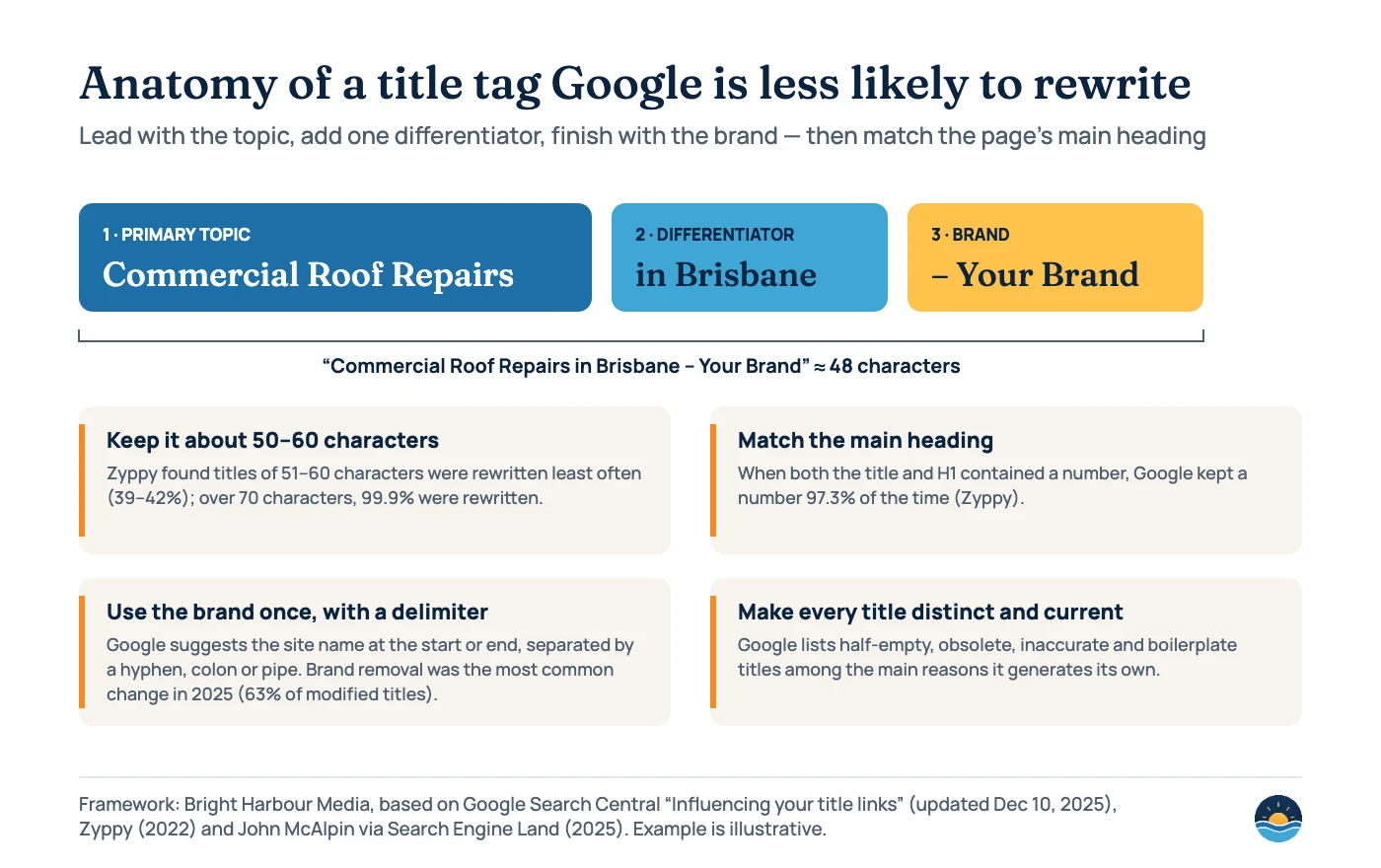
- In Zyppy’s data, titles of 51–60 characters were rewritten least (39–42%), while 99.9% of titles over 70 characters were changed.
- Google sets no character limit for either element. Both are truncated to fit the device width, and changes can take a few days to a few weeks to show.
What do title tags and meta descriptions actually do?
Title tag → title link
Google’s documentation lists the <title> element first among the sources for title links. It may also use the main visible title, headings such as <h1>, og:title, other prominent text, anchor text on and pointing to the page, and WebSite structured data.
Meta description → snippet
Google says snippets are created automatically from page content to match each search, so one page can show different snippets for different queries. It uses the meta description when that “might give users a more accurate description” than the on-page text.
Neither element is a place to repeat keywords. Both are your pitch to a searcher, so they should reflect the intent behind the query — the same principle behind our guide to search intent mapping.
How often does Google rewrite titles and meta descriptions?
It depends on who measured it, when and how. Google published its own figure a month after its August 2021 title-link update. Third-party studies compared the HTML of large samples of ranking pages with what actually appeared in results.

| Study | Element | Sample | Finding |
|---|---|---|---|
| Google Search Central Blog (Sept 17, 2021) | Title | Google’s own systems | Title elements used “around 87% of the time, rather than around 80% before” |
| Ahrefs (Nov 16, 2021) | Title | 953,276 pages ranking in the top 10 | Rewritten 33.4% of the time; when the title was not used, the H1 was used in 50.76% of cases |
| Zyppy (published July 12, 2022; Q1 2022 data) | Title | 80,959 titles from 2,370 sites | Rewritten 61.6% of the time |
| John McAlpin via Search Engine Land (May 1, 2025; Q1 2025 data) | Title | Top 20 results across a keyword set in the 30,000 range before paring down | Changed 76% of the time; changed titles kept only 35% of the original words |
| Ahrefs (Mar 25, 2020) | Meta description | 20,000 keywords; 192,656 pages for the length analysis | Rewritten 62.78% of the time — 59.65% for fat-head and 65.62% for long-tail keywords |
Why such a gap between Google’s 87% and the 61.6–76% rewrite rates? The figures use different samples, periods and definitions of a “change”. Google described its own systems overall; the studies checked specific pages, and Zyppy notes the true rate is probably higher because Google can show different titles for different queries and devices. The direction is consistent, though: a large share of titles, and most meta descriptions, will not appear exactly as written.
The 2025 study also shows what Google tends to change. Removing the brand name was the most common edit, in 63% of modified titles. About 30% of changes were for clarity and about 8% were length-related.
Why does Google rewrite a title?
Google’s title link documentation (updated December 10, 2025) lists the situations where it is most likely to look beyond the <title> element. Each one has a straightforward fix:
| Issue Google describes | Example | Fix |
|---|---|---|
| Half-empty title | | Site Name | Lead with a descriptive page title, then the brand |
| Obsolete title | Title says “2020 admissions criteria” but the page is about a newer year | Update the title whenever the page’s date, year or offer changes |
| Inaccurate title | Title doesn’t reflect what the page contains | Describe the page as it is, in natural language |
| Micro-boilerplate | Near-identical titles across a set of pages, missing the detail that tells them apart | Put the distinguishing detail (service, location, season) in every title |
| No clear main title | Several headings look equally prominent | Make one visible title clearly the most prominent, and align it with the <title> |
| Language or script mismatch | Title in a different language or script from the content | Write the title in the same language and writing system as the page |
| Unnecessary site name | Site name repeats what is already shown in the result | Use the site name once, at the start or end, with a delimiter |
Zyppy’s data adds detail on formatting. Google rewrote 77.6% of titles containing brackets and removed the bracketed text 32.9% of the time; parentheses fared better (61.9% rewritten, removed 19.7% of the time). Pipe separators were removed or replaced 41.0% of the time, against 19.7% for dashes. Where both the title and the H1 contained a number, Google kept a number 97.3% of the time, but when only the title had one, 25.8% of titles were rewritten with no number at all — a strong argument for aligning your title and H1.
How long should a title tag be?
Google does not set a character limit: title links are truncated “as needed, typically to fit the device width.” Length still affects rewrites. These are the length bands Zyppy reported:
| Title length | Share rewritten (Zyppy, Q1 2022 data) | What it means |
|---|---|---|
| 1–5 characters | 96.6% | Too short to describe a page |
| 20 characters or fewer | More than 50% | Usually missing useful detail |
| 51–60 characters | 39–42% (lowest band) | The practical sweet spot |
| More than 60 characters | More than 76% | Likely to be cut or rewritten |
| More than 70 characters | 99.9% | Almost always changed |
Ahrefs saw the same pattern by pixel width: titles wider than 600 pixels were rewritten 46.12% of the time, against 29.45% for shorter ones. Treat 50–60 characters as a guide, not a rule — a clear 45-character title beats a padded 60-character one.
Are meta descriptions still worth writing?
Yes — with realistic expectations. In Ahrefs’ study, length made little difference: Google rewrote 61.46% of descriptions that were too long and 63.69% of those within limits. Rewrites were more common for long-tail queries (65.62%) than fat-head queries (59.65%), because one description cannot match every search. Ahrefs also found only a weak correlation (0.28) between ranking position and having a meta description, which is consistent with descriptions being about the click rather than the ranking.
So write each description for the page’s main query and the people most likely to click: what the page offers, who it is for and why it is worth visiting. Google’s snippet guidance (updated April 20, 2026) asks for descriptions that are unique to each page, avoid strings of keywords and include relevant details such as the author, publication date, price or manufacturer. For large, database-driven sites, it says generating descriptions programmatically is appropriate, as long as they are human-readable and diverse.
You also have controls if you need them: the nosnippet rule prevents a snippet, max-snippet:[number] limits its length, and the data-nosnippet attribute keeps specific sections of a page out of snippets.
A six-step process for titles and descriptions that stick
- Start from the query. Identify the main search the page should answer and the intent behind it.
- Write the title first. Put the specific topic or service first, add one differentiator (location, format, year or number), and finish with your brand after a dash or pipe. Aim for roughly 50–60 characters.
- Align the title and H1. They don’t need to be identical, but they should say the same thing — and share any numbers.
- Write a unique description. One or two plain sentences on what the page delivers and for whom, with concrete details.
- Fix templates, not just pages. Most rewrites come from patterns — half-empty, repeated or outdated titles — so correct the template that generates them.
- Check what Google shows. Google says title changes can take a few days to a few weeks to be reflected. Then search for the page, compare, and look for the cause in the issues table above if it was rewritten.
Titles and descriptions also travel beyond the results page: og:title is one of Google’s title sources and is used for social sharing, and clear, accurate summaries help as search shifts towards AI-generated answers — see our guide to SEO for AI Overviews. To check titles and descriptions across a whole site, start with our SEO audit checklist, and fold the fixes into a regular content refresh.
Frequently asked questions
Is there a character limit for title tags?
Google does not set one; title links are truncated to fit the device width. In Zyppy’s study, titles of 51–60 characters were rewritten least often (39–42%), while titles over 70 characters were rewritten 99.9% of the time.
Why does Google ignore my meta description?
Google builds snippets to match each search and uses the meta description only when it describes the page better than the on-page text. Ahrefs found Google rewrote meta descriptions 62.78% of the time, and more often for long-tail queries.
Can I stop Google rewriting my title?
There is no setting that prevents it. The most reliable approach is to fix the issues Google lists — half-empty, obsolete, inaccurate or boilerplate titles — and to make your title match the page’s most prominent visible heading.
Should my brand name be in every title tag?
Google suggests using your site name once, at the start or end of the title, separated by a hyphen, colon or pipe. It may drop the site name when it repeats what the result already shows — brand removal was the most common change in the 2025 study.
Sources
- Influencing your title links in search results — Google Search Central (last updated Dec 10, 2025) — title sources, best practices, common issues, truncation
- Control your snippets in search results — Google Search Central (last updated Apr 20, 2026) — meta descriptions and snippet controls
- More information on how Google generates titles for web page results — Google Search Central Blog, Sept 17, 2021
- Title tag rewrite study — Ahrefs, Nov 16, 2021 (953,276 pages)
- Google Rewrites 61% of Page Title Tags — Zyppy, July 12, 2022 (80,959 titles, Q1 2022 data)
- Google changed 76% of title tags in Q1 2025 — John McAlpin, Search Engine Land, May 1, 2025
- Meta description rewrite study — Ahrefs, Mar 25, 2020 (20,000 keywords)
Cite this article: Bright Harbour Media. “Title Tags and Meta Descriptions: Why Google Rewrites Them.” Bright Harbour Media Insights, October 2026. https://brightharbourmedia.com/title-tags-meta-descriptions/
You are welcome to reference the charts and frameworks in this article with a link back to this page.
Want titles and descriptions that earn the click? Our content strategy and SEO content service covers on-page copy across your key pages and templates — or get in touch for a review of the pages that matter most.