
Content syndication is republishing your article, in full or in part, on another website with your permission. Google’s current advice is that the partner site should block indexing of its copy with a noindex rule; a cross-domain canonical tag is “not recommended” for syndication because syndicated pages are often very different from the original.
Key takeaways
- Since May 2, 2023, Google’s canonicalization documentation has said the canonical link element is not recommended for avoiding duplication by syndication partners.
- Google’s preferred fix is for partners to block indexing, for example with
<meta name="Googlebot" content="noindex">, orGooglebot-Newsto block only Google News. - The 2017 advice to use rel=”canonical” plus rel=”nofollow” for syndicated duplicates has been superseded for syndication.
- Google’s spam policies (updated Aug 28, 2026) say syndicated news and wire services are not inconsistent with the site reputation policy, but republishing without added value is listed as scraping.
- Without noindex, Google “will try to determine the original contents. But it’s harder,” according to Google’s Search Liaison in July 2023.
What is content syndication?
Syndication means the same article lives on two or more sites by agreement. A trade publication republishes your guide, a news aggregator carries your press coverage, or a partner blog runs your post a week after you publish it. The goal is reach: the partner’s audience sees your work and, ideally, clicks through to you.
The SEO risk is simple. Google usually shows one version of substantially similar content for a query. If the partner site is larger and better known, its copy can rank instead of yours, and the traffic you hoped to earn goes to them. That is why the setup details matter more than the decision to syndicate.
Syndication is different from guest posting, where you write original content for someone else’s site, and from scraping, where a site copies your work without permission. We cover the link side of guest content in Guest Posting for SEO and wire distribution in Press Releases and SEO.
What does Google recommend for syndicated content?
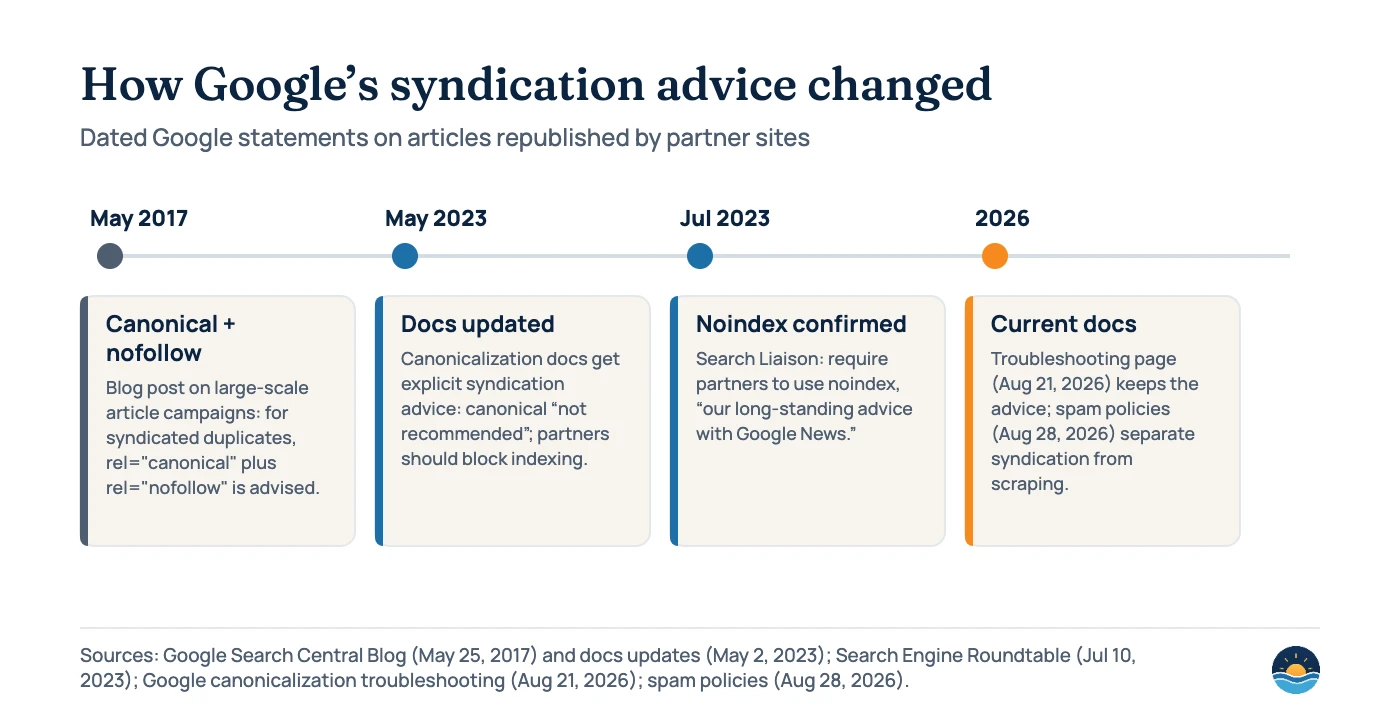
Google’s canonicalization troubleshooting page (last updated Aug 21, 2026) has a short section on syndicated content. It says the canonical link element “is not recommended for those who want to avoid duplication by syndication partners, because the pages are often very different.” It then gives the fix: “The most effective solution is for partners to block indexing of your content.”
The Google News Publisher Center help page “Avoid article duplication in Google News” says the same thing in more detail. Partners can add a Googlebot-News noindex meta tag, which stops Google News from indexing the syndicated version, or a Googlebot noindex tag to keep the copy out of Google Search as well. The page repeats that the canonical link element is not recommended because syndicated articles “are often very different in overall content from original articles.”
Google’s Search Liaison, Danny Sullivan, explained the reasoning in July 2023, as reported by Search Engine Roundtable: “our recommendation is to require their partner to use noindex. That’s been our long-standing advice with Google News.” He added that canonical “is designed primarily to deal with near duplicate pages,” and that without noindex Google’s systems will try to work out the original, “But it’s harder.”
Why did Google move away from cross-domain canonicals?
In May 2017, a Google Search Central blog post about large-scale article campaigns covered “contributor posts, guest posts, partner posts, or syndicated posts.” For full duplicates of your own articles, it said that “use of rel=”canonical”, in addition to rel=”nofollow”, is advised.” Many syndication contracts still ask for exactly that.
On May 2, 2023, Google’s documentation changelog recorded an update to the canonicalization docs “with explicit recommendations for syndicated content.” The older guidance that listed syndication as a reason to use rel=canonical was replaced by the advice above. The reason Google gives is practical: a syndicated page usually has a different header, navigation, sidebar, related links and sometimes an edited version of the article. Canonical works best for near-duplicates on pages you control, and Google’s “Specify a canonical” page (updated Jul 10, 2026) describes rel=canonical as “a strong signal,” not a directive.
| Method on the partner copy | What Google says | Our view |
|---|---|---|
noindex for Googlebot | “The most effective solution” (canonicalization troubleshooting, Aug 21, 2026) | Ask for this first. The copy stays readable for the partner’s audience but out of Google Search. |
noindex for Googlebot-News only | Stops Google News from indexing the syndicated version (Google News help) | Useful for news partners who still want Search visibility. Your original can still compete with their copy in web results. |
| Cross-domain rel=canonical | “Not recommended” for syndication (since May 2023) | Harmless to request, but don’t rely on it. Google may ignore it when the pages differ. |
| Link back to the original | Not described as a deduplication method in the current docs | Always ask for a visible link. It helps readers and gives Google another clue, but it isn’t a substitute for noindex. |
| No controls at all | Google “will try to determine the original contents. But it’s harder.” (Search Liaison, Jul 2023) | Expect the larger site to win some queries. |
Can a syndicated copy really outrank the original?
Yes, and there is some evidence of it in news. In a July 2023 study, NewzDash analysed “millions of records” from US Google mobile Top Stories between January and June 2023 and matched articles by exact headline. It reported that Yahoo “gets 82% of Google search traffic for all identified AOL syndicated articles” (AOL and Yahoo share an owner). The authors call the data directional, the study is from a vendor, and it covers news only, so treat it as an illustration rather than a measurement for every industry.
We found no independent study that measures how often syndicated copies outrank originals across the web. HTTP Archive’s Web Almanac 2025 reports that 7% of desktop and 9% of mobile pages are “canonicalized” (their canonical points elsewhere), but that figure includes same-site canonicals, so it says nothing specific about syndication.
Is syndication against Google’s spam policies?
Not when it’s done openly and with permission. Google’s spam policies (last updated Aug 28, 2026) list “wire service or press release service sites” and “news publications that have syndicated news content from other news publications” as examples that are not inconsistent with the site reputation policy.
The same policies define scraping, including “republishing content from other sites without adding any original content or value, or even citing the original source” and “reproducing content feeds from other sites without providing some type of unique benefit to the user.” If your own site republishes other people’s articles, either add something original or keep those pages out of the index. Links inside syndicated articles are still links: if they are part of a paid arrangement, qualify them as described in our guide to nofollow, sponsored and UGC links.
Usually a good deal
A respected publication reaches an audience you can’t, agrees to noindex its copy, credits you with a link, and publishes after Google has indexed your original.
Usually a poor deal
A large site runs your full article on the same day, with no noindex and no link, on topics where you want to rank. You give away the best version of your page.
How to syndicate content without losing rankings
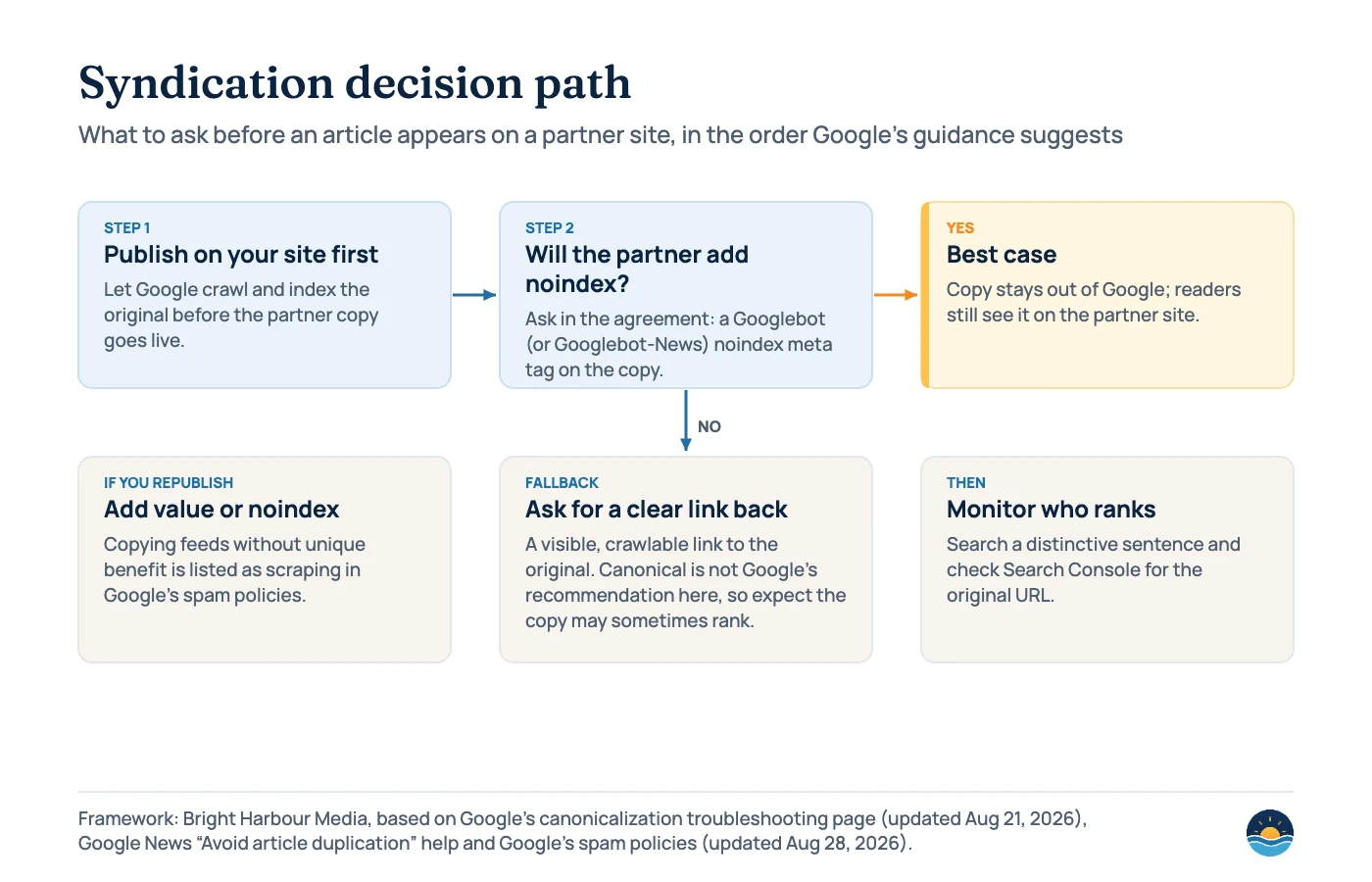
- Decide what to syndicate. Keep your most important ranking pages exclusive, or offer partners a shorter version or an excerpt with a link to the full piece.
- Publish on your site first. Make sure the original is crawlable, internally linked and in your XML sitemap. Use the URL Inspection tool to confirm Google has indexed it before the partner publishes.
- Put noindex in the agreement. Ask for
<meta name="Googlebot" content="noindex">on the partner copy, or the Googlebot-News version if they need web visibility. Get it in writing before you send the article. - Ask for attribution and a link. A line such as “This article first appeared on…” with a crawlable link to your original URL.
- Treat canonical as optional. If the partner offers a cross-domain canonical as well, accept it, but don’t accept it instead of noindex.
- Check the partner page after launch. View the source for the robots meta tag and the link. Our noindex tag guide explains how to check both the HTML tag and the X-Robots-Tag header.
- Monitor who ranks. Search a distinctive sentence in quotes and check Search Console’s Performance report for the original URL. If the partner copy ranks and they won’t add noindex, consider shortening future syndicated versions.
| Situation | Ask the partner for | Watch out for |
|---|---|---|
| Trade or industry publication | Googlebot noindex + link to original | Edited headlines that compete with yours |
| News partner or aggregator | Googlebot-News noindex (or full noindex) + attribution | Same-day publishing before your page is indexed |
| Partner blog with its own audience | Excerpt with a link, or full copy with noindex | Paid placements with unqualified links |
| You republish someone else’s article | Your own noindex, or added commentary and a citation | Scraping under Google’s spam policies |
For duplicate URLs on your own site, rel=canonical remains the right tool. Our guide to canonical tags and duplicate content explains how Google weighs canonicals, redirects and sitemaps.
Frequently asked questions
Should syndication partners use rel=canonical or noindex?
Google recommends noindex. Its canonicalization troubleshooting page says the canonical link element is not recommended for syndication because the pages are often very different, and that partners blocking indexing is the most effective solution.
Is syndicated content duplicate content that gets penalised?
No. Google’s spam policies treat wire services and syndicated news as consistent with the site reputation policy. The practical risk is that the wrong copy ranks, not a penalty. Republishing without permission or added value is a different matter and is listed as scraping.
Does the 2017 canonical plus nofollow advice still apply?
Not for syndication. Google’s May 2023 documentation update replaced it with the noindex recommendation. Qualifying paid or promotional links with nofollow or sponsored still applies.
What if the partner refuses to add noindex?
Ask for a link to the original, publish on your site first, and consider offering an excerpt instead of the full article. Without noindex, Google tries to identify the original but has said that is harder.
Sources
- Fix canonicalization issues — Google Search Central, last updated Aug 21, 2026 — syndicated content section
- Avoid article duplication in Google News — Google Publisher Center Help — Googlebot-News and Googlebot noindex tags
- Latest Google Search documentation updates — Google Search Central — May 2, 2023 canonicalization entry
- How to specify a canonical URL — Google Search Central, last updated Jul 10, 2026 — rel=canonical as a strong signal
- A reminder about links in large-scale article campaigns — Google Search Central Blog, May 25, 2017 — earlier canonical + nofollow advice
- Spam policies for Google web search — Google Search Central, last updated Aug 28, 2026 — scraping and site reputation policy
- Google SEO guidance for syndication partners — Search Engine Roundtable, Jul 10, 2023 — Danny Sullivan’s statements
- Guard your SEO: are news syndication partners hijacking your traffic? — NewzDash, Jul 3, 2023 — Top Stories syndication analysis
- Web Almanac 2025: SEO — HTTP Archive — canonical tag usage
Cite this article: Bright Harbour Media. “Content Syndication and SEO: What Google Recommends.” Bright Harbour Media Insights, November 2026. https://brightharbourmedia.com/content-syndication-seo/
You are welcome to reference the charts and frameworks in this article with a link back to this page.
Planning a content programme that includes partner publications? Our content strategy service builds syndication into the plan without giving away your rankings. Get in touch to talk it through.