
Keyword cannibalization is when two or more pages on the same site compete for the same search query and the same intent, so the wrong page ranks, rankings swap between URLs, or neither page performs as well as one stronger page would. Google does not penalise it, and several pages from one site ranking for a query is often fine. It only needs fixing when the overlap is costing you results.
Key takeaways
- Google’s Search Console counts two results from one site for a query as a single impression in the chart, and reports the topmost position. Use the Pages tab to see every URL that appeared.
- Since June 2019 Google “usually won’t” show more than two listings from the same site in its top results, and treats subdomains as part of the root domain in most cases.
- In Searchmetrics data from June 2019, 44.2% of searches showed two URLs from one domain and 3.5% showed three (down from 6.7% in March).
- Google’s John Mueller (September 2025): three pages in one result “doesn’t seem problematic” just because it’s “more than 1”.
- When you do consolidate, a permanent redirect and rel=”canonical” are both “strong” signals in Google’s documentation (updated July 10, 2026); sitemap inclusion is “weak”.
What is keyword cannibalization?
The term describes pages on one site that target the same query with the same purpose. Two near-identical blog posts on “how to choose a roofer”, or a service page and a blog post that both try to be the main answer for “emergency plumber Manila”, are typical examples. Search engines have to pick one, and they may not pick the one you want.
The term is used loosely, which causes a lot of wasted work. Seeing two of your URLs in Search Console for the same query is not proof of a problem. Google’s own documentation does not use the word “cannibalization” at all. What it does document is how it handles duplicate and near-duplicate pages, how it limits how many results one site gets, and how to consolidate pages when you decide to.
Usually a real problem
- Two pages with the same intent and largely the same content
- Rankings flip between URLs from week to week
- A thin or outdated page ranks instead of your best page
- Links and internal links are split across both versions
Usually not a problem
- A product page and a buying guide both appear for a broad query
- Two of your pages hold positions 2 and 4
- Pages appear together for a vague query but target different longer queries
- Location pages that each serve a genuinely different area
What Google says about multiple pages ranking for one query
Google has not published a page on cannibalization, but three documented positions shape how you should think about it.
Duplicate content is not a penalty. The SEO Starter Guide (last updated December 10, 2025) says duplicate content “is not a violation of our spam policies, but it can be a bad user experience”. Under the heading Duplicate content “penalty” it adds: “it’s fine; don’t fret about it. It’s inefficient, but it’s not something that will cause a manual action.”
Google limits how many results one site gets. On June 6, 2019 Google’s Search Liaison account announced a site diversity change: “you usually won’t see more than two listings from the same site in our top results”. Google said it may still show more “in cases where our systems determine it’s especially relevant to do so for a particular search”, that it will “generally treat subdomains as part of a root domain”, and that the change was separate from the June 2019 core update. Danny Sullivan added: “It’s not really about ranking.” In other words, several of your pages may be eligible, but only one or two will usually be shown.
Multiple rankings are not automatically bad. Asked in September 2025 how to avoid cannibalization, John Mueller replied on Bluesky that Search Console “shows data for when pages were actually shown, it’s not a theoretical measurement”, and that “If you have 3 different pages appearing in the same search result, that doesn’t seem problematic to me just because it’s “more than 1”.” He also said: “Reduce unnecesary duplication and spend your energy on a fantastic page, sure. But pages aren’t duplicates just because they happen to appear in the same search results page.”
There is one policy boundary to keep in mind. Google’s spam policies (last updated August 28, 2026) define doorway abuse as “when sites or pages are created to rank for specific, similar search queries”, including “substantially similar pages that are closer to search results than a clearly defined, browseable hierarchy”. Mass-producing near-identical pages for keyword variants is not cannibalization; it is a policy risk.
How often does one site get several results?
Google does not publish figures on this, so the best numbers come from rank-tracking vendors measuring before and after the 2019 change. They are directional, not definitive.
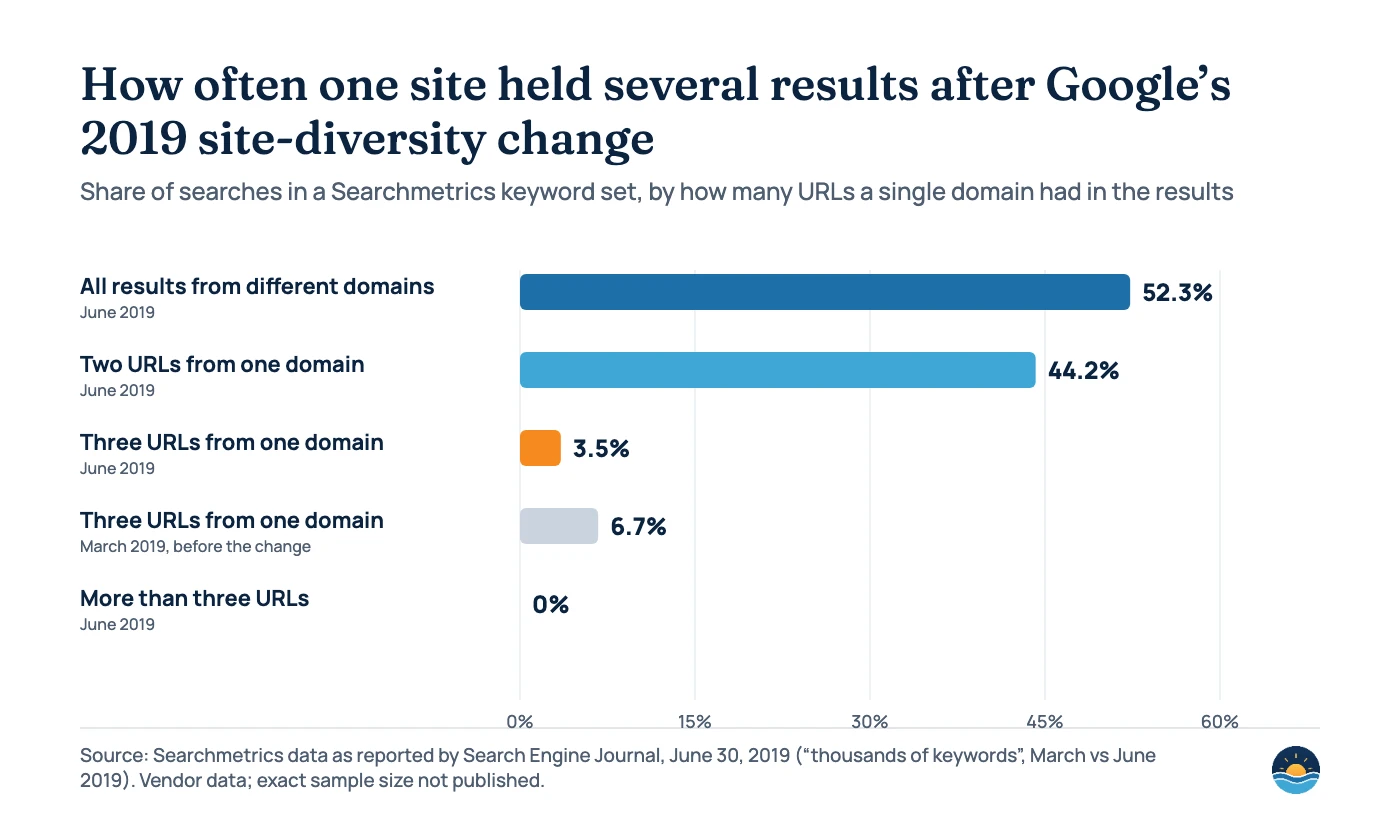
Searchmetrics, as reported by Search Engine Journal on June 30, 2019, found that 3.5% of searches in its keyword set showed three URLs from one domain after the change, down from 6.7% in March 2019. Two URLs from one domain appeared in 44.2% of searches, and 52.3% showed a different domain in every position. The exact sample size was not published.
Moz measured the same week on its 10,000-keyword MozCast set and found a smaller effect: average page-one diversity rose “from 90.23 percent to 90.72 percent”, and Moz concluded that “Google has made minor improvements but still has work to do.” Moz also found that the searches where one site still held six or more listings were mostly brand or navigational queries.
Ahrefs looked at the issue from the other direction in February 2024. It found 9,700 cases of multiple rankings on ahrefs.com, but after reviewing “a sample of 80 keywords with multiple rankings, I found only one case that needed action.” That is one site’s experience, not a general rate, but it matches Google’s message: most overlap is harmless.
| Source | Date | Sample | Finding |
|---|---|---|---|
| Google Search Liaison | June 6, 2019 | Announcement | Usually no more than two listings from one site in top results; subdomains generally count as the root domain |
| Searchmetrics via Search Engine Journal | June 30, 2019 | “Thousands of keywords”, March vs June 2019 | Three URLs from one domain fell from 6.7% to 3.5% of searches; two URLs 44.2% |
| Moz | June 19, 2019 | 10,000 keywords (MozCast) | Average diversity 90.23% → 90.72%; “minor improvements” |
| Ahrefs (own site) | February 14, 2024 | 9,700 multiple-ranking cases; 80 reviewed | Only one of 80 needed action |
How to find keyword cannibalization in Search Console
The Performance report is the most reliable starting point because, as Mueller put it, it records pages that were actually shown. You need to understand how it aggregates data first.
| Report view | How Google aggregates | What it means for cannibalization |
|---|---|---|
| Chart totals | “Aggregated by property” | Two of your results for one query count as one impression |
| Queries, Countries, Devices, Dates tables | Aggregated by property | A query row shows your site’s topmost position, not each page |
| Pages and Search appearance tables | Aggregated by page | Every URL that appeared for a filtered query is listed separately |
| Average position | Topmost result from your site | If you rank 2, 4 and 6 for a query, Google records position 2 |
| Canonical URLs | Data assigned to the Google-selected canonical | Duplicates Google already folded together won’t show as separate pages |
So the method is: filter the Performance report by a query (or a query pattern), then open the Pages tab. If more than one URL appears, switch the date range to compare periods and look at clicks and position for each page. Rankings that alternate between URLs, or a weaker page taking most of the impressions, are the signs worth acting on.
Two limits apply. Rare queries are anonymised and, according to Google’s Search Central blog (October 19, 2022), are “omitted whenever a filter is applied”. And the interface exports a maximum of 1,000 rows, so large sites should use the Search Console API (up to 50,000 rows per day per site per search type) to pull query-and-page pairs in bulk.
Is it really cannibalization? A decision path
Before merging anything, run each overlapping pair through four questions. Most pairs drop out at the first or second question.
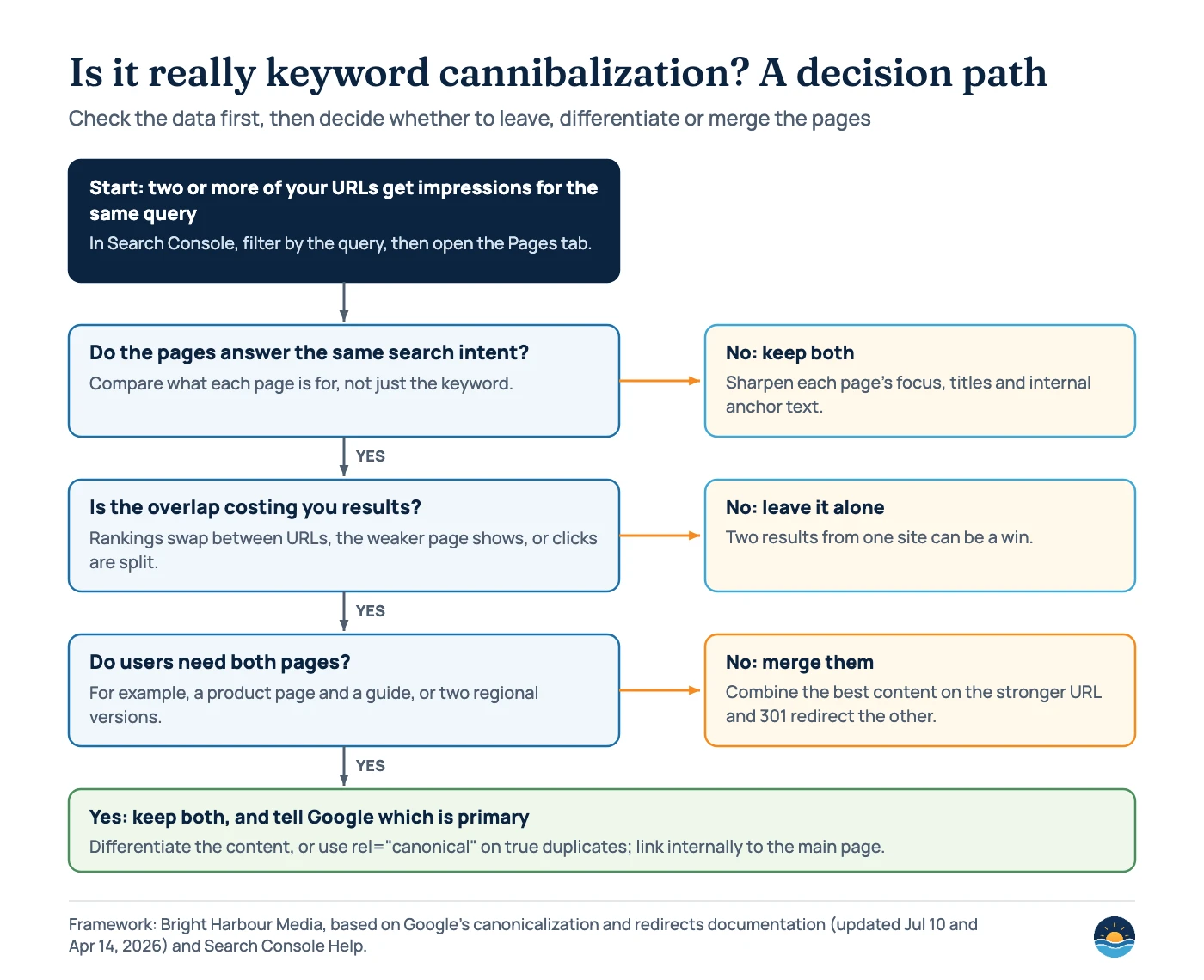
Intent is the key test. If one page is a how-to guide and the other is a service page, they answer different needs, even when they share a keyword. Our guide to search intent mapping explains how to assign one primary intent to each URL.
How to fix keyword cannibalization
Google documents several ways to tell it which page is primary. They differ in strength and in what happens to the other page.
| Fix | When to use it | What Google says |
|---|---|---|
| Merge and 301 redirect | Both pages target the same intent and users don’t need both | Redirects are “a strong signal that the target of the redirect should become canonical”; use permanent redirects “when you’re sure that the redirect won’t be reverted” |
| rel=”canonical” | Near-duplicates that must both stay live (for example, print or filtered versions) | “A strong signal that the specified URL should become canonical” |
| Differentiate the content | Pages overlap but serve different needs | Not a canonical signal; refocus titles, headings and copy on each page’s own intent |
| Internal links | Always, alongside any fix | Point internal links and anchor text at the primary page so its importance is clear |
| Sitemap | Supporting signal only | “A weak signal”; list only the primary URL |
| noindex | Avoid for choosing between pages on one site | “We don’t recommend using noindex to prevent selection of a canonical page within a single site” |
Google’s canonical documentation notes that these methods “can stack and thus become more effective when combined”. A merge with a permanent redirect, updated internal links and a clean sitemap sends one consistent message.
A seven-step process for fixing cannibalization
- Build the list. Export query-and-page pairs from Search Console (via the API for large sites) and flag queries where two or more URLs got impressions over the last three to six months.
- Filter for value. Keep only queries that matter commercially or bring meaningful impressions. Overlap on queries no one searches for isn’t worth your time.
- Check intent. Open both pages and the live results. If the pages serve different intents, keep both and sharpen each one’s focus.
- Check the cost. Compare clicks and position by page over time. Leave stable pairs alone; act on swapping, splitting or the wrong page ranking.
- Choose the primary page. Pick the URL with the stronger content, links and conversions. Fold the best parts of the other page into it.
- Consolidate. 301 redirect the retired URL to the primary page, or use rel=”canonical” if both must stay live. Update internal links and the sitemap to point at the primary URL.
- Measure. Annotate the change date and compare the primary page’s clicks and position for the query group after a few weeks. Record what you changed so the overlap doesn’t creep back in.
Prevention is cheaper than cleanup. Keep a keyword map that assigns one primary page per topic, check it before publishing new content, and review overlapping posts as part of a regular content refresh and pruning cycle.
Frequently asked questions
Does Google penalise keyword cannibalization?
No. Google has no penalty for it, and its SEO Starter Guide says duplicate content is not a spam policy violation and won’t cause a manual action. The risk is lost performance, such as the weaker page ranking or signals split across URLs.
Is it bad if two of my pages rank for the same keyword?
Not necessarily. Two results from one site can mean more visibility. It becomes a problem when the pages serve the same intent and the overlap is costing you clicks, for example when rankings swap between URLs or the wrong page shows.
Should I use a 301 redirect or a canonical tag?
Use a 301 redirect when users no longer need the second page, because the page is retired and its signals consolidate on the target. Use rel=”canonical” when both pages need to stay live, such as near-duplicate versions. Google describes both as strong signals.
Can I use noindex to fix cannibalization?
Google advises against using noindex to choose a canonical page within a single site. Use redirects, rel=”canonical”, internal links and clearer content differentiation instead.
Sources
- How to Specify a Canonical with rel=”canonical” and Other Methods — Google Search Central, last updated July 10, 2026 — signal strength of redirects, rel=”canonical”, sitemaps; noindex advice
- What is URL Canonicalization — Google Search Central, last updated August 20, 2026 — how Google chooses a canonical
- Redirects and Google Search — Google Search Central, last updated April 14, 2026 — permanent vs temporary redirects
- SEO Starter Guide: The Basics — Google Search Central, last updated December 10, 2025 — duplicate content and penalties
- Spam Policies for Google Web Search — Google Search Central, last updated August 28, 2026 — doorway abuse
- Performance report (Search results): Overview and basic setup — Search Console Help — aggregation by property vs by page
- What are impressions, position, and clicks? — Search Console Help — topmost position; data assigned to canonical URLs
- A deep dive into Search Console performance data filtering and limits — Google Search Central Blog, October 19, 2022 — anonymised queries, row limits
- Google Search Change Restricts Two Results From Same Domain For Most Search Results — Search Engine Roundtable, June 7, 2019 — Google Search Liaison and Danny Sullivan statements
- Did Google’s Site Diversity Update Live Up to its Promise? — Moz, June 19, 2019 — MozCast diversity data
- Google’s Diversity Update Gives Smaller Sites a Chance to Rank — Search Engine Journal, June 30, 2019 — Searchmetrics figures used in the chart
- John Mueller’s replies on keyword cannibalization — Bluesky thread, September 20, 2025 (covered by Search Engine Journal, September 22, 2025)
- Keyword Diversification: Cannibalization’s Good Twin (SEO Study) — Ahrefs, February 14, 2024 — 9,700 multiple rankings, 1 of 80 needed action
Cite this article: Bright Harbour Media. “Keyword Cannibalization: How to Find and Fix It.” Bright Harbour Media Insights, November 2026. https://brightharbourmedia.com/keyword-cannibalization/
You are welcome to reference the charts and frameworks in this article with a link back to this page.
Not sure whether overlapping pages are holding your site back? Our content strategy service maps each topic to one strong page and cleans up the overlap. Get in touch to talk it through.