
HARO alternatives are services that pass journalists’ requests for expert sources to businesses that can answer them, the job Help a Reporter Out did before Cision shut its renamed successor, Connectively, on December 9, 2024. In 2026 the main options are the relaunched HARO newsletter (now owned by Featured.com), Qwoted, Source of Sources, SourceBottle, ProfNet, ResponseSource and MentionMatch.
Key takeaways
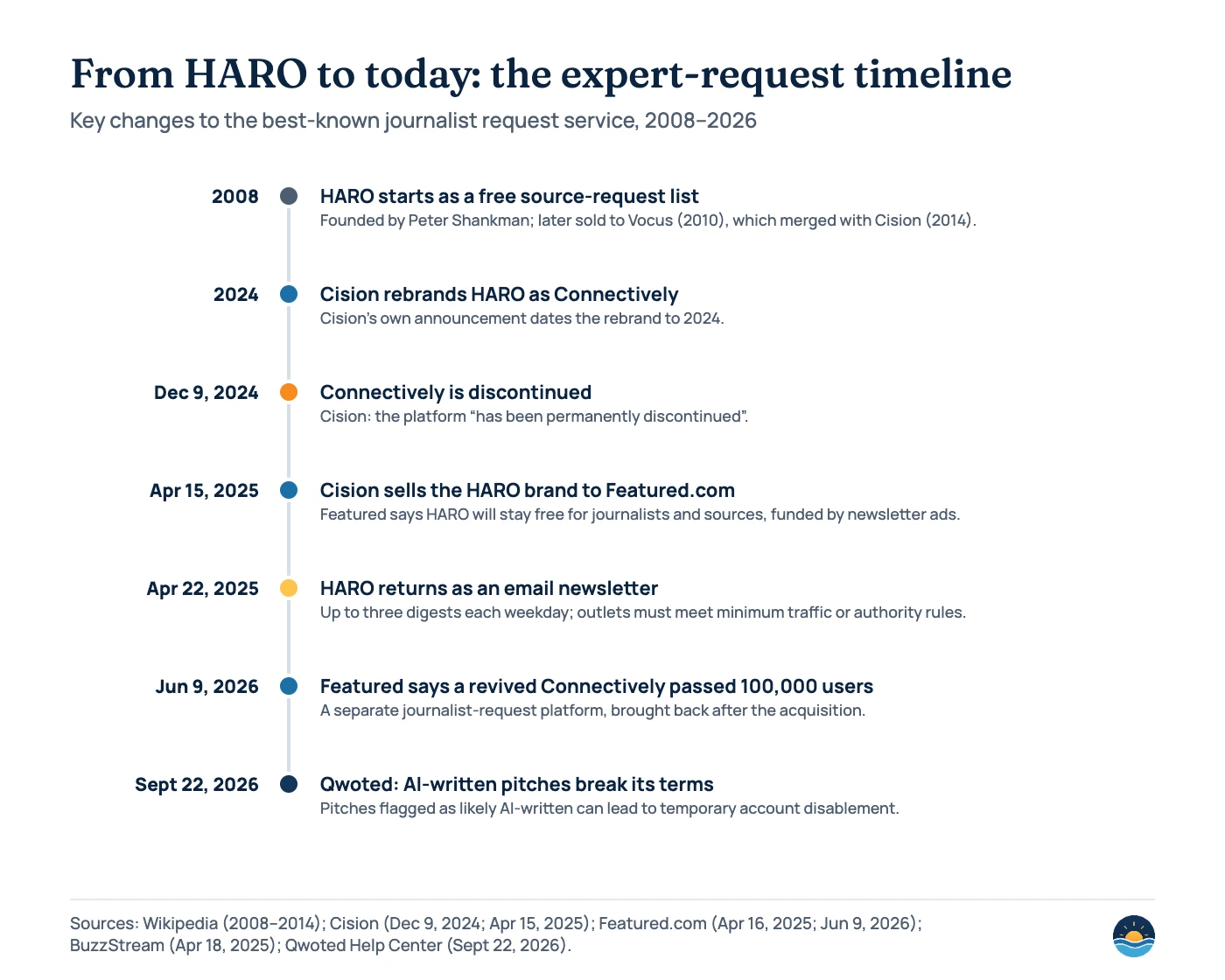
- Cision discontinued Connectively, the renamed HARO, on December 9, 2024, sold the HARO brand to Featured.com in April 2025, and HARO returned as a free email newsletter on April 22, 2025.
- In Reporter Outreach’s Q1 2026 survey of 500 SEO professionals, 41.6% use HARO or journalist sourcing and 21% rate it their best link-building method, second only to digital PR (34%).
- 89.9% of the 150+ digital PR professionals in BuzzStream’s 2026 report use expert commentary as a tactic.
- 53% of 1,899 journalists in Cision’s 2026 State of the Media oppose AI-generated pitches, and Qwoted now says using AI to write pitches is against its terms.
- Google treats paying for links, including “posts that contain links”, as link spam unless the link is marked
sponsoredornofollow. A quote earns a link only when the journalist chooses to add one.
What happened to HARO?
HARO started in 2008 as Peter Shankman’s free list of source requests from journalists. It was sold to Vocus in 2010, and Vocus merged with Cision in 2014. For more than a decade it was the default way for small businesses to get quoted, and for SEOs to earn links from news sites by answering reporters’ questions.
In 2024 Cision rebranded HARO as Connectively. Its own notice is short: “As of December 9, 2024, the Connectively (HARO) platform has been permanently discontinued.” On April 15, 2025 Cision announced it had sold the HARO brand to Featured.com, and confirmed it “no longer offers the Help A Reporter Out or Connectively services”.
Featured relaunched HARO as an email newsletter on April 22, 2025. It says HARO stays free for journalists and sources, paid for by newsletter ads. The current service sends up to three digests each weekday. In June 2026 Featured said it had also revived Connectively as a separate journalist-request platform, which it said had passed 100,000 users.
Which HARO alternatives exist in 2026?
Every service below does the same basic thing: a journalist posts a request, and sources who fit it reply. They differ in who pays, which countries they cover and how hard they police spam. The member counts are each platform’s own marketing claims, not audited figures.
| Platform | Best fit | Cost for sources | Rules and claims |
|---|---|---|---|
| HARO (Featured.com) | General requests, mostly US outlets | Free (ad-supported newsletter) | Outlets need Domain Authority 20+ or 10,000 monthly visitors; “No guest blogging, link exchanges, or backlink solicitation”; claims 800K+ sources and 75K+ journalists |
| Qwoted | Experts and PR teams that want a pitch inbox | Basic free (2 pitches a month, 2-hour delay); Pro $149.99 a month (35 pitches) | AI-written pitches break its terms; journalists can check pitches for AI |
| Source of Sources | General requests by email | Free, up to three emails a day | Pitch off topic even once and you are removed; claims 20,000+ journalists, bloggers and brands |
| SourceBottle | Australia, New Zealand, Singapore, UK, Ireland, North America | Free; paid tiers from $25 per pitch or $65 a month (currency not stated) | Claims 65K+ experts, brands and PR professionals |
| ProfNet (PR Newswire / Cision) | Organisations with PR teams | Paid subscription (price not published) | Free for journalists; “thousands of story leads every month” |
| ResponseSource | UK media | Journalist Enquiry Service from £625 per category, annual | Free for journalists; “hundreds” of requests each week |
| MentionMatch (formerly Help a B2B Writer) | B2B writers and sources | Not shown on its home page | Claims 8,000+ sources |
Featured.com itself is now a paid AI PR assistant, with plans from free to $299 a month for individuals, that responds to “journalist queries from HARO, LinkedIn, and more”. It is a tool for answering requests, not a separate source of them. Journalists also post requests on social media under hashtags such as #JournoRequest; there is no official rulebook for those, so treat them like any cold request and check the outlet first.
How much link-building value does expert sourcing deliver?
Survey data says expert sourcing is common and well regarded, but these are self-reported numbers from companies that sell link building, so read them as practitioner opinion rather than measured results.
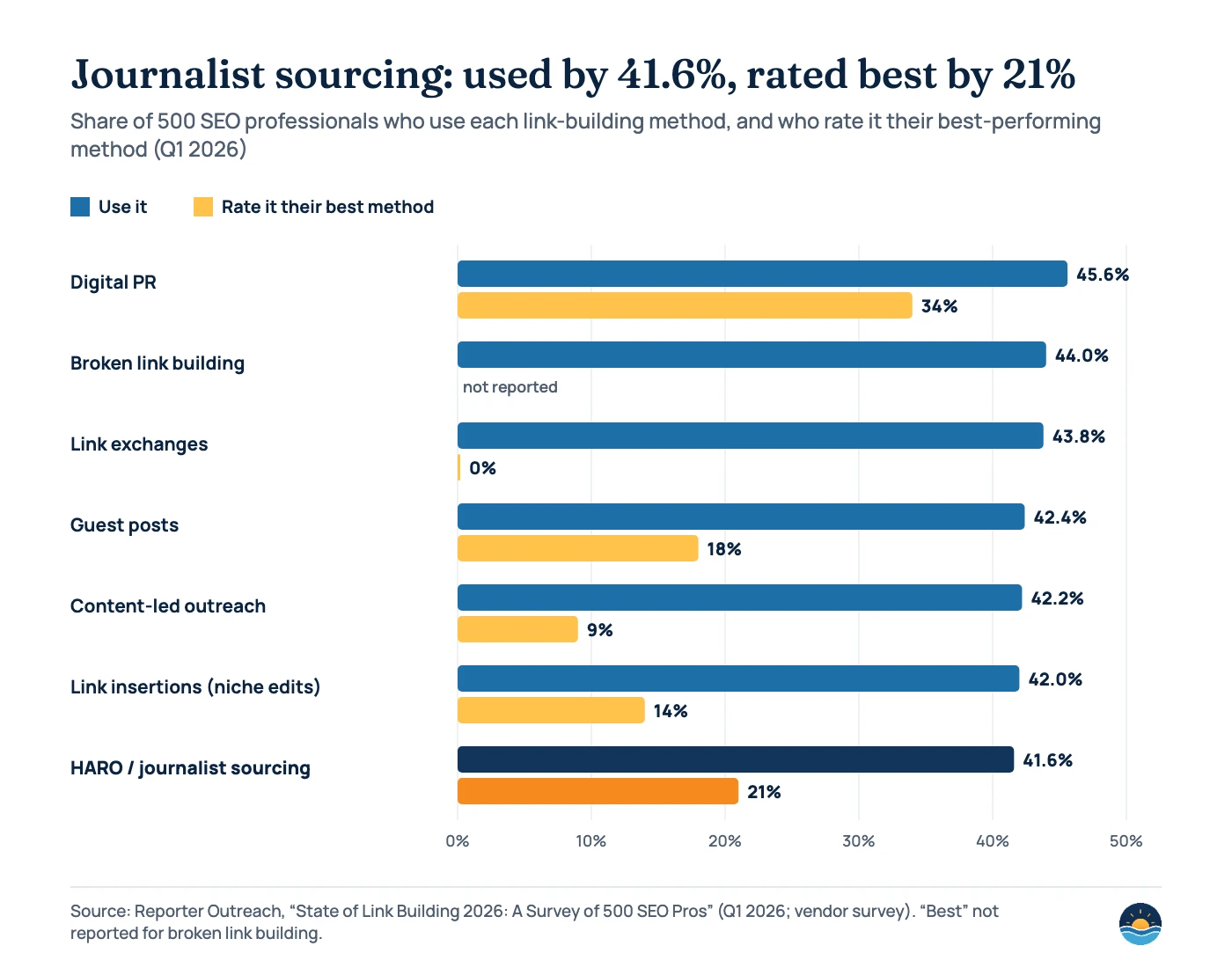
In Reporter Outreach’s survey, adoption of every major method sat between 41.6% and 45.6%. The difference was in results: 21% of respondents rated HARO or journalist sourcing their best method, compared with 18% for guest posts and 0% for link exchanges. Reporter Outreach notes that journalist sourcing is really the reactive side of digital PR, and it says the two PR-style approaches together are the best performers for 55% of respondents.
BuzzStream’s 2026 State of Digital PR report, based on 150+ digital PR professionals, found 89.9% use expert commentary, second only to pitching data-led content (95.9%). The same report found 41.2% use AI to write email pitches, which is exactly what journalists and platforms are now pushing back on.
What do journalists want from expert sources?
| Finding | Figure | Survey |
|---|---|---|
| Want “clear relevance to my beat” with a pitch | 70% | Muck Rack, State of Journalism 2026 |
| Want “interview access to relevant sources” | 58% | Muck Rack, State of Journalism 2026 |
| Want pre-written quotes | 14% | Muck Rack, State of Journalism 2026 |
| Immediately delete pitches irrelevant to their coverage | 88% | Muck Rack, State of Journalism 2026 |
| Reject pitches that feel overly promotional | 71% | Muck Rack, State of Journalism 2026 |
| Seldom or never respond to PR pitches | 54% | Muck Rack, State of Journalism 2026 |
| Oppose AI-generated pitches | 53% | Cision, 2026 State of the Media |
| Say fewer than a quarter of pitches are relevant | 72% | Cision, 2026 State of the Media |
Two points stand out. Journalists want access to a real person far more than ready-made copy: 58% want interview access, while only 14% want pre-written quotes. And relevance decides everything. A short, specific answer from someone with genuine experience beats a long, generic one. Our guide on how to pitch journalists covers the same survey data for proactive pitches.
Why are platforms cracking down on fake experts and AI answers?
Because expert quotes can earn links from national news sites, they have attracted people who invent experts. Press Gazette’s investigations, starting in April 2025, found “experts” quoted widely in UK media whose credentials could not be confirmed, some of whom had reached journalists through request services. In December 2025 it reported that a network of apparently fake experts linked to one home-services company had supplied commentary published more than 600 times, with one persona quoted 172 times.
In January 2026 the UK’s CIPR and PRCA launched a joint campaign after Press Gazette’s reporting linked more than 50 fake or non-existent experts to over 1,000 likely fabricated stories. In July 2026 Press Gazette reported that Qwoted was handling more than 15 violations a day and blocking about 50 sign-ups daily.
The platforms have responded. Qwoted’s help centre (September 22, 2026) says “Using AI to write your pitches is against Qwoted’s Terms & Conditions”, and pitches flagged as likely AI-written can lead to a temporary account disablement. HARO lists “AI-generated content detection, masked emails, community reporting, and lifetime bans” among its trust and safety measures. The practical lesson: answer under a real name, with a real profile, about things you actually know.
Does Google count links from expert quotes?
Google has not published guidance about HARO or expert-quote links specifically. Its general rules still apply. Google’s spam policies (last updated August 28, 2026) list “Exchanging money for links, or posts that contain links” as link spam, and its outbound-link guidance (December 10, 2025) says paid placements should carry rel="sponsored". An editorial link that a journalist adds because your answer was useful is the kind of link those policies do not target.
That makes paid “guaranteed placement” offers a different thing entirely. At least one freelance marketplace listing sells a followed link from a major news site “via journalist”, and HARO’s own rules ban pay-to-play requests. Buying those placements is exactly what the spam policy describes. Many publishers also add nofollow or sponsored to outbound links by default, so treat a brand mention without a link as a normal outcome. Our article on brand mentions vs backlinks explains why unlinked mentions still matter, and nofollow, sponsored and UGC links covers the link attributes.
Worth answering
- Requests on your real area of expertise
- Outlets your customers actually read
- Deadlines you can meet with a considered answer
- Requests that want a named person, not a brand statement
Skip it
- Requests outside your experience, however big the outlet
- Anything that asks for payment or a link swap
- Answers you would need AI to write
- “Guaranteed placement” offers from third parties
A seven-step process for answering journalist requests
- Pick one or two platforms that match your market. UK businesses get more from ResponseSource or SourceBottle; US-focused firms usually start with HARO and Qwoted.
- Set up a real expert profile. Use a named person with a photo, job title, LinkedIn profile and a short bio page on your site.
- Filter hard. Answer only requests where your expert has first-hand experience. 88% of journalists delete irrelevant pitches.
- Answer the question in the first two sentences. Then add one specific example, number or practical tip the journalist cannot get elsewhere.
- Write it yourself. Qwoted bans AI-written pitches and 53% of journalists oppose them. Edit for accuracy, then send.
- Offer access, not copy. 58% of journalists want interview access; say when your expert is free to talk.
- Track every placement. Log the outlet, date, link status (followed, nofollow or none) and referral traffic. Our guide to digital PR metrics shows what to report beyond link counts.
Frequently asked questions
Is HARO still running in 2026?
Yes. Cision discontinued Connectively, the renamed HARO, on December 9, 2024, then sold the HARO brand to Featured.com in April 2025. Featured relaunched HARO as a free email newsletter on April 22, 2025.
What is the best free HARO alternative?
HARO itself is free again, and Source of Sources is free by email. Qwoted and SourceBottle have free tiers with limits, such as two pitches a month on Qwoted Basic. The best choice depends on which country’s media you want to reach.
Can I use AI to write answers to journalist requests?
It is risky. Qwoted says using AI to write pitches is against its terms and can lead to account disablement, and 53% of journalists in Cision’s 2026 survey oppose AI-generated pitches. Use your own words and first-hand knowledge.
Do links from expert quotes help SEO?
An editorial link from a relevant news site is the kind of link Google’s policies do not target, but many publishers add nofollow by default and some quotes run with no link at all. Paying for a placement turns it into link spam under Google’s policies.
Sources
- Connectively has been discontinued — Cision (modified Feb 25, 2025): discontinued December 9, 2024
- Cision Announces Sale of Help A Reporter Out (HARO) to Featured.com — Cision via AAP, April 15, 2025
- Featured.com Acquires Help A Reporter Out (HARO) from Cision — Featured.com via Kyodo PR Wire, April 16, 2025: HARO free for journalists and sources
- Help a Reporter Out (HARO) is Back! — BuzzStream, April 18, 2025: relaunch on April 22, 2025
- Journalist Request Platform Connectively Surpasses 100,000 Users — Featured.com via PR Newswire, June 9, 2026
- About HARO — Help a Reporter Out — HARO: claims, digests, trust and safety measures
- HARO Submission Guidelines & Requirements — HARO (updated Oct 15, 2026): outlet minimums, banned requests
- Qwoted Pricing — Qwoted (modified Oct 28, 2026): Basic and Pro plans
- Can I Use AI to Craft My Pitch? — Qwoted Help Center, September 22, 2026
- Source of Sources — Source of Sources: frequency, rules, claims
- SourceBottle pricing — SourceBottle: free and paid tiers
- ProfNet — PR Newswire: how ProfNet works
- ResponseSource pricing — ResponseSource: Journalist Enquiry Service pricing
- MentionMatch (formerly Help a B2B Writer) — MentionMatch home page
- Featured pricing — Featured.com: AI PR assistant plans
- State of Link Building 2026: A Survey of 500 SEO Pros — Reporter Outreach (Q1 2026; vendor survey): method use and best-performer shares
- BuzzStream State of Digital PR Report (2026) — BuzzStream (updated Feb 19, 2026): expert commentary 89.9%, AI pitch writing 41.2%
- The State of Journalism 2026 — Muck Rack (1,044 journalists surveyed; 897 analysed)
- PR Emerges as the Primary Source for Journalists in High-Pressure Newsrooms — Cision, May 13, 2026: 53% oppose AI-generated pitches
- Dubious experts deployed by MyJobQuote published more than 600 times in UK press — Press Gazette, December 4, 2025
- PR bodies launch campaign against fake experts after Press Gazette investigation — Press Gazette, January 29, 2026
- Journalist response platform plays ‘whack-a-mole’ against AI deluge of PR content — Press Gazette, July 27, 2026
- Spam Policies for Google Web Search — Google Search Central (last updated Aug 28, 2026): link spam
- Qualify Outbound Links for SEO — Google Search Central (last updated Dec 10, 2025): rel=”sponsored” for paid placements
- Help a Reporter Out — Wikipedia: founding (2008), Vocus (2010), Cision (2014)
Cite this article: Bright Harbour Media. “HARO Alternatives: Expert Sourcing for Links in 2026.” Bright Harbour Media Insights, November 2026. https://brightharbourmedia.com/haro-alternatives/
You are welcome to reference the charts and frameworks in this article with a link back to this page.
Want expert sourcing and digital PR that earns real coverage without risky shortcuts? See our link building and digital PR service or get in touch to talk it through.